

The short answer: for a large bust, the best sports bra construction for high-impact exercise is usually combination or encapsulation, because both control movement in more than one direction. Compression still has a place at DD+ sizes, mainly for lower-impact training, shorter sessions, and readers who want a firm, wire-free hold. The right choice depends on three things: your activity, your dominant fit problem, and whether your size is actually made in that construction.
This guide applies the framework from our compression vs encapsulation sports bras explainer to DD+ sizes specifically: which construction survives a run at a 36G.
Why does construction matter more on a large bust?
Breast movement during faster exercise is not only up and down. In University of Portsmouth biomechanics research reported by Live Science, movement split across three directions: just over half up and down, 22 percent side to side, and 27 percent in and out. A small bust can sometimes get away with a bra that only tackles the vertical share. A large bust usually cannot.
That is the logic of this guide. Compression mostly handles the up-and-down share. Encapsulation adds control in the other directions through structured individual cups. Combination designs do both at once, which is why they dominate the serious end of the DD+ market.
The three constructions, compared for large busts
| Construction | How it controls movement | Best for at DD+ | Watch out for |
|---|---|---|---|
| Encapsulation | Separate structured cups, often with an underwire frame, hold each breast individually | Running and high impact when you want shape as well as support | Wire fit is unforgiving; a wrong cup size shows up fast |
| Compression | Firm fabric and high coverage press the bust toward the chest as one unit | Lower-impact training, shorter sessions, readers who refuse wires | The flattened “one block” feel; heat on long sessions |
| Combination | Separate cups plus a firm compressive outer layer, shell, or band | High impact at larger cup sizes; readers failed by both pure types | More structure means more to fit; sizing is less forgiving |
Which construction should you choose for your activity?
Running, HIIT, and court sports: start with combination or encapsulation. Movement in all three directions is at its worst here, and a compression-only bra at DD+ tends to feel fine for ten minutes and inadequate by thirty. Pick encapsulation for a natural, separated shape, combination for the most locked-down feel.
Strength training and gym work: any of the three can work. Barbells and machines produce less repetitive bounce, so this is where a good compression bra earns its keep. If you superset gym work with treadmill intervals, judge the bra by the intervals, not the lifting.
Yoga, Pilates, walking, and cycling: compression is usually enough. The movement is slower and positional rather than repetitive impact, and many DD+ readers prefer the simpler, wire-free feel. The exception is side spillage in floor work, where a deeper encapsulation cup contains tissue better.
What if your current bra fails in one specific way?
Name the failure before you change construction, because each failure points somewhere different.
Side spillage or tissue escaping toward the underarm points to cup structure. Move toward encapsulation or combination with deeper, divided cups, and check your cup size before you blame the style. Our guide to measuring your bra size walks through both measurements; the bra size calculator turns them into a starting size.
Everything moves as one block, and you overheat is the classic compression trade-off. Switching to encapsulation separates the breasts, reducing the single-mass feel and the skin-on-skin contact at the center.
Straps dig in and shoulders ache is rarely a construction problem. It usually means the band is too loose and the straps are doing the band’s job. The fit experts quoted by MedicalXpress list a firm, level band among the core fit checks for a reason.
The band rides up or the bottom edge rolls means the bra is anchoring badly, and no cup design compensates. Size down in the band and up in the cup, the move explained in our sister sizes guide.
Does your size limit which constructions you can buy?
Yes, and it is the least discussed part of shopping at DD+. Encapsulation and combination ranges run deeper: the combination example below reaches a K cup, while alpha-sized compression styles often stop being useful well before that. Pure compression also gets harder to engineer as cups grow, which is why so many DD+ “compression” bras quietly add divided cups, including one below. Read the range in the system the brand actually uses, US, UK, or EU, because a K in one system is not a K in another.
Three bras that show the three constructions
Affiliate disclosure: the cards and comparison table below are inserted with the Hostinger Affiliate Marketing Tools plugin and link to Amazon.com. We may earn a commission on qualifying purchases, at no extra cost to you. Recommendations are research-based; we have not hands-on tested these styles.
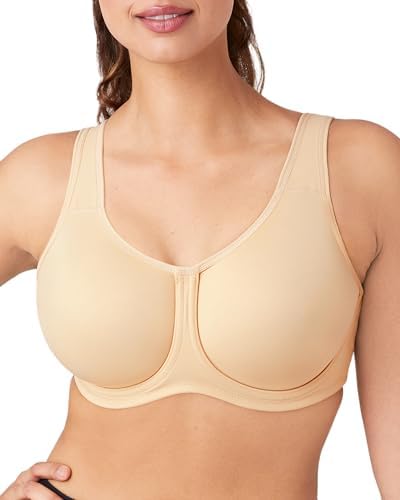


Encapsulation example: Wacoal Simone Sport Underwire Bra (855170)

The Simone is the clearest encapsulation argument in this guide. Each breast sits in its own full-coverage, two-ply cup, framed by a cushioned underwire placed on the outside of the cup, a Wacoal detail meant to keep the wire from pressing against the body. Wacoal rates it as maximum support for high-impact activities and adds a hidden sling inside the cups in G to I cup sizes. Choose it if you run and want a separated, natural shape. Skip it if wires are a hard no, because an unforgiving frame punishes a near-miss cup size.
Pros
- True encapsulation: separate cups control movement in more than one direction
- Cushioned outside underwire frame, per Wacoal’s product page
- Hidden inner sling added in G to I cups
- Slide-and-hook back strap adjustment for a customized fit
Cons
- Underwire fit leaves little room for a wrong cup size
- Hand wash only, per Wacoal’s care instructions
- The largest cup, H, is only offered in bands 34 to 40 on the range we checked
Key Specs
| Support | Maximum support for high-impact activities (Wacoal) |
| Size range | US bands 32 to 42, cups C to H; H in bands 34 to 40 |
| Closure | Back hook-and-eye, 3 columns and 3 rows, increasing with size |
| Construction | Encapsulation: separate two-ply cups, outside underwire frame, hidden sling in G to I cups |
| Adjustability | Back straps with slide-and-hook adjustment; multi-row hook-and-eye |
Compression example: Shock Absorber Active D+ Classic (SN109)
This is the honest face of compression above a DD. Specialist fitting retailer She Science classifies the SN109 plainly as a compression style bra with high-impact support, built on firm fabric and high coverage rather than wires. Its fitters say wearers choose it after doubling up two bras for the same firm hold. It borrows one trick from the other camp: two separate cups that keep some shape instead of flattening everything into a single shelf. Pick it for the firmest wire-free feel in gym work and shorter runs. It is sold in UK sizing, so order by your UK size, not your US one.
Pros
- Compression hold with no underwire anywhere in the design
- High coverage contains the top of the cup, where compression bras often fail
- Wide, soft, non-slip straps per the retailer’s technical notes
- Separate cups keep more shape than a one-piece crop
Cons
- Narrow band range: UK 30 to 38 only
- Cups stop at H, with GG offered only in some bands
- The compressed, flattened feel is the point, and not everyone likes it
Key Specs
| Support | High impact (She Science); Berlei version rated Extreme Impact, Support Factor 4 |
| Size range | UK bands 30 to 38, cups D to H (GG in some bands) |
| Closure | Back hook-and-eye, adjustable |
| Construction | Compression-led and wirefree, high coverage, two separate cups for shape |
| Adjustability | Cushioned adjustable straps; adjustable hook-and-eye back |
Combination example: Anita Extreme Control Plus (5567)
The Extreme Control Plus is what combination construction looks like when a brand designs for big cups first. Anita says the style was developed specifically for big cup sizes, up to a K cup, and rates it Maximum Support. The encapsulation half is a five-section cup, divided into outer and inner layers, with no seams against the skin. The compression half is the firm outer build: elastic side panels, a piqué and mesh cup shell, and a power-mesh-lined back. Anita’s catalog gives the range real reach: cups F to H across bands 30 to 48, and cups I to K across bands 30 to 40. Choose it if you are above an H cup and tired of ranges that end before your size starts. Anita’s K follows its own cup sequence, roughly a UK H per US retailer Breakout Bras, so convert before you order.
Pros
- The deepest cup range in this guide: up to K in Anita’s sizing
- Five-section divided cups give real structure and cup depth
- Ventilation zones and a power-mesh back for long sessions
- Strap width increases with size, and the straps adjust
Cons
- The biggest cups, I to K, stop at band 40
- Structured, engineered feel that some readers find more bra than they want for low-impact days
- Sizing system needs converting for UK and US readers alike
Key Specs
| Support | Maximum Support (Anita) |
| Size range | Bands 30 to 48 in cups F to H; bands 30 to 40 in cups I to K (Anita catalog, US columns) |
| Closure | Back hook-and-eye, multiple rows |
| Construction | Combination: five-section divided outer and inner cups, firm piqué and mesh shell, power-mesh-lined back |
| Adjustability | Adjustable straps; strap width increases with size; double strap combination |
Common questions
Is encapsulation always better than compression for a large bust? No. Encapsulation controls movement in more directions, which matters most at high impact. For low-impact training, a well-fitting compression bra can be the more comfortable tool, and comfort decides whether a bra gets worn.
Can a compression bra work for running at a DD+ size? Sometimes, for shorter runs, but it is the exception rather than the rule. If a compression bra leaves you sore after a run, the fix is usually a construction change, not a tighter size of the same design.
What is the largest cup size these constructions reach? Here, the combination example reaches a K cup in Anita’s sizing in bands 30 to 40. Ranges shrink as bands widen in almost every brand, so check your exact band and cup pairing, not just the headline maximum.
The bottom line: match the mechanism to the movement. Combination and encapsulation for impact, compression for control at lower intensity, and a band that fits before either is asked to perform.


3 Comments