
The short answer: a plus-size sports bra fits when the band stays level on the loosest hook, the cups hold everything with no bulging or gaping, and the straps adjust without digging. Most complaints at larger sizes, the rolling band, the shoulder grooves, the mid-run chafe, trace back to one of those three checks, and most are fixable in the fitting room, before any money changes hands.
That matters because the base rate is poor. Studies reported by MedicalXpress put the share of women wearing the wrong bra size at 70 to 100 percent, and every fit error gets louder as band and cup sizes grow. Work through these ten fixes in order. The first five are free.
1. Start from a measurement taken this month, not the size in your drawer
Bodies at plus sizes shift with weight changes, hormones, and training itself, and a sports bra has less stretch forgiveness than an everyday bra. Measure your underbust and full bust, then convert the numbers with our guide to measuring your bra size or the bra size calculator. Treat the result as a starting size, not a verdict: brands grade differently, so try the neighbour sizes too.
2. Read the hook rows like a mileage gauge
A new sports bra should fasten comfortably on the loosest hook. The extra columns exist so you can move inward as the elastic relaxes with wear and washing. If a new bra only feels right on the tightest hook, it has nowhere to go, and its supportive life is already half spent. If your current bra is on the tightest hook and still loose, that is the elastic telling you it is done, a point that returns in Tip 10.
3. Keep the band level, and read a rolling band as a size signal
The underband should sit level around the body and stay put when you move; that is one of the five best-fit criteria set out by the fit experts quoted in MedicalXpress. A band whose bottom edge rolls or folds under the bust is usually either too loose to anchor or being pushed out of place by cups that are too small. Scoop all your tissue into the cups first, then judge the band again. If it still rolls, try a cup size up before you try a band size down, and look for a taller band that spreads the load over more ribs.
4. Move the work off your shoulders and onto the band
Shoulder grooves mean the straps are carrying weight they were never meant to carry. The same fit criteria state that the main support should come from the underband, not the straps, and that straps should stretch no more than about 5 cm when pulled. If your straps dig, check the band first: going down a band size fixes more strap problems than any strap cushion. Then choose wider straps, which spread whatever load remains over more skin.
5. Contain the whole cup before you shop for more support
Breasts should be fully enclosed, with no bulging and no gaping, per the best-fit criteria. At larger bands this is where alpha-sized bras quietly fail: an XL compression top stretches one fabric over very different cup volumes, while a band-and-cup style scales the cup with the band. Two practical checks: scoop and swoop before judging, and look at the neckline. The researchers quoted by MedicalXpress found that each extra centimetre of neckline height cut breast bounce by about 1 percent, which is why high-neckline and camisole-panel styles contain a fuller bust so well.
6. Match the construction to the movement, not to the label on the tag
Support levels are marketing until construction backs them up. Encapsulation holds each breast in its own cup, compression presses tissue to the chest, and combination designs do both; our compression vs encapsulation sports bras explainer walks through the differences. At plus sizes, encapsulation or combination styles usually control high-impact movement better, because there is simply more tissue moving in more directions. Compression remains the simpler, cooler choice for walking, yoga, and strength work.
7. Use a sister size when you are between bands
If the cups are right but the band is wrong, do not abandon the bra. Move along the sister-size line: up a band and down a cup, or down a band and up a cup, keeps roughly the same cup volume on a different frame. A 42DD that digs, for example, has a sister in the 44D. Our sister sizes guide has the full chart. Sister sizing rescues one step in either direction; two steps changes the proportions too much.
8. Hunt chafe at its three addresses
Plus-size chafe shows up in predictable places: the underband line, the strap edges, and under or between the breasts. The root cause is usually movement plus moisture, a bra loose enough to travel, holding sweat against skin; the activewear guide at NeceSera makes the same point about wet, heavy fabric leading to chafing. Fix the travel first with Tips 3 and 5, choose smooth or bonded edges where you can, and rinse sweat out promptly. Anti-chafe balm is a reasonable backup for race day; it is not a cure for a band that moves.
9. Rotate at least two bras, and keep elastic out of the dryer
Elastic recovers between wears, so a bra worn on back-to-back days is working on tired fibres. Rotate two or three bras through the week, wash cool, and line dry: Glamorise, for one, specifies line drying on the care label of its sports styles. Heat is elastic’s fastest enemy, and the dryer is where supportive life goes to shorten.
10. Replace on the bra’s schedule, not when it falls apart
For regular gym-goers, NeceSera puts sports bra life at six to twelve months, because sports bras lose elasticity faster than other activewear. Retire yours when the hooks reach the tightest setting and the band still moves, the cups have lost their shape, or bounce has crept back into workouts that used to feel controlled. A bra that looks fine can still be finished; judge it by the fit checks above, not by the fabric.
Two bras that build the fixes in
Affiliate disclosure: the cards and comparison table below are inserted with the Hostinger Affiliate Marketing Tools plugin and link to Amazon.com. We may earn a commission on qualifying purchases, at no extra cost to you. Recommendations are research-based; we have not hands-on tested these styles.


The containment example: Glamorise No-Bounce Camisole Sports Bra (1067)
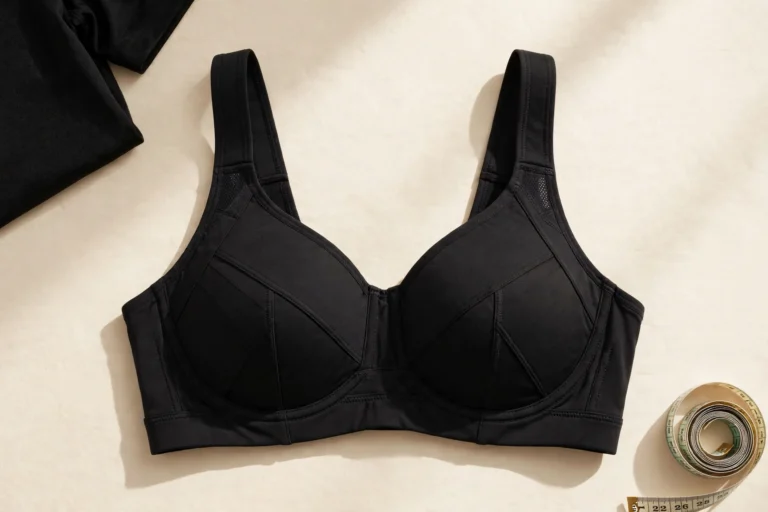
This is Tip 5 in product form. A breathable mesh camisole panel rises above the cups to contain the upper bust, the exact area that escapes first at larger bands, and the cups themselves are reinforced and non-stretch, so they hold a shape instead of stretching around one. The straps are the wide, back-adjusting kind Tip 4 asks for, and the range is genuinely plus: US bands 34 to 50, cups C to J. Glamorise positions the 1067 for low to medium impact, so treat it as the walking, cycling, and gym-work fix. Runners at these sizes should take the construction in Tip 6 instead.
Pros
- Mesh camisole panel adds upper-bust containment without a second layer
- Wide, adjustable, non-stretch straps that stay where they are set
- One of the widest verified ranges here: bands to 50, cups to J
- Hook-and-eye rows increase with size, per Glamorise
Cons
- Medium bounce control only; Glamorise itself aims it at low to medium impact
- Non-stretch straps allow less fine-tuning than elasticated straps
- The high camisole neckline shows under low-cut workout tops
Key Specs
| Support | Medium bounce control (Glamorise); positioned for low to medium impact |
| Size range | US bands 34 to 50, cups C to J |
| Closure | Back hook-and-eye, 3 columns and 3 rows, increasing with size |
| Construction | Wirefree; reinforced non-stretch separate cups with a mesh camisole overlay |
| Adjustability | Adjustable non-stretch straps; multi-column hook-and-eye |
The hook-row example: Knix Catalyst Sports Bra
The Catalyst is Tip 2 with hardware: its back closure has five rows of hooks, the longest adjustment runway in this article, so the fit you dial in when it is new can be maintained far longer as the band relaxes. Knix builds it as a combination design, encapsulated molded cups plus compression, and reports a 76 percent reduction in breast movement from a 2018 University of Portsmouth treadmill study. The honest limit for this readership: Knix’s range translates to about a 42 band and a G cup at the top, so readers above that should start with the Glamorise pattern instead.
Pros
- Five-row hook-and-eye closure gives the most band adjustment of any bra here
- Encapsulated cups plus compression, per Knix, for high-impact support
- Front ventilation and moisture-wicking fabric for long sessions
- Movement-reduction figure Knix attributes to University of Portsmouth testing
Cons
- Range tops out around a 42 band and G cup in Knix’s own size translation
- Alpha sizing with plus modifiers means the size chart is not optional
- Strap adjustability is not stated on the manufacturer page we read
Key Specs
| Support | High impact (Knix) |
| Size range | Knix sizes XS to XXXXL with + and ++ cup options; Knix guides translate the range to 32A to 42G |
| Closure | Back hook-and-eye, five rows |
| Construction | Combination: encapsulated molded cups plus compression (Knix) |
| Adjustability | Five-row hook-and-eye band adjustment; strap adjustment not confirmed |
The bottom line: fix the band first, the cups second, and the straps last, in that order. When you are ready to compare fuller shortlists, our roundup of the best plus-size sports bras applies the same checks to a wider field.