

Ask “can a sports bra improve performance” in a shop and you will hear percentages. The research answer splits in two. Support reliably reduces breast movement and exercise related breast pain; that part is settled. Whether it makes you faster, stronger or more economical is a separate claim, and the studies disagree with each other. Each mechanism below is graded at the strength its evidence earns.
The short answer: a sports bra does not add performance. It removes limiters. Pain, muscular bracing, a shortened stride and the urge to skip the session are all taxes on performance. Good support reduces several of those taxes, so you perform closer to the fitness you already have. The movement itself is three directional and always a beat behind your torso, as our guide to why do breasts bounce explains.
How can a sports bra improve performance? Six mechanisms, graded
1. Pain removal: established
Breast pain during exercise is common, it scales with movement, and athletes change their behaviour because of it: they shorten sessions and hold back in competition. In Brisbine and colleagues’ 2020 survey of 540 elite female athletes across 49 sports, 32% said exercise induced breast pain had negatively affected their performance (Journal of Sports Sciences). Support that cuts movement cuts the pain that causes the holding back. An indirect effect, through behaviour, and the best evidenced one here.
2. Muscle compensation: suggested, and contested
Chest and shoulder muscles busy bracing against breast movement are not free for the work of running. In Alexandra Milligan’s Portsmouth doctoral research, high support reduced peak activity in the pectoralis major and deltoid muscles during the early kilometres of self paced 5 km runs; the authors linked the extra activity in low support to muscles tensing against greater breast pain (Human Movement Science). But total activity across the full runs did not differ, and a separate Portsmouth indicator study found muscle activity among the measures unaffected by support level (Academia.edu). One lab’s early run effect is another lab’s null result; grade it suggested, not proven.
3. Stride and gait: suggested, and small
Portsmouth research summarised in Canadian Running Magazine put the cost of poor support at up to 4 cm of stride length, often extended into a hidden extra mile over a marathon. Treat it as what it is: a summary figure and an extrapolation, not a measured marathon result. Milligan’s own step length data found a small difference in the first two minutes of running and none across the 5 km intervals, and her torso measurements in high support sat only marginally closer to economical patterns. A real effect, probably; a large one, not on this evidence.
4. Breathing: unproven, and mostly about the band
The breathing studies disagree: one found breathing frequency changed with support level, another found no effect of bra style during running, and a small 2024 study of nine trained runners found that a tighter underband raised the work of breathing and made breaths shallower. The actionable finding is about fit: a band sized down for lockdown can tax breathing; a correctly fitted firm band has not been shown to.
Running economy, the claim this topic is usually sold on, is the most contested of all: one lab study found runners more economical in high support while the Portsmouth indicator study found no physiological effect, and we lay that disagreement out in running and breast health.
5. Confidence and participation: suggested, at survey strength
In a Portsmouth linked survey of 70 elite sportswomen, 26% said breast discomfort had prevented them giving 100% in training or competition, and embarrassment about movement recurs across surveys as a reason women train less. Nobody has timed this effect in a race, and surveys cannot do that. But a season is built from sessions actually completed and efforts actually given, so a limiter working on attendance and effort counts in aggregate.
6. Heat, sweat and chafing: comfort factors, not performance claims
No study grades thermoregulation or chafing as performance mechanisms, and we will not pretend otherwise. They end sessions early, occupy attention and punish the next day’s training. Breathable fabric and flat seams are comfort engineering. Comfort is worth having on its own terms; it does not need a borrowed performance claim.
The mechanisms at a glance
| Mechanism | Evidence strength | What it means in practice |
|---|---|---|
| Pain removal | Established | Support cuts the movement that drives pain, and pain makes athletes hold back |
| Muscle compensation | Suggested, contested | Muscles may brace less in high support; one Portsmouth study found no muscle effect |
| Stride and gait | Suggested | Effects are small and may fade within minutes; marathon version is extrapolated |
| Breathing | Unproven | No consistent effect; an overtight band is the real risk |
| Confidence and participation | Suggested (surveys) | Discomfort cuts effort and attendance, compounding over a season |
| Heat and chafing | Comfort factor only | Worth engineering for, never evidence of a performance gain |
What has not been shown
No study shows a sports bra making a given athlete faster in a race outcome. Every number in this field describes tissue movement, muscle activity, lab oxygen use or survey answers. None is a finish time. When marketing converts a bounce reduction percentage into a performance promise, it spends evidence it does not have: the lab measure is real, the promised gain is invented. The stride figure above carries its sourcing for the same reason. If a bra claims a percentage improvement in your performance, ask which race it was measured in. There is not one.
Three bras that remove limiters
None of these will make you faster. Each removes a specific limiter in a specific context. Choose by pain and movement first, using what a good sports bra should do as the standard and sports bra impact levels to match support to your sport and cup size.
Disclosure: this article contains affiliate links. If you buy through a link on this page, Stellaleah may earn a commission from Amazon at no extra cost to you. Picks were researched from manufacturer and retailer specifications; we have not wear tested them.


Race day: Handful Gametime Sports Bra
Race day limiters are distraction and chafe: anything still on your mind at mile ten is costing you. Handful rates the Gametime high impact, built for running and HIIT, with pockets and a longer line band, and positions it as its maximum chafing prevention style, per Handful. The longline band spreads pressure over more ribcage than a narrow elastic, and the pockets take a gel or key instead of a bouncing waistband. Alpha sized, so the fit is an approximation.
Pros
- Brand rated high impact, designed for running and HIIT
- Pockets carry a gel or key without a belt
- Longline band spreads pressure on long efforts
Cons
- Alpha sizes only, with no band and cup precision
- Size span stops at XL, leaving larger bands unserved
Key Specs
| Row | Detail |
|---|---|
| Support | High impact (brand’s stated level), wire free |
| Size range | Alpha sizes XS to XL |
| Closure | Pull on |
| Construction | Wire free compression, longline band, crisscross back, pockets |
| Adjustability | Not confirmed |
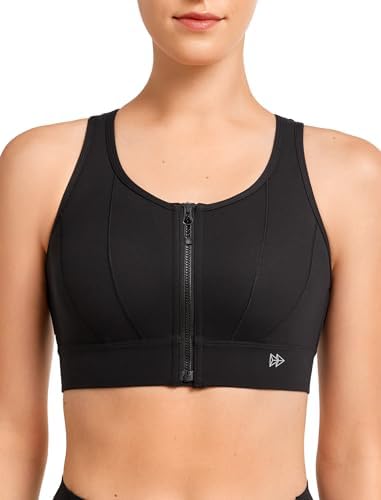
High intensity training: Yvette Front Closure High Support Sports Bra
Intervals, circuits and lifting days have a logistics limiter nobody markets: wrestling a tight, sweaty bra off between rounds and after the session. This Yvette closes with a front zip, so that problem disappears. The listing data at Amazon records a wire free racerback in 60% polyamide and 40% elastane, a high elastane knit with a firm compression feel, and most letters split into regular and Plus cup versions. Alpha sizing is still coarser than band and cup sizing, and the support level is the brand’s own rating, not a lab measurement.
Pros
- Front zip ends the post session wrestle with a sweaty bra
- Regular and Plus cup splits reach sizes most alpha bras skip
- High elastane knit holds firm compression
Cons
- Alpha sizing cannot match band and cup precision
- A zip is a single point of failure and must sit flat
Key Specs
| Row | Detail |
|---|---|
| Support | High support (brand’s stated level), wire free |
| Size range | Alpha S to 5XL Plus (brand chart: 34A to 48DDD) |
| Closure | Front zip |
| Construction | Wire free compression, racerback |
| Adjustability | Not confirmed |
Long session: RUNNING GIRL BX3071 Square Neck Longline Bra
Long, steady sessions punish narrow bands and busy seams, so the limiter here is pressure over hours. This longline’s seamless knit (90% polyamide, 10% elastane) with removable pads spreads the load over a longer torso panel, per the listing at Amazon. Honesty about the ceiling: the listing labels it high support, but a shelf bra longline in alpha sizes will not control movement like a band and cup encapsulation bra, and we rate it medium in practice, best for A to C cups at steady paces.
Pros
- Longline panel spreads band pressure over more torso
- Seamless knit and removable pads suit hours of wear
- Racerback keeps straps clear of shoulder blades
Cons
- Real world control is medium despite the high support label
- Alpha sizing caps the cup range it can honestly serve
- Closure fields conflict across listing variants
Key Specs
| Row | Detail |
|---|---|
| Support | Listed as high support; rated medium here (shelf construction) |
| Size range | Alpha sizes (full span to confirm in catalog) |
| Closure | Pull on longline (listing closure fields conflict across variants) |
| Construction | Seamless knit compression longline, removable pads, racerback |
| Adjustability | Fixed racerback straps |
Common questions
Will a better sports bra make me faster?
No study shows a race time improvement from a bra. It removes pain, bracing and distraction that tax the fitness you have, a more defensible claim.
Is the stride length claim real?
The figure is a real Portsmouth summary number; the marathon version is an extrapolation from it. Lab step length data found a small early run difference and none across a full 5 km, so treat the headline version with care.
Should I size down for more support before a race?
No. An overtight band raised the work of breathing in one small study. Fit by pain and movement, in your measured size.
The bottom line
Treat support like shoes that fit: it will not make you faster, and the wrong one will quietly make you sorer, more distracted and less likely to train. Choose by pain and movement first. The performance case follows from comfort, never the reverse.



2 Comments