Here is the honest version of how the right bra boosts your confidence: it does not change how you feel about your body, and no study says it can. What the research supports is narrower and, for most women, more useful. Confidence during exercise turns out to be mostly the absence of specific frictions: pain, movement you are busy monitoring, straps that need rescuing, coverage you keep checking. A well fitted bra cannot give you self esteem. It can remove the things that keep interrupting you.
Every claim in this article sits at survey and self report strength. Women in these studies reported pain, embarrassment and changed behaviour; nobody measured a bra raising anyone’s body image. Our wider guide to the benefits of wearing the right sports bra grades the rest of the evidence the same way.
The friction chain: how the right bra boosts your confidence in practice
Friction one: pain. In the survey of 1,285 runners at the 2012 London Marathon, reported by ScienceDaily, 32% experienced breast pain, and 17% of those affected said it changed their exercise behaviour: more than a quarter of the women with pain had cut their intensity, and a fifth had skipped a session. Elite athletes are not exempt: in a survey of 540 elite Australian athletes, published in the Journal of Sports Sciences, 44% reported exercise induced breast pain, and 32% of those said it hurt their performance. Pain is the loudest friction, and the one support most directly addresses.
Friction two: self monitoring. The companion marathon survey, from the University of Portsmouth, found 75% of runners reported bra fit issues, with chafing and straps digging in the most common. Every dig, slip and shift is a small tax on attention: a hand going up mid run, a glance down, a choice of the back row. In the Portsmouth barrier survey, one of the two most influential breast barriers women named was embarrassment about excessive breast movement. The habit starts early: among 2,089 UK schoolgirls surveyed for the Journal of Adolescent Health, 73% reported at least one breast concern about sport, breast bounce the most common at 38%, a schoolgirl sample, used here only to show how early the monitoring starts.
Friction three: participation itself. When University of Portsmouth researchers asked women what stops them exercising, the breast itself was a barrier for 17% of respondents, the fourth largest barrier, ahead of cost and facilities. The two most influential breast barriers were “I can’t find the right sports bra” and embarrassment about movement. And 24% said they had reduced their activity to relieve breast pain. The same survey found women who wore a sports bra more often also did more activity, a correlation in self reported data, not proof of cause, but pointing the same way as the rest of the chain: remove the friction and fewer sessions are lost. Whether support changes measurable output is a separate question, graded honestly in our article on whether a sports bra can improve performance.
| Friction | What the research shows | What a fit can change |
|---|---|---|
| Pain while moving | 32% of 1,285 marathon runners reported breast pain; 44% of 540 elite athletes reported exercise induced pain | Support matched to the activity reduces the movement that drives most exercise pain reports |
| Self monitoring | 75% of marathon runners reported bra fit issues; embarrassment about movement was a top two breast barrier | A bra that stays put removes the adjusting, checking and mirror glancing that eat attention |
| Skipping or shrinking sessions | 17% of symptomatic runners said pain changed their behaviour; the breast was a barrier for 17% of women in the Portsmouth survey | Removing pain and embarrassment removes the two named reasons sessions get cut or missed |
| Not finding a bra that works | “I can’t find the right sports bra” was one of the two most influential breast barriers | A measured size and the right construction end the trial and error loop |
The post purchase test: one session tells you
You do not need a study to grade your own bra. Wear it for one session of your hardest activity.
The no touch test. Count how many times your hands go to the bra: a strap pulled back up, a band tugged down, a cup rearranged, a pad smoothed. Every touch is a friction the bra was supposed to remove. A bra doing this job scores zero.
The forget it test. At the end of the session, ask whether you thought about the bra after the first five minutes. Our step by step guide to find your perfect sports bra chooses support to pass this test, and the five checks in how should a sports bra fit set a new bra up to pass it before the tags come off.
The appearance section, kept honest
Liking how a bra looks is a legitimate preference, and nobody has to justify the color or cut they enjoy. What we will not do is sell that preference as a psychological result, because the best recent survey evidence points the other way. Researchers at Edith Cowan University surveyed more than 800 women about activewear, reported by StudyFinds: women who engaged more with activewear reported exercising more, but that engagement showed no association with body appreciation or self esteem, and about 30% felt self conscious in activewear at least half the time they wore it. The lead researcher’s conclusion was that no type of gym clothing is inherently empowering.
Buy the bra you like looking at, because you like looking at it. Judge it as equipment by the friction test above. Keeping those two decisions separate stops a pretty bra with a slipping strap from disappointing you twice.
Three bras, each picked for a friction it removes
This article is research based: we checked manufacturer specs and retail listings, and we do not wear test. As an Amazon Associate I earn from qualifying purchases, and the product cards below are how the site is funded. The cards show current prices and availability. Each pick is framed by the friction it removes, and none is sold here on a beauty or confidence promise.


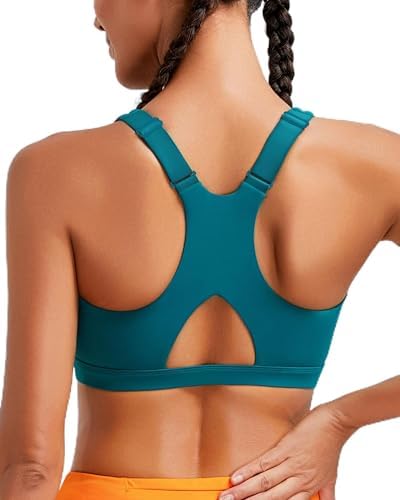
The no adjust run: RUNNING GIRL High Support Sports Bra WX3106
The marathon data names the enemy precisely: in the University of Portsmouth survey, three quarters of runners reported fit issues, and the common ones move. This bra is built so that nothing on it can migrate. The pads are sewn in, so they cannot fold, bunch or travel mid run. It pulls on, so there are no hooks to work loose. The straps adjust once, at the mirror, and the racerback holds them where slipping is least likely. RUNNING GIRL rates it high support and full coverage, in a 75% nylon, 25% spandex knit. The ceiling is the sizing: alpha letters blur band and cup, so a wearer between letters gets an approximate fit, and the friction returns.
Pros
- Sewn in pads cannot shift, fold or need repositioning mid session
- Pull on design with no hooks to loosen or dig
- Adjustable straps set once, then held by the racerback
Cons
- Alpha sizing only, with no separate band and cup control
- Pull on entry is a wrestle when you are already sweaty
- High support is the brand’s own rating, not a lab measurement
| Key Specs | RUNNING GIRL High Support Sports Bra WX3106 |
|---|---|
| Support | High support (brand rating) |
| Size range | Alpha sizes S to XXL (brand chart maps them to roughly 30C to 40C) |
| Closure | Pull on |
| Construction | Wirefree molded cups with sewn in pads, racerback, full coverage |
| Adjustability | Straps (adjustable); band fixed by size |
Full coverage, no checking: Lunaire Coolmax High Impact Sports Bra
For the coverage check, the glance down, the hand smoothing the top of the cup, the design answer is encapsulation with a frame: each breast held in its own cup, with the underwire carried in a floating frame so the wire is not resting directly against the skin. Lunaire describes it as a high impact style for curvy figures, lined with Coolmax to move moisture, with adjustable straps and a hook and eye back. The honest limit is evidence, not design: these specifications come from the manufacturer’s description, so check the size chart against your measurements before ordering.
Pros
- Encapsulation cups hold each breast separately, which settles the coverage question
- Floating frame underwire keeps the wire off direct skin contact
- Adjustable straps and a hook and eye band give two points of fit control
Cons
- Size grid and full spec sheet are thin in current listings; measure carefully
- Underwire structure will not suit readers who prefer wirefree on principle
- Hand wash care is typical for framed styles, adding laundry friction of its own
| Key Specs | Lunaire Coolmax High Impact Sports Bra |
|---|---|
| Support | High impact (manufacturer description) |
| Size range | Not confirmed in current listing data (size chart to confirm at build) |
| Closure | Hook and eye, back |
| Construction | Underwire encapsulation with floating frame, Coolmax lining |
| Adjustability | Straps (adjustable); band (hook and eye) |
Smooth under clothes: Wacoal Back Appeal Minimizer 857303
Not every confidence friction happens on a run. One happens in front of a wardrobe: the band line showing through a fitted top, checked in every mirror. This is an everyday bra, not a sports bra, and it earns its place here for low impact and dressed days. Wacoal builds the band from a microthin spacer fabric designed to minimize back and side bulge, with extra back and side coverage, close set fully adjustable straps that sit where they are less likely to slip, and a smooth U back; Neiman Marcus lists the same spacer fabric band. Wacoal markets the style as a minimizer. It makes no support promise for exercise, and neither do we: for anything above a walk, use a bra built for the job.
Pros
- Spacer fabric band and extra side coverage smooth the line under fitted tops
- Close set straps reduce the slip and check cycle through a dressed day
- Real band and cup sizing, bands 32 to 42 and cups C to H
Cons
- An everyday bra: no impact rating and not a training bra
- Unlined cups, so show through is possible under thin fabrics
- Hand wash only, per the listing
| Key Specs | Wacoal Back Appeal Minimizer 857303 |
|---|---|
| Support | Everyday support (no sports impact rating; the listing rates it medium support) |
| Size range | US bands 32 to 42, cups C to H (brand comparison table) |
| Closure | Hook and eye, back |
| Construction | Unlined full coverage underwire minimizer, U back, microthin spacer fabric band |
| Adjustability | Straps (fully adjustable, close set); band (hook and eye) |
Common questions
Can the right bra actually improve my body image?
No study we could find shows that, and the largest recent activewear survey found no link between engaging with workout clothing and body appreciation or self esteem. What a fit can do is remove pain, movement monitoring and adjusting, which is what the surveys measure.
How do I know if my current bra is costing me sessions?
Run the two tests on your next hard session. If your hands keep going to the bra, or you have shortened a workout because something hurt or shifted, the friction is real, whatever the bra cost.
Is embarrassment about bounce a fit problem or a me problem?
The research treats it as an equipment problem. Embarrassment about excessive breast movement was one of the two most influential breast barriers in the Portsmouth survey, and it is the barrier a supportive, well fitted bra most directly addresses.
Should I size down for a firmer, more secure feel?
No. A band that is too tight trades the monitoring friction for a digging one. Start from your measured size, and change construction before you change size.
The bottom line
Confidence, in the version the research can defend, is a quiet workout. No pain negotiating with you, no strap to rescue, no coverage to check, no hand leaving the barbell to fix your clothes. That is how the right bra boosts your confidence: not by changing what you think of your body, but by removing the frictions that keep reminding you of it mid session. Pick the friction that costs you most, buy against that one first, and grade the result with the no touch test.