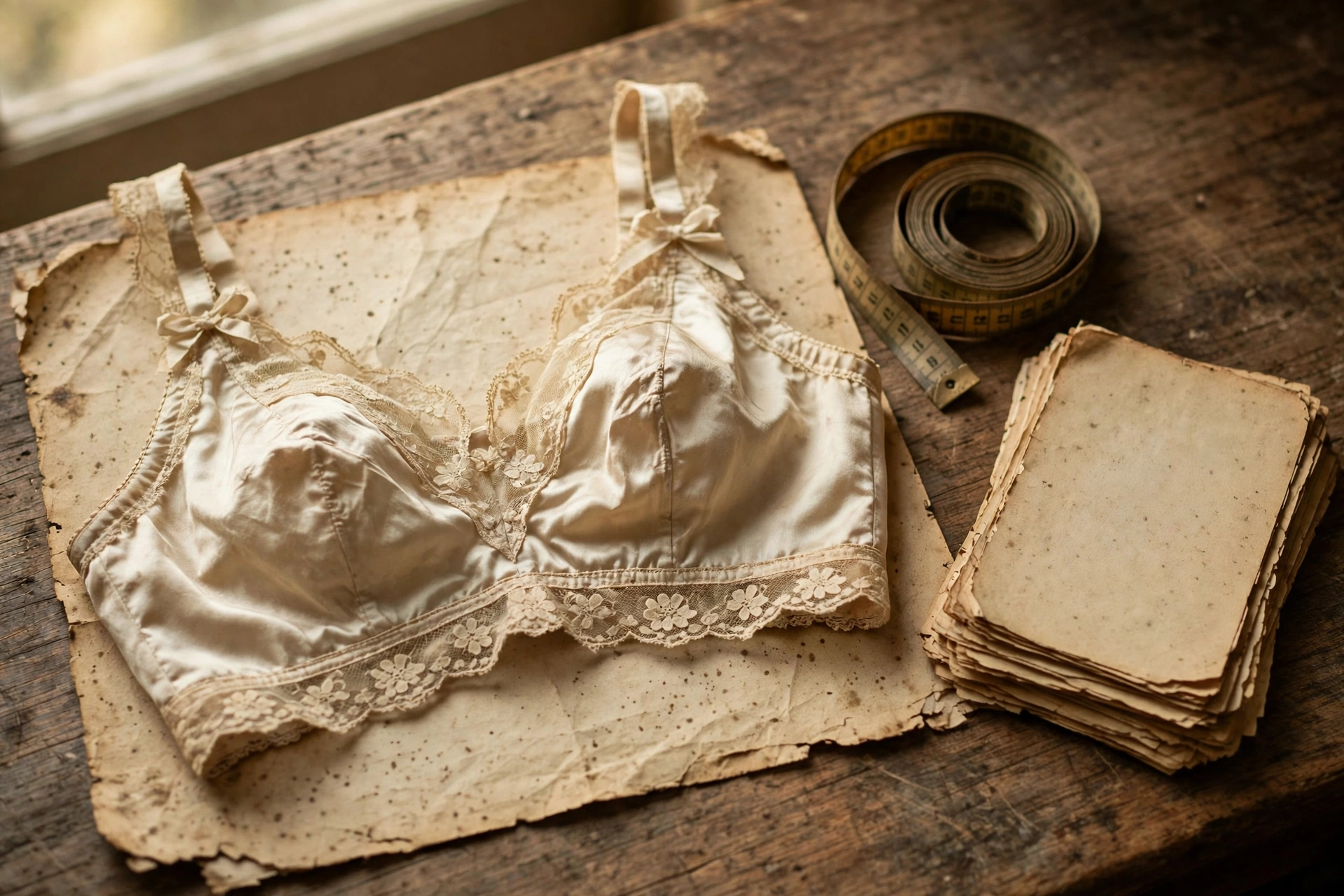
The history of bra sizing is the story of a system nobody designed in one sitting. No single person invented bra sizing, and no single date marks its birth. The modern bra size, a band number plus a cup letter, took shape slowly across a century: a patented breast supporter in 1859, a two piece undergarment in 1889, a handkerchief brassiere patented in 1914, cup categories in 1928, and lettered cups in 1932. This article traces that timeline, invention by invention, and explains why there is still no single standard behind the label in your drawer.
Before Sizes Existed: Breast Bands, Corsets and Dress Reform
Long before anyone talked about a bra size, women wore breast bands. On Crete, Minoan women wore bands that lifted and displayed the bust. In ancient Greece, women wore a cloth band called the strophion, tied around the chest to steady the breasts during exercise or work. In Rome, women wore a similar band, the strophium, and mosaics from the Villa Romana del Casale in Sicily show women exercising in bandeau style tops. These were supports, not sizes. A band was cut to fit the woman wearing it, and no two were alike.
Medieval Europe kept the idea alive in linen pouches sewn into tunics, sometimes called breast bags. A find at Lengberg Castle in Austria in 2008 proved how developed these were: four linen undergarments from the 1400s, complete with distinct cups, lace edges and shoulder straps. Cupped support is not a modern invention. What was missing was any system for describing it.
The corset then took over for roughly 350 years, and it pushed breast support in the opposite direction. Instead of supporting each breast separately, the corset shaped the whole torso, pushing the bust upward from below and narrowing the waist above it. ThoughtCo traces the fashion to Catherine de Medici, wife of King Henri II of France, who enforced a ban on thick waists at court in the 1550s. It had no cups and no cup sizes: it came in waist measurements, and the bust went where the corset put it.
By the late 1800s, dress reformers such as Amelia Bloomer were pushing back, and inventors began patenting alternatives to the corset.
The First Patents: 1859 to 1914
The first bra like device to reach the US Patent Office came from Brooklyn. In 1859, Henry S. Lesher patented a device meant to give the breasts a symmetrical shape, recorded as patent 24,033. TextileGlossary notes that it is recognisably a bra, even though the design looks uncomfortable by modern standards. Other patents followed in the same spirit, including a wire supported corset substitute in 1863 and a waist for fuller figures in 1876. None of these became a standard. Each was one inventor’s answer, sold in small numbers, and none of them described the wearer in a size.
The first design that pointed toward the modern bra came from France. In 1889, corset maker Herminie Cadolle split the corset in two at the Paris Exposition: a lower corselet for the waist and an upper piece, the corselet gorge, that supported the breasts from shoulder straps. She called it le bien-etre, the well being, and sold it as a health aid. Textile School records that the upper half was sold separately from 1905 as the soutien-gorge, the name French women still use for a bra today. Cadolle’s idea mattered because it moved support from below to above. The shoulders, not the waist, now carried the bust, and that single change made separate cups possible.
Four years later, Marie Tucek patented a breast supporter in 1893 with separate pockets for the breasts, shoulder straps and hook and eye fastenings. It was an early version of the shape every modern bra still uses: two cups, two straps, a back fastening. Vogue first used the term brassiere in 1907, and it entered the Oxford English Dictionary by 1911.
Then came the patent most histories treat as the birth of the modern bra. In 1913, New York socialite Mary Phelps Jacob stitched two silk handkerchiefs together with ribbon because her corset poked out beneath a sheer evening gown. Friends asked her to make them the same garment, and she applied for a patent. US Patent 1,115,674, for a backless brassiere, was granted in November 1914. Jacob, later known as Caresse Crosby, sold the patent to the Warner Brothers Corset Company of Bridgeport, Connecticut, for 1,500 dollars. ICON Magazine reports that Warner Brothers went on to make about 15 million dollars from the idea over the next 30 years. Jacob’s design had no sizes. It was made in one soft shape, and the wearer tied it to fit. But it proved that a light, boneless garment could replace the corset, and the war finished the corset’s reign. In 1917, the US War Industries Board asked women to stop buying corsets so the metal could go to the war effort, freeing some 28,000 tons of steel.
The 1920s: Cups Are Born
The 1920s gave the bra its first real sizing idea, and it came from a dress shop, not a laboratory. The fashionable flapper silhouette was flat chested and straight lined, and the bras of the moment were bandeaus, wide bands of fabric that flattened the bust. In 1922, Ida Rosenthal, her husband William Rosenthal and shop owner Enid Bissett founded Maidenform in New York, and they took the opposite view. Their dresses looked better, they believed, when the bust was lifted and separated rather than flattened, so they redesigned the bandeau into a bra with two distinct cups. The name Maidenform was a deliberate answer to the boyish form of flapperdom.
Rosenthal’s decisive contribution to sizing came in 1928. That year she introduced the idea of grouping women into bust size categories, the first cup sizes. ThoughtCo credits her directly with grouping women into bust sized categories, and Finally Bra dates her invention of cup sizes to 1928 as well. For the first time, a shopper could be sorted into a group by the size of her bust, and a manufacturer could cut cups to match each group. Maidenform was patenting new designs by 1927, including a nursing bra.
The 1928 idea was a category system, not a measurement system. Rosenthal grouped busts; she published no formula for turning a body into a size. Her cups were a maker’s categories, and every maker was free to define them differently. That freedom is still with us, and it is why the next decade’s letters never became a true standard.
The 1930s: Letters Arrive
The letters arrived in 1932, and they arrived from an unlikely source: a company that made surgical supports. In October 1932, S.H. Camp and Company became the first firm to correlate breast size with letters of the alphabet, A through D. Camp advertised the letters in the February 1933 issue of Corset and Underwear Review, and they caught on fast. There is an important qualification, though, and it explains a century of confusion. Camp’s letters described how pendulous the breasts were, not their volume. A C in Camp’s system was a shape description, not a cup capacity, and the letters were never meant for larger breasted women at all.
Warner’s followed in the 1930s with its Alphabet Bra, offering cups A through D and building breast volume into the sizing. Some histories date Warner’s Alphabet Bra to 1935 and others to 1937, so the safest statement is that Warner’s popularized letter cups in the mid 1930s. Two other companies, Model and Fay-Miss, began offering A, B, C and D cups in the late 1930s. The decade also added the hardware that made sized bras practical: adjustable bands with multiple hook and eye positions, elastic straps, and padded cups. The word brassiere was shortening to bra at the same time, and by the end of the decade the letter system looked settled. It was not. Catalog companies kept selling bras in Small, Medium and Large through the 1940s, and no two makers agreed on what an A or a B actually measured.
War, Wire and the 1950s
The Second World War changed bra sizing twice over, once through materials and once through numbers. Women in factories and in uniform needed practical support. Maidenform, like other makers, turned part of its production to parachutes during the war. Nylon, introduced in the 1940s, made bras cheaper and more comfortable than silk had allowed, and it ended silk’s dominance in everyday underwear.
After the war, the underwire became a household staple. Wire had existed in earlier designs, but wartime shortages had limited its use, and post war availability let makers build it into everyday bras. The 1950s silhouette demanded it: the bullet bra, with its pointed cone shaped cups, became the look of the decade, popularized by film stars of the time. Frederick Mellinger invented the padded bra in 1947, and training bras arrived for teenagers during the baby boom.
Numerical band sizing also took hold in the United States after the war, replacing dress sizes and Small, Medium and Large. The new numbers gave every bra two coordinates, a band number and a cup letter, and that is the format still printed on labels today. The format survived; the agreement behind it did not. Each brand still set its own measurements for each letter, so a 34C from one maker could fit like a 36B from another.
The 1960s to the 1990s: Culture, Materials and Wider Ranges
The 1960s treated the bra as a symbol before it treated it as a garment. In 1965, designer Rudi Gernreich introduced the no bra bra, a sheer netting design that suited the flat silhouette of the decade. Then came the protest that gave the era its most repeated myth. In 1968, women’s liberation activists protested at the Miss America pageant in Atlantic City by throwing bras, nylons, hair curlers and magazines into a freedom trash can. No bras were actually burned. ICON Magazine explains that the protesters were not allowed to burn anything, and organizer Carol Hanisch later said she liked to joke that if they had been called girdle burners, every woman in America would have joined them. The protest changed no sizing rule, and it should not be read as one. It was symbolism, not standardization.
The 1970s did bring one real attempt at a standard, and it came from Europe. In 1975, the European Common Market passed regulations defining bra sizing objectively: the band number would correspond to the underbust circumference, and the cup letter would describe the difference between the underbust and the fullest part of the bust. Grail Bra Specialists describes this as the birth of modern bra sizing, the system still in place today. The change was unpopular at first, because it forced shops to stock many more sizes beyond the original four cup letters.
The same decade produced the sports bra, and that story belongs to its own article: our history of the sports bra covers the 1977 Jogbra and everything that followed. For sizing, the sports bra mattered because it introduced alpha sizing, a parallel system that still competes with band and cup sizes today. Our guide to alpha sizes vs bra sizes explains how the two systems map onto each other.
The 1980s and 1990s brought comfort and range: better underwires, better strapless designs, moisture wicking synthetics, stretchy molded cups, and growing plus size options. By the end of the century, a shopper could buy bras in far more sizes than the A to D range of 1932 had ever imagined. What she still could not do was trust that the same letter meant the same thing in two different shops.
Why the History of Bra Sizing Still Has No Single Standard
A century after the first cup categories, there is still no universal bra sizing standard, because every step was taken by a different company, for its own customers, with its own measurements. S.H. Camp defined its letters by shape. Warner’s defined its letters by volume. Maidenform defined its cups by its own fit model. None of them published a shared rulebook, and no government in the United States ever imposed one. The 1975 European regulation standardized the definition, not the fit, and American brands never adopted it as a single system.
The clearest evidence is what happens past DD. American brands typically extend the alphabet by repeating the D: DD, then DDD. British brands move on to new letters instead: DD, then E, then F, then FF. Neither sequence is wrong, and neither is universal. A shopper who wears a US DD may be an E in a British brand and a different letter again in a European one. Our guide to what is the biggest bra size shows how far the letter sequences run today, and how much they differ between systems. Check each brand’s own chart before you buy, and never treat one brand’s letter sequence past DD as the rule for all brands.
The same split applies to the band. US, UK and European bands use different numbering, and the same number can mean a different underbust in each system. Our UK, US and EU bra size conversion guide lays out the differences, but a conversion table is a translation, not a guarantee. Two brands that both claim to follow the US system can still cut a 34 band differently, because the system defines the label, not the garment.
There is one more reason the confusion survives: a cup letter is not a size on its own. A D cup on a 38 band holds a larger volume than a D cup on a 34 band, because the letter describes the cup in proportion to the band it sits on. That is why sister sizes work, and why the same letter can feel generous in one band and tight in another. The 1932 letters were never designed to carry that idea, and the industry has been patching the gap ever since. The styles that grew out of this history show the patchwork in action: our guide to the types of bras walks through the styles the sizing story produced, from the balconette to the minimizer, and explains which fit problem each one was built to solve.
Even the question of the average size has no settled answer. The most widely quoted figure comes from a 2013 survey by the retailer Intimacy, which fitted 40,000 women and reported an average of 34DD, up from 34B twenty years earlier. But a later survey of more than 15,000 women worldwide by Bedbible put the average US size at 40C. HoneyLove reports both figures and warns that self reporting and fitting errors make any national average an estimate. Published averages disagree, so no single figure is reliable, and an average is no substitute for your own size.
Frequently Asked Questions
Who invented bra sizing?
No one person invented it. Mary Phelps Jacob patented the first modern brassiere in 1914, but her design had no sizes. Ida Rosenthal introduced bust size categories at Maidenform in 1928, and S.H. Camp and Company introduced the lettered A to D cup system in 1932. Bra sizing was built in stages by several inventors and companies, not by a single inventor.
When did cup sizes start?
Cup categories started in 1928, when Ida Rosenthal grouped Maidenform customers by bust size. Lettered cups followed in 1932, when S.H. Camp and Company assigned the letters A through D. Warner’s popularized letter cups with its Alphabet Bra in the mid 1930s. Numerical band sizing became common in the United States after the Second World War.
Why do bra sizes differ between brands?
Because no shared standard was ever imposed in the United States. Each brand set its own measurements for each letter, and they still do. American brands extend past D with DD and DDD, while British brands use E, F and FF. The same labeled size can fit differently in two shops, so check each brand’s own chart.
What is the average bra size in the US?
There is no reliable single figure. The most widely quoted estimate is 34DD, from a 2013 survey by the retailer Intimacy of 40,000 women. A later survey of more than 15,000 women by Bedbible put the average at 40C. Published averages disagree because they measure different populations with different fitting methods, so treat any average as a rough estimate, not a target.
Your Next Step
The history explains why the label alone is never enough, and it points to the practical answer. Start from the current US chart, not from the average. Our US bra size chart shows how the modern system is organized, and our bra size calculator gives you a starting size to try on. Then try the size, try its neighbours, and judge by the fit on your body. A century of inventors gave you the letters. Only a fitting can tell you which ones are yours.