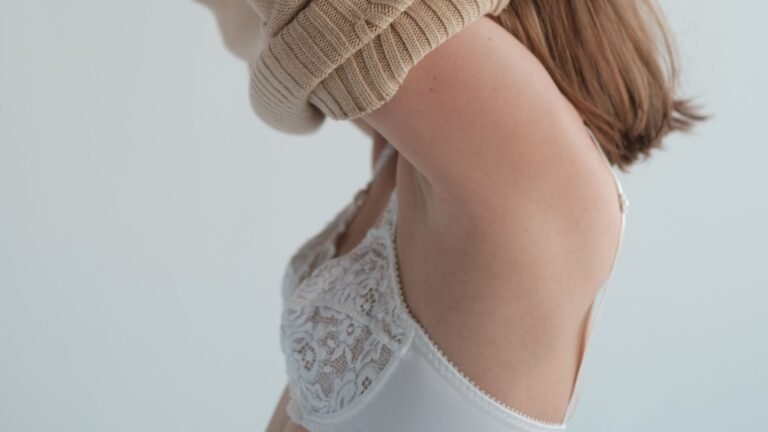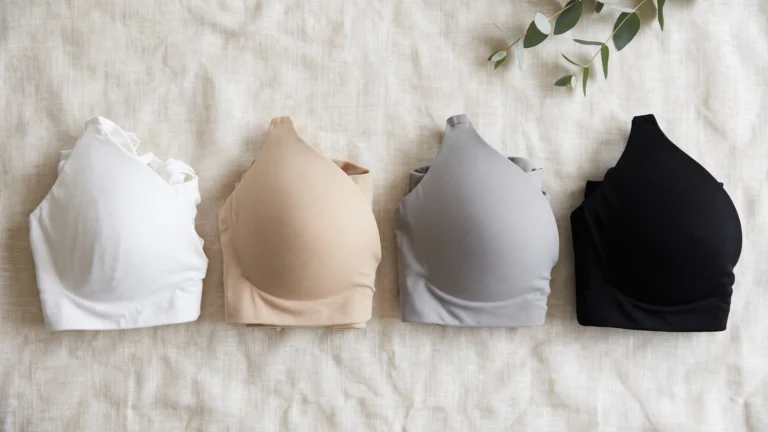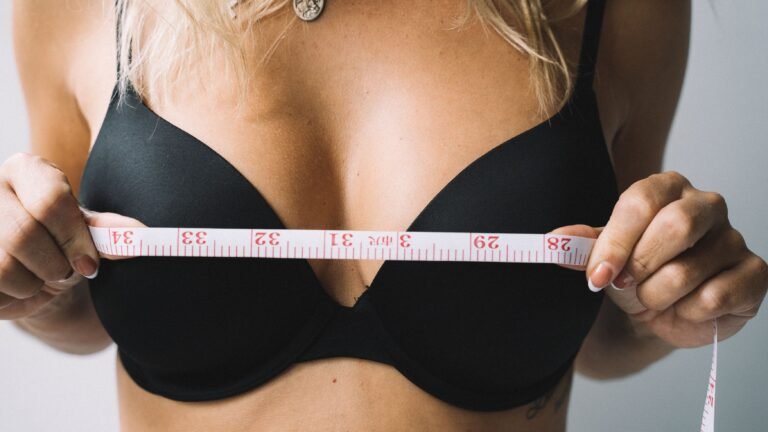

Body positive bra fitting starts with one idea: your bra should fit the body you have today, not the body you think you should have. A good fit is judged by how the bra feels on you, not by how your body measures up to a picture, and not by the size printed on the label. If the band sits level, the cups hold you without pinching or gaping, and you forget you are wearing it by mid-morning, that is a good fit. No perfect shape is required, because there is no perfect shape to chase.
Most of us learned the opposite. This guide works the other way around: the bra is the thing that has to earn its place. The measuring method is not re-taught here. Our measurement guide and our bra size calculator carry that.
Quick Answer
Body positive bra fitting means choosing a bra by how it feels on your body today, with the size treated as a starting point and the fit checks treated as the verdict. Judge a bra by five checks: a level band that feels snug on the loosest hook, cups that hold you smoothly without spilling or gaping, a centre gore that lies flat, wires that follow your natural curve without sitting on tissue, and straps that stay put without digging in. If a bra fails those checks, the bra is wrong, not your body.
What Body Positive Means in a Fitting Room
Body positivity in a fitting room is smaller and more practical than the phrase sounds. Neubodi puts it plainly: body positivity is not about loving every part of yourself every day. It is about respecting your body, embracing your natural shape, and choosing pieces that help you feel supported. You only need a bra that does its job without hurting, pinching, or demanding that you change first.
Three facts from the Neubodi guide are worth carrying in with you. First, a larger cup size does not mean you are “too big,” and a smaller cup size does not make you “less feminine.” The letter is a measurement, not a grade. Second, band and cup sizes work together, so the letter alone does not tell the full story. A 34D and a 36C hold a similar cup volume on different bands. Third, your size today does not have to be the same as it was five years ago. Neubodi also advises against saving bras for a “future you”: if a bra does not fit comfortably today, it is time for a replacement. Buying bras that fit your current body is not giving up. It is choosing comfort over unrealistic expectations.
Body Neutrality: A Quieter Option That Also Works
Not everyone wants to feel positive about their body, and this guide does not ask you to. Body positivity is one frame. Body neutrality is another: where body positivity asks you to feel good about your body, body neutrality asks you to feel less about it altogether. In a fitting room, that sounds like this: “This band is too loose,” instead of “I am too big for this band.” Only the first one helps you find a better bra.
This is editorial guidance, offered as a choice rather than a rule. What matters is that the fitting room stops being a place where your body is on trial. If your first thought is a judgment about your body, rephrase it as a fact about the bra: “This cup shape does not match my shape.” Our guide on breast shape and bra fit explains how different cup shapes suit different shapes, without ranking any shape above another.
What a Good Fit Feels Like
A good fit is a feeling before it is a look. ThirdLove describes it in one line worth keeping: a bra that fits properly should feel like an extension of you, not something you cannot wait to take off after a long day. There should be no itching, poking, or pinching.
Five checks decide whether a bra meets that standard, from the fit guides published by ThirdLove, Wacoal, and the University of Portsmouth Research Group in Breast Health. The Portsmouth researchers add a useful motto: search for your fit, not your size.
1. The band sits level and feels snug. The band does most of the support, so it comes first. It should sit level all the way around and feel snug on the loosest hook of a new bra. Wacoal uses a simple test: two fingers should slide under the band with light resistance.
2. The cups hold you smoothly. Your breasts should sit fully inside the cups, with no spilling over the top or out at the sides, and no gaping at the top edge. If the cups gape, try a different cup shape before a smaller size. If they spill, the cup is too small.
3. The centre gore lies flat. The gore is the small panel between the cups, and on a bra that fits it sits flat against your breastbone. If it floats away, the cups are usually too small.
4. The wires follow your natural curve. If the bra has an underwire, it should sit flat against your rib cage and follow the natural crease under your breast, never resting on tissue. A wire that hurts is a wire in the wrong place.
5. The straps stay put without digging in. Straps should sit comfortably on your shoulders without slipping off or leaving grooves. They keep the bra in place; they do not carry your breasts. Straps carry only about 10 percent of the support, says Wacoal; the band does the rest.
Run these five checks in order, band first, every time.
The Label Is Not the Verdict
The size on the label is a starting point, not a verdict. Brands do not all grade their sizes the same way: each brand writes its own size chart and cuts its own patterns, so the same label can fit differently from one brand to the next, and even from one style to the next inside the same brand.
The Portsmouth researchers advise searching for your fit rather than your size, and Neubodi warns against chasing the size on the label instead of the fit that feels best. If you order your usual size from a new brand and it does not fit, the most likely explanation is the brand’s grading, not your body. A size that does not fit is information about the bra, not evidence about you.
There is also a quieter trap in the label: the number itself. Many of us treat a different size as a failure or a loss, but sizes are measurements of your body on a given day, in a given brand’s system. Our guide on signs your bra does not fit lists the faults to watch for, and none of them is “the label says a different number than it used to.”
When the Bra Fights Your Body, Change the Bra
Sometimes a bra fails the five checks and no size change fixes it: the band fits but the cups gape, or the cups fit but the wire sits on tissue. When that happens, the problem is usually the style, not the size.
A full-coverage cup, a demi cup, and a plunge cup in the same size can fit three different ways, because cup shapes differ just as bodies do. Our guide on breast shape and bra fit maps shapes to styles in detail, so this guide will not repeat that ground. The point here is the attitude: a gap or a spill in a new style is information about the style, not a verdict on your body.
The same attitude applies to body types. Our guide on bras for different body types covers frame and proportion in full. This guide deliberately does not predict a size from a body type, because no such prediction is honest. A body type can point you toward a construction worth trying, and it can never tell you a size. Try the bra on, run the five checks, and let the fit decide.
Trying On Without the Mirror Test
Most fitting advice tells you to look in the mirror. This guide suggests you start by looking away from it for the first minute. Your body can tell you how the bra feels before your eyes get a vote, and the feeling is the more reliable test.
Try the bra on, fasten it on the loosest hook, and settle the tissue into the cups. Then stand up and move. Raise your arms: the band should stay put and your breasts should stay in the cups. Walk and sit: the band should stay level and the straps should stay put. Reach forward: nothing should pinch, poke, or ride up. A bra you keep noticing is a bra that does not fit, however good it looks in the mirror.
Only then look in the mirror, and look at the bra, not at your body. If three sizes in one style all fail, the style is wrong for you. Move on to another construction. When you buy online, keep the tags on and wear the bra around the house for an hour before you decide. If it still feels like an extension of you after an hour, keep it. If you spent the hour aware of it, send it back.
The Fitting Room Script: Kinder Language That Still Works
The words you use in the fitting room change the outcome. If you walk in thinking “I need to look smaller,” you will reach for a bra that squeezes. If you walk in thinking “I need a bra that stays put without hurting,” you will reach for a bra that fits.
Here is a small script to carry in, offered as editorial guidance. Instead of “This makes me look fat,” try “This band is digging in at the sides.” The first sentence is a judgment with no fix. The second names a fit fault with a clear next step. Instead of “My breasts are too big for this,” try “These cups are too small for me.” The cups are the thing that is too small. Your body does not come in a wrong size. Instead of “I used to be a 34C and now I am not,” try “My size today is different from my size then.” Sizes move. That is what they do. Our measurement guide and our bra size calculator will give you the number for today.
Accurate language is kinder language, because it puts the problem where it belongs: on the garment.
When to Ask for Help
Most fitting problems are solved by the five checks, a different size, or a different style. Two situations call for help from a person rather than a guide. The first is a professional fitting. If you have tried several styles in several brands and nothing passes the five checks, a fitter can help. You do not need to know your size before you go. If a fitter ever makes you feel judged about your body or your size, leave and find another one. A fitting is a service, and you are the customer.
The second is your clinician. This guide covers fit and comfort only. If you have individual concerns about changes in your body, talk to your clinician rather than trying to solve it with a new bra size. A bra can fix a fit problem. It cannot diagnose a body problem.
Frequently Asked Questions
Do I need to love my body to find a bra that fits?
No. You need a tape measure, five fit checks, and a willingness to blame the bra when it fails them. Body positivity helps some people, and body neutrality helps others. Neubodi puts it this way: body positivity is about respecting your body and choosing pieces that help you feel supported, not about loving every part of yourself every day.
My size changed. Is something wrong with me?
No. Sizes move when bodies move. Neubodi notes that your size today does not have to be the same as it was five years ago, and our guide on why your bra size keeps changing explains the causes in full. What matters is whether the bra you are wearing passes the five checks today. If a change in your body worries you, talk to your clinician. This guide covers fit only.
What if no bra feels right?
First, check whether you have been trying different sizes in the same style. If so, change the style, not the size. Our guides on breast shape and bra fit and bras for different body types explain which constructions suit which shapes and frames. If several styles in several brands all fail, book a professional fitting.
The Short Version
Body positive bra fitting means your bra fits the body you have today, and the fit is judged by feel, not by the label and not by the mirror. A good fit passes five checks: a level band that feels snug on the loosest hook, cups that hold you smoothly, a centre gore that lies flat, wires that follow your natural curve, and straps that stay put without digging in. If a bra fails those checks, the bra is wrong, not your body. Change the size first, then the style, and if several styles fail, ask a fitter for help. Buy bras that fit your current body, not your previous size. Comfort is the standard, and your body does not have to change to meet it.