

If you have ever stood in a fitting room wondering how should a sports bra fit, the useful answer is not a feeling. Fit is testable. A good sports bra passes five checks, in a set order: band, cups, straps, movement, time. Each takes seconds and returns a clear pass or fail, and each failure names its fix. Run them in order, because the early checks explain the later ones. A strap problem is usually a band problem wearing a disguise.
You need no equipment beyond two fingers and a mirror. The checks follow mainstream fitter practice: REI and the University of Portsmouth breast health fitting guide use the same points, in the same order.
How should a sports bra fit? The two minute version
A sports bra fits when the band sits level and snug on the loosest hook, the cups contain everything after a scoop and swoop, the straps stay put without digging, movement settles instead of travelling, and ten minutes of wear leaves nothing worse than marks that fade. Fail one check and the bra is not your fit yet.
Check 1: The band check
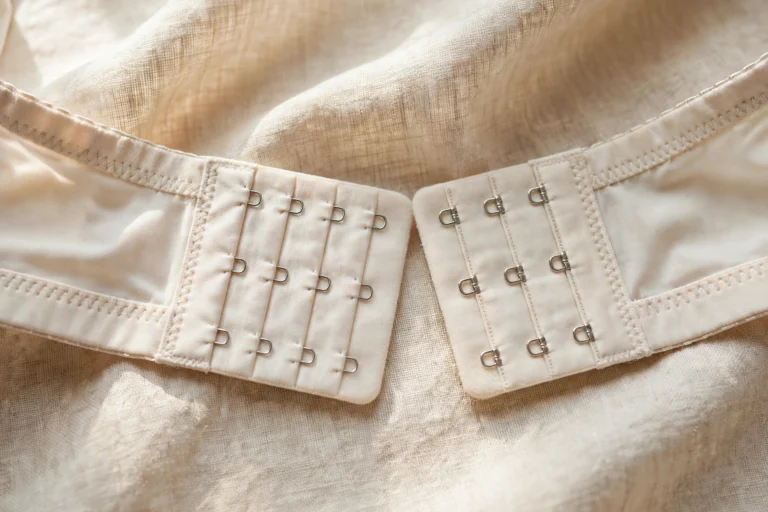
On a new bra, fasten the loosest hook: the band should sit level all the way around, parallel to the floor, snug enough that two fingers slide underneath and no more. Raise both arms overhead: the band stays put, and nothing escapes underneath.
Fitters treat the band as the foundation of support. As REI puts it, the band does most of the work in supporting your breasts. That is fitting convention, not a lab measured percentage, so treat exact percentages quoted online with suspicion. If the band rides up your back, it is too big, and every later check fails downstream of it. Our parts of a sports bra guide shows what each part should do.
Check 2: The cup check
Before judging the cups, scoop and swoop: lean forward and guide all breast tissue into the cups (our step by step guide to how to put a bra on properly covers the technique). Only then look. A pass means full containment: no spillage over the top, none at the sides, and no gaping or wrinkling, which means the cup is too big.
The center front reads differently by construction. On an encapsulation or underwire style, the center should sit flat against your breastbone; per the University of Portsmouth fitting guide, a center front lifting away means the cups are too small. A compression style has no center panel to sit flat, so judge it on containment alone.
Check 3: The strap check
Slide two fingers under each strap: secure, with a little give, is the working tension. Straps that dig are usually compensating for a loose band, so recheck the band before blaming them. Straps that slip are a placement problem: shorten them, then try a racerback conversion or J-hook if offered.
Straps finish a fit; they do not create one. If tightening them is the only thing holding you up, the bra already failed check 1.
Check 4: The movement check
Jog in place for 20 to 30 seconds, do a few jumping jacks, reach both arms overhead and twist. Watch the mirror, not the bra. A pass: movement happens, then settles quickly. A fail keeps travelling long after you stop.
REI and Fleet Feet both use the same test, and both make the same honest point: some breast movement is natural and normal. The check is about how much, and whether it keeps going. Recheck the band after the reaches: still level?
Check 5: The time check
Two minutes hides what ten minutes reveals. Wear the bra for ten minutes around the store or your home before you commit. Then look at the evidence. Red marks that fade within minutes of removal are normal pressure marks. Pain, numbness, tingling, or grooves that linger are not a break in period. They are a fail. Heat and movement relax elastic as you wear it, so a bra that barely passes check 1 at minute two can ride up by minute ten.
The fit check table
| Check | How to run it | Pass sign | Fail sign | First fix |
|---|---|---|---|---|
| Band | Loosest hook, two fingers under the band, arms overhead | Level, snug, stays put | Rides up or shifts | Smaller band, sister size up a cup |
| Cups | Scoop and swoop, then look in the mirror | Fully contained, smooth fabric | Spillage or gaping | Cup size up or down one |
| Straps | Two fingers under each strap | Secure, no digging or slipping | Grooves, or straps slide off | Recheck the band, then adjust straps |
| Movement | Jog in place, jumping jacks, overhead reaches | Movement settles fast | Movement keeps travelling | Firmer construction, not tighter straps |
| Time | Wear it for ten minutes, then inspect | Fading marks only | Pain, numbness, lingering grooves | Stop: wrong size or wrong style |
As an Amazon Associate I earn from qualifying purchases. The three bras below were chosen because their adjustment points make these checks passable. Each is labelled with the check it best serves. Full details are on our affiliate disclosure page.


Three bras that give you something to adjust
A check you cannot act on is trivia. These three were picked because each hands you a real adjustment point, a band clasp, front straps, or a back closure, plus a wide size system.
For the band check: Victoria’s Secret VSX Featherweight Max Sports Bra
Most sports bras need the band right from the hanger. This one lets you tune it. Victoria’s Secret builds the Featherweight Max with an adjustable back clasp, its own design notes’ pick for customizing fit, plus adjustable cushioned straps and bonded seams. The cups are molded and wirefree, and it is sold in band and cup sizes, which is what makes the band check winnable: start from your actual band size, then work the clasp columns as the band settles. Max is the brand’s highest impact label; let the movement check arbitrate.
Pros
- Adjustable back clasp gives the band several working positions
- Band and cup sizing, with Amazon variants confirmed in 32C and 36DD
- Molded wirefree cups with a smooth bonded finish
Cons
- Fixed molded cup shape is less forgiving of asymmetry than an unlined cup
- Amazon size coverage is uneven by color; your size may miss some variants
- No underwire separation, which some fuller bust readers prefer
| Key Specs | Detail |
|---|---|
| Support | High impact (brand’s Max level) |
| Size range | US band and cup sizes; full grid flagged in BUILD PREP |
| Closure | Back clasp, adjustable |
| Construction | Molded cup, wirefree, bonded seams |
| Adjustability | Band clasp and straps |
For the strap check: SYROKAN Front Adjustable High Impact Wirefree Sports Bra (11000)
Every other strap on this page adjusts behind your back or not at all. The SYROKAN 11000 puts hook and loop straps at the front, where you can reach and re-tension them mid workout, bra on. The brand pairs them with double knit spacer cups, mesh panels and a wide underband, and describes the straps as built for extra support and a custom fit. Its own size chart on the listing runs bands 34 to 46 and cups C to G, a wide grid for a wirefree style.
Pros
- Front hook and loop straps adjust while worn, no reaching behind
- Wide grid: bands 34 to 46, cups C to G
- Spacer cups and mesh panels keep the cup structured and aired
Cons
- Hook and loop loses grip as it collects lint; fasten straps before washing
- Hand wash only
- High neckline shows under lower cut workout tops
| Key Specs | Detail |
|---|---|
| Support | High impact (brand label) |
| Size range | Bands 34 to 46, cups C to G (brand chart on the listing) |
| Closure | Front hook and loop straps; band closure not confirmed in listing data |
| Construction | Wirefree spacer cups, mesh panels, U back |
| Adjustability | Straps (front, hook and loop) |
For the movement check: BaseTry High Impact Padded Seamless Sports Bra
The movement check is where seamless compression bras usually get exposed, because most give you nothing to tune. The BaseTry listing specifies adjustable straps and a back closure on a seamless padded, criss-cross back cup, so you can set strap tension and band position before the jumping jacks instead of accepting a pull-on’s fixed fit. Its chart translates alpha sizes into bra sizes: S to XXXL, against equivalents from 28D to 42A.
Pros
- Adjustable straps and a back closure on a seamless style, a rare combination
- Published size chart maps every alpha size to band and cup equivalents
- Seamless padded cups; no hardware at the front
Cons
- Alpha sizing makes the band check blunt: each letter spans several band sizes
- Size chart tops out at D to DD cup equivalents, so fuller busts are out of range
- Compression containment only, with no separation between the breasts
| Key Specs | Detail |
|---|---|
| Support | High support (brand label) |
| Size range | Alpha S to XXXL; chart equivalents 28D to 42A |
| Closure | Back closure (listing field reads hook and loop; confirm at build) |
| Construction | Seamless padded compression, criss-cross back |
| Adjustability | Straps and band closure |
Which check failed, what to change
Work down this list in order, and change one thing at a time, or you will never know what fixed it.
Band rides up (check 1): a size change. This is where sister sizes earn their keep. Sister sizes hold roughly the same cup volume in a different band: down a band and up a cup, or the reverse. A 36D that rides up becomes a 34DD; a 36D that digs on the loosest hook while the cups fit becomes a 38C. If neither sister behaves, remeasure with our measurement guide and bra size calculator.
Cups spill (check 2): a size change first, then construction. Spillage over the top means one cup size up in the same band. Spillage at the sides, with the top behaving, is usually cup shape, not volume: look for a wider cup or a style with side support.
Cups gape or wrinkle (check 2): a size change, then a style change. One cup size down. If the smaller digs while the larger still wrinkles on top, your shape is shallower than the cup: change style, not just size.
Straps dig (check 3): fix the band, then the construction. Digging straps are almost always a loose band outsourcing its job. Pass check 1 first. Still digging in a firm band? Wider or padded straps spread the load over more skin.
Straps slip (check 3): a construction change. Shorten them, then convert: a J-hook or racerback moves the straps inward, off the shoulder edge they escape from.
Movement keeps travelling (check 4): a construction change. Do not answer bounce with tighter straps. Step up the architecture: pure compression to encapsulation or a combination style, low cut to fuller coverage.
Pain or numbness at ten minutes (check 5): stop. No adjustment fixes this. It is the wrong size, the wrong style, or, on an older bra, elastic that has retired. A sports bra is never something to break in.
Common questions
Should a new sports bra feel tight?
Snug, yes; restrictive, no. On the loosest hook, think firm hug you can breathe fully inside. If a deep breath is a struggle, the band is too small, whatever the chart promised.
Are red marks a bad sign?
Marks that fade within minutes are normal pressure marks, like a sock’s. Lingering marks, grooves, pain or numbness mean the fit failed the time check.
My bra passes standing still but fails the movement check. Which wins?
For a sports bra, the movement check wins. Standing fit is the entry requirement; the bra earns its keep on the run, not in the mirror.
The bottom line
Run the five checks in order: band, cups, straps, movement, time. Each failure names its own fix, and most fixes are a size change, not a new bra hunt. Start with the band, and let ten honest minutes have the final word.

10 Comments