

Your bra arrived with a retirement plan already sewn into it. The columns of eyes beside the hooks are not spare settings for good days and bad days. They are a one way path, and your bra hook and eye settings record where the band is in its working life. Start a new bra on the loosest column, move inward as the elastic relaxes, and read the tightest column as the band announcing its strength is nearly spent. Most wearers run the path backwards: they buy on the tightest hook because it feels secure in the fitting room, then have nowhere to go when the band gives, which it always does.
This guide explains how to read the settings and what each stage means. It builds on our guide to sports bra band fit and the fastening routine in how to put a bra on properly: hooks first, judgment second.
Rows hold the band together; columns let it age
A closure is a grid, and the two directions do different jobs. Rows are the hooks stacked vertically, two to five of them, setting how tall the closure panel is. Columns are the eye settings running horizontally, setting the band’s tightening travel.
The supply trade shows how fixed the column count is. Bra-makers Supply sells its sealed sets as 2 by 3, 3 by 3, 4 by 3 and 5 by 3: the rows climb, and every standard set is three columns wide. With eyes spaced at a 3/4 inch spread, the full path buys roughly an inch to an inch and a half of tightening across a bra’s whole life. That is the entire budget. Spend it at the speed the elastic sets, not the speed the fitting room suggests.
Rows are strength and pressure spread. Each added row lengthens the panel that carries the band’s pull, sharing the load across more hooks and a taller back. A short closure on a tall band is a weak hinge. That is why closures grade with size: as HerRoom puts it, a bra is not made the same way in every size, and makers add hooks as sizes rise. At larger bands and cups, expect three to five rows. Two rows on a 44 band is not minimalism; it is a design telling you it was never built for that load.
Reading your bra hook and eye settings: the three stages
| Hook stage | What it means | What to do |
|---|---|---|
| Loosest column | The band is new, or new enough that its elastic is still at full strength | Judge fit here, including in the fitting room; this is where a new bra belongs |
| Middle column | Normal midlife: the elastic has relaxed and you have taken up the slack | Nothing is wrong; expect to live here for much of the bra’s working life |
| Tightest column | The band’s planned travel is used up and its grip is fading | Start shopping for the replacement and move this bra to lighter duty |
| Tightest column, and the band still rides up | The elastic has given more than the columns can repay | Retire it; no setting fixes a band that has run out of grip |
| Tightest column on day one | The band was too big at purchase, and the secure feeling was borrowed | Exchange down a band size and up a cup letter while you still can |
Three reads that diagnose more than fit
Starting on the tightest hook is the most common misread. It feels like choosing support. It actually announces that the band was too large on day one, because a correctly sized new band is snug on its loosest setting with its whole life ahead of it. The bra then has no answer when the elastic relaxes, and it gets blamed for dying young. Most symptoms in our roundup of sports bra fitting problems start exactly here.
Moving inward quickly is the second read. Travelling a full column in the first few weeks means the size was wrong and fresh elastic was masking it, or the elastic is poor or being cooked by hot washes and dryers. Slow travel over months is aging; fast travel is evidence.
Uneven hook use on a multi row band is the third. Fastening only the hooks that are easy to reach twists the panel and concentrates the whole load on part of the grid. On a tall closure, fasten every hook, every time, and check that the panel sits flat. A closure that will not lie flat is reporting a mismatch between the band’s shape and yours.
The extender bridge, and its limit
An extender clips onto the hooks and adds eye columns beyond the loosest setting. Used honestly, it is a bridge: the band that is a fraction small, the firm new bra in its first wears, the temporary change your body is passing through. It must match your closure’s row count, or the mismatched panel pinches where the two grids meet.
Used as a rescue, it fails in both directions. It cannot fix a band that is too big, because it only adds length. It cannot revive a band already living on its tightest hook, because that bra needs the opposite of length. And when an extender becomes permanent furniture, it is a confession that the size is wrong; the audit in signs your sports bra is the wrong size will tell you which one you are looking at.
As an Amazon Associate I earn from qualifying purchases. The three bras below were chosen because each closure makes a different point: rows that grade openly with size, a front closure that turns the grid sideways, and an honest two row band. Full details are on our affiliate disclosure page.


Three closures that teach the settings
Each pick below is here because of its closure: three worked examples of the grid at work.
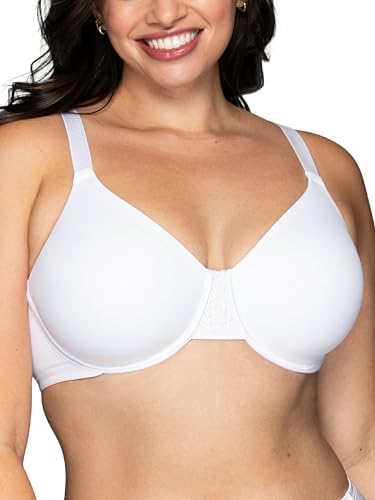
Rows that grow with the load: Vanity Fair Beauty Back Smoothing Minimizer Bra 76080
Most brands grade their closures quietly. Vanity Fair publishes the whole map. Macy’s lists this full figure underwire minimizer with 3 rows of hooks at 38B to 44B, 36C to 42C and 36D to 38D; 4 rows at 44C to 46C, 40 to 48D and 38 to 46DDD; and 5 rows at 48DD and 44 to 48DDD. The columns stay at three settings throughout: the life path is constant, and the strength is what scales. A leotard back keeps the straps placed, and the non padded molded cups are rated by Vanity Fair as minimizing the bust line by up to 1 1/2 inches. It is an everyday bra, not a sports bra, and it is here for the reason the Bali spa closure anchored our band guide: no sports line we checked publishes its closure grading this plainly.
Pros
- The closure grading is published size by size, so you can check what your size receives
- Five rows at the top of the range, matching a 48 band
- Leotard back keeps straps placed closer together, away from the shoulder edge
Cons
- Hand wash only, like most structured underwire styles
- A minimizer redistributes rather than lifts; the flatter profile is a preference, not an upgrade
- At the largest sizes the tall closure is a lot of hardware to fasten behind your back
| Key Specs | Detail |
|---|---|
| Support | Medium support (listing field); an everyday full figure minimizer, not a sports bra |
| Size range | US bands 36 to 48, cups B to DDD in the graded closure table at Macy’s; the Amazon listing family runs to H cups in some sizes |
| Closure | Back hook and eye, 3 columns; rows grade 3 to 4 to 5 across the size range (Macy’s) |
| Construction | Underwire minimizer, molded non padded cups; cups 78% nylon and 22% spandex, back 80% polyester and 20% spandex; leotard back |
| Adjustability | Back adjustable straps; 3 column hook path |
The grid turned sideways: Glamorise Front-Closure Cotton T-Back Comfort Bra 1908
A front closure turns the grid on its side, and the jobs swap. Glamorise describes this wirefree leisure bra’s closure as one column and five rows of hooks, increasing with size: a vertical stack up the center front does the holding, and the small choice of loops across is all the travel you get. So the forgiveness lives in the cups instead, stretch cotton cut in combined sizes such as B/C/D and G/H across bands 34 to 48. Glamorise positions the 1908 for lounging and light support, with a lace T-back and wide cushioned straps. The honest trade: you gain a closure you can see and fasten without reaching behind you, and you give up the tightening path almost entirely. This bra has to fit on day one, because it has no plan for year two.
Pros
- Front fastening you can watch your hands do, with no reaching behind
- Combined stretch cup sizes forgive fluctuations a fixed cup cannot
- Cotton rich knit and a breathable lace T-back suit long home days
Cons
- Light support only; this is a leisure bra, not a training bra
- Almost no tightening travel, so a wrong size cannot be hooked into behaving
- Five front hooks take longer to fasten than three back hooks
| Key Specs | Detail |
|---|---|
| Support | Light support leisure bra (Glamorise positioning) |
| Size range | US bands 34 to 48, cups B to H in combined cup sizes (B/C/D, DD/F, G/H) |
| Closure | Front hook and eye; Glamorise describes 1 column and 5 rows, increasing with size |
| Construction | Wirefree stretch cups, cotton rich four way stretch knit, lace T-back (exact blend not stated in the sources checked) |
| Adjustability | Front hook settings; strap adjustment not stated by Glamorise |
Two rows, sized honestly: Wacoal How Perfect Wire Free T-Shirt Bra 852189
Two rows is a defect only when the load outgrows it. Bare Necessities lists this wirefree T-shirt bra with a 3 column, 2 row hook and eye closure that increases with size, and the rest of the spec explains why two rows suffice here: seamless foam lined cups for a light, smooth job, built in side boning to steady the band’s edges, and a brushed microfiber body in 81% nylon and 19% spandex. The three columns still deliver the full life path; what is shorter is the panel, matched to smaller bands and cups that top out at DDD. Even this minimal closure grades upward with size, which is the tell: when a bra past this range keeps two rows, the design is announcing its ceiling.
Pros
- The full three column life path survives in a minimal, low profile closure
- Side boning adds the steadiness the short panel cannot
- Small bands from 30, a range many wirefree styles skip
Cons
- Wirefree foam cups stop at DDD; no version exists for larger cups
- Two rows spread less pressure than a taller panel, so it is the wrong template for heavy loads
- Hand wash only
| Key Specs | Detail |
|---|---|
| Support | Light to medium everyday support; a wirefree T-shirt bra (retailer positioning) |
| Size range | US bands 30 to 40, cups A to DDD (tracked listings include 30DD, 34A, 36B and 36DDD; confirm the full grid in the catalog at build) |
| Closure | Back hook and eye, 3 columns by 2 rows, increasing with size (Bare Necessities) |
| Construction | Wirefree seamless foam lined cups, built in side boning, brushed stretch microfiber; 81% nylon and 19% spandex |
| Adjustability | Adjustable close set straps; 3 column hook path |
Common questions
The loosest hook feels insecure, so I start on the middle one. Is the bra wrong?
Probably, yes. A new band that is not snug on its loosest column is usually one band size too big; try down a band and up a cup letter, which keeps the cup volume while restoring the grip. If the loosest setting is snug and you simply prefer the middle, know the price: you are spending the bra’s travel early, and it will reach retirement sooner.
Can an extender save a bra that already lives on its tightest hook?
No. An extender adds length at the loose end of the path, and a tired band needs the opposite of length. A bra on its tightest hook that still moves is finished; the extender belongs on the new bra that fits a fraction small, not the old one.
Do more hooks mean a better bra?
No. Rows should match the load and the height of the band they close. Two rows on a 32B and five rows on a 48DDD are both correct engineering, and either count in the other’s place would be a warning sign.
The bottom line
Read your columns before you judge your bra. Loosest means new, middle means midlife, tightest means the plan is spent. Rows tell you what a bra was built to carry; columns tell you how much life it has left. Buy the bra whose loosest hook already fits, and the settings will do the rest.


2 Comments