

A sports bra buying guide usually starts with products. This one starts with an order of operations, because most bad sports bra purchases are sequencing errors: the style gets chosen first, the support level gets guessed from the activity, and the size gets checked last. This sports bra buying guide walks the seven decisions a fitter makes and links each one to the Stellaleah guide that owns it. Follow the sequence and the right product nearly chooses itself.
How to Use This Sports Bra Buying Guide
Buying your first sports bra? Read the steps in order. Already own bras that nearly work? Jump to the step where your last purchase went wrong: a fit failure is usually a skipped step announcing itself. Steps 1 to 6 cost nothing but a tape measure, a mirror and ten honest minutes.
Step 1: Start With a Measured Size, Not a Remembered One
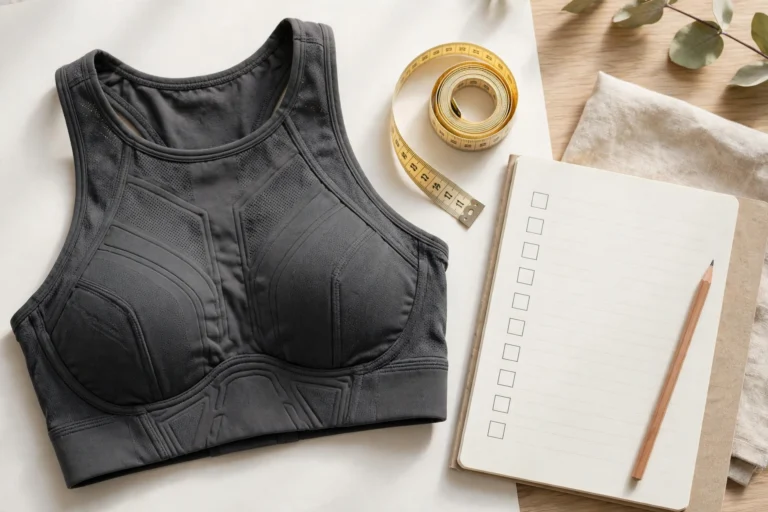
Your size is a measurement, not a memory. Bodies drift with training, weight change and time. Measure your underbust and full bust now, and treat the result as a starting size: a hypothesis that the fitting checks in step 5 will confirm or correct. Our measurement guide covers tape placement, the bra size calculator does the arithmetic, and the at home sizing session shows how to verify that size three ways.
Step 2: Name the Job Before You Name a Style
Impact is the activity multiplied by your cup size: a D cup at a fast walk can need what an A cup needs for a jog. So name the job, your hardest activity and your measured cup size, before you look at a single product photo, and buy for the hardest session in your normal week. Our guide to sports bra impact levels explains why the label on the rail is a claim rather than a standard, and the activity by activity guide maps common sports to the support they actually demand.
Step 3: Choose the Construction That Does That Job
Compression presses the breasts toward the chest and suits lower impact and smaller cups. Encapsulation holds each breast in its own shaped cup and is the default answer as impact and cup size climb. Hybrid designs combine both. Wirefree versus underwire is a second, separate decision: a wire is one way to build a cup’s structure, not a guarantee of one. The full comparison is in compression vs encapsulation and in wirefree vs underwire sports bras.
Step 4: Choose the Closure and Back Your Shoulders Agree With
A hook and eye back closure gives you three columns of adjustment, so the band can start on the loosest hooks and be taken in as the elastic relaxes. A front zip is the kind option for stiff, sore or healing shoulders, and the easiest exit from a sweat soaked bra. A pullover has no hardware to fail and no adjustment at all, so its fit is fixed on the day you buy it. Our zip front sports bras guide covers the front close branch, and bra hook and eye settings explains what each column is telling you about a band’s remaining life.
Step 5: Fit It With the Five Checks, in Fitter Order
Work in fitter order: band first, level and firm on the loosest hooks, then cups filled without spillage or gaping, then straps adjusted so they assist rather than carry, then the centre front. The order matters because each check changes the ones after it; tightening straps to fix a loose band just moves the problem to your shoulders. The full routine is in how should a sports bra fit. If the band is wrong, nothing downstream can rescue the fit.
Step 6: Run the Movement Test Before the Tags Come Off
Before the tags come off, jump, reach overhead, twist, bend and take two deep breaths. Watch for the band migrating, cups gaping, straps sliding and any point that rubs on repetition. Two minutes of honest testing beats a season of adjusting mid workout. If a problem shows up, sports bra fitting problems works through the ten common failures in the order a fitter tries the fixes, so you adjust before you conclude the bra is wrong.
Step 7: Buy the Rotation, Not the Bra
One bra worn daily is a bra being worn out. Elastic needs rest between wears, and sweat left sitting in a band shortens its life, so the real purchase is a rotation: for most training weeks, three bras, worn in turn, washed in rotation, and replaced when the signs appear. A new bra that starts on the tightest hooks, straps that will not stay adjusted and a band that rides up on a fresh wash are retirement notices, not fit problems. The full audit is in signs your sports bra is the wrong size.
The Decision Table: Where Your Situation Starts
| Your situation | Start with | Because |
|---|---|---|
| You run, and you wear a DD cup or above | Encapsulation in your measured size | Cup size raises impact faster than activity does, and separate cups control movement one breast at a time |
| You train at low to medium impact and hate underwire | Wirefree compression | At lower impact the wire is structure you may not need, and simple construction fits forgivingly |
| Your shoulders are stiff, sore or healing | A front close bra | The closure is a mobility decision; a zip removes the reach behind your back entirely |
| This is your first sports bra purchase in years | A budget seamless bra, bought by measurement | A first buy teaches you your current size; save the serious spend for the second purchase |
| You already own one bra that works | Two more of the same job, not a new style | A proven fit, repeated, beats three experiments; the rotation protects it |
| Your size is changing | The bra that fits today, in the smaller rotation | A changing body makes every size a starting size; buy for the body you measured this week |
As an Amazon Associate I earn from qualifying purchases. Links on this page may earn Stellaleah a commission at no extra cost to you, and the full policy is on our Affiliate Disclosure page.


Start From Your Branch: Four Exemplars
Each exemplar teaches one branch of steps 3 and 4. None is right for everyone; each is the right starting point for the reader whose decisions point down that branch.
The Encapsulation Exemplar: Anita Air Control 5533
Encapsulation does not require a wire. Anita builds the Air Control with double layered, seamlessly preshaped cups and side support set between the net layers, so each breast is held in its own shaped cup rather than pressed flat, and the brand rates it at its own top tier, Maximum Support. Anita’s size grid runs in US bands 32 to 42 for cups A to E, narrowing to bands 32 to 40 for cups F to G.
Pros
- Maximum Support rating from Anita itself, achieved without an underwire
- Preshaped cups separate and hold, rather than compressing into one mass
- Breathable mesh construction suits hot training and long sessions
Cons
- Nothing above a 42 band or a G cup exists in this style
- Straps are fixed comfort straps; Anita claims no slider adjustment, so fit tuning lives at the band
- Shaped cups are unforgiving of a guessed size: measure first, per step 1
| Field | Detail |
|---|---|
| Support | Maximum Support (Anita’s own rating) |
| Size range | US bands 32 to 42, cups A to E; bands 32 to 40, cups F to G |
| Closure | Back closure |
| Construction | Encapsulation: preshaped double layer cups with side support, wirefree |
| Adjustability | Band only; fixed comfort straps centered toward the back |
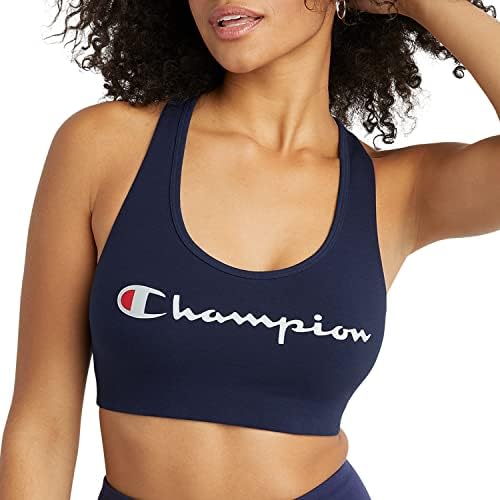
The Wirefree Exemplar: Champion Authentic Sports Bra (B2304)
This is the wirefree decision in its simplest form: no wire, no cups, no hardware, just compression fabric. The listing’s own spec block, captured on Amazon, describes the Authentic, style B2304, as medium support, wire free, pull on, in a cotton and spandex blend. At low to medium impact, for many readers, the honest answer is that you do not need structure at all, and everything this design leaves out is weight, cost and failure points removed.
Pros
- The simplest wirefree design on this page: nothing to dig, poke or break
- Pull on racerback is easy on shoulders and needs no fitting skill
- Machine washable and low maintenance, which suits a daily rotation
- Plus sizes are offered alongside the standard alpha run
Cons
- Medium support is a real ceiling: it rules out running for most cup sizes
- There is no adjustment anywhere, so the fit is whatever your letter gives you
- Cotton rich fabric feels soft but dries slowly once a session turns hard
| Field | Detail |
|---|---|
| Support | Medium (the listing also calls it moderate) |
| Size range | Alpha sizes, including plus sizes |
| Closure | Pull on |
| Construction | Wirefree compression, no separate cups |
| Adjustability | None: fixed racerback straps |
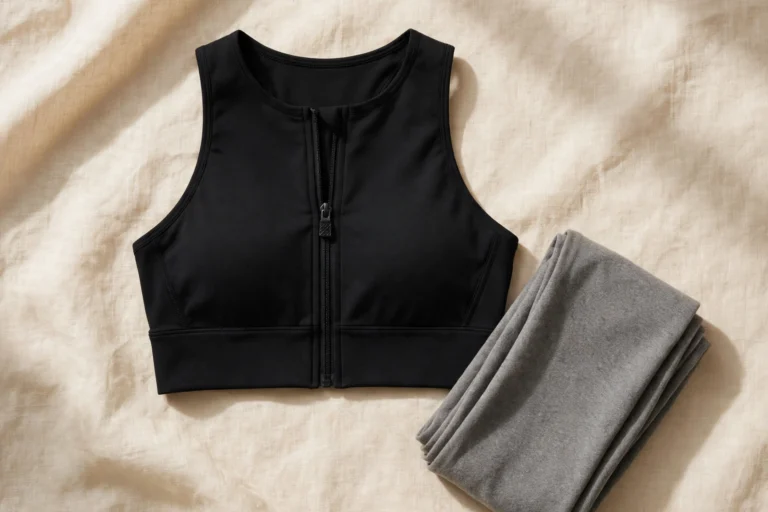
The Front Close Exemplar: Brooks Dare Zip Run Bra 2.0
The front close branch exists for shoulders. Brooks builds its Dare line around built in molded cups, and retailer Runner’s Edge, reproducing Brooks’ own collection copy, describes the Dare bras as delivering high impact support from cups that surround each breast. The zip removes the two worst moments of a back close bra: the reach behind to fasten it, and the peel off when you are soaked. Brooks’ own comparison chart sizes the Zip in bands 30 to 40, in grouped cups A/B, C/D and DD/E.
Pros
- Front zip is the easiest on and off in this guide, and the kindest to stiff shoulders
- Molded cups encapsulate rather than compress, in a genuine band and cup size run
Cons
- Grouped cups fit fewer bodies precisely than single cup sizes do
- Brooks’ chart shows no strap adjustment, so the band and cup group must be right
- The run stops at band 40 and the DD/E group: above that ceiling, start from the encapsulation branch instead
| Field | Detail |
|---|---|
| Support | High impact (Brooks Dare run line) |
| Size range | Bands 30 to 40, cup groups A/B, C/D and DD/E (Brooks chart) |
| Closure | Front zip |
| Construction | Encapsulation: built in molded cups |
| Adjustability | None at the straps, per Brooks’ comparison chart |
The Budget First Buy: C9 Champion Seamless Racerback Bra (N9069C)
Every rotation in step 7 has to start somewhere affordable. The tracker record at CamelCamelCamel identifies the bra precisely: manufacturer C9 Champion, model N9069C, a medium support seamless racerback. There are no cups to fit wrong and no hardware to learn, which is exactly what a first buy should be. It teaches one skill, translation: C9’s own size chart, published by Target, maps each letter to real band and cup sizes, with plus sizes 1X to 4X covering 38C to 44DD in the no cup range.
Pros
- Seamless, cup free design removes most first buy mistakes
- Medium support is honestly labelled, and matches walking, gym and studio work
- The brand chart translates alpha letters back into measured bra sizes
- Priced as an entry level bra, so buying the rotation of three is realistic
Cons
- Medium support will not cover running as your training or cup size grows
- Alpha sizing averages fit; some bodies fall between letters and feel it
- No adjustment of any kind, and seamless knit gives up its firmness sooner than structured bras
| Field | Detail |
|---|---|
| Support | Medium (manufacturer’s label) |
| Size range | Alpha sizes; plus sizes 1X to 4X on the C9 chart |
| Closure | Pull on |
| Construction | Seamless compression, no cups, no wire |
| Adjustability | None |
Common Questions
How many sports bras do I actually need?
For most training weeks, three: one on, one in the wash, one ready. Train six days a week and the honest number rises to four or five. What matters is the rhythm: no bra worn two days running, and none kept past the replacement signs in step 7.
Should a new sports bra feel tight?
The band should feel firm, not painful, on the loosest hooks. Cups should feel containing, not compressive to the point of changed breathing. Tight everywhere is not support; it is a size error wearing a confident expression.
Does spending more guarantee a better sports bra?
No. Spend buys construction options, wider size grids and better fabrics, but a costly bra bought in the wrong order, style first and size last, loses to a modest bra bought in sequence. Work steps 1 to 6 first; they decide what your money should buy.
The Bottom Line
The order is the answer. Measure your size, name the job, choose the construction, pick the closure your shoulders agree with, fit in fitter order, test in motion, and buy the rotation. Start again at step 1 with a tape measure, and let each decision narrow the rail.

One Comment