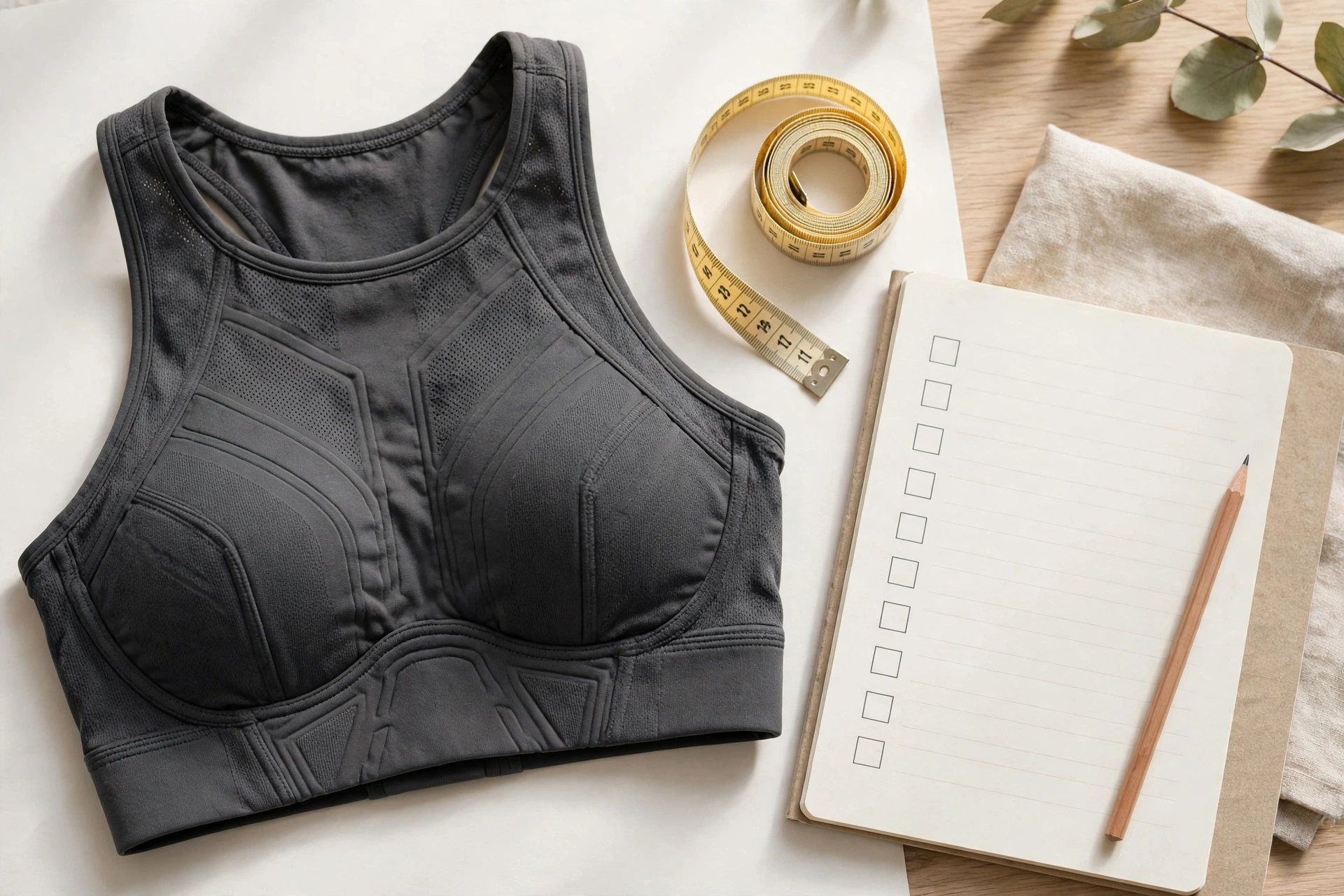
Ask a size chart how much support you need and it answers with two measurements: band and cup. Five things that affect the support you need decide whether that answer works: your breast mass, the movement pattern of your sport, your tissue firmness and life stage, your pain history, and your asymmetry and shape. Two women in the same 34DD can need completely different bras; this page tells you which one you are.
Start from the chart: our sports bra impact levels guide maps levels to sizes and activities; the five factors below correct it for your body.
The Five Things That Affect the Support You Need, at a Glance
| Factor | How it changes the need | How to check yours |
|---|---|---|
| Breast mass | More mass means more force to control | Band and cup read together; top of range, level up |
| Movement pattern | Direction changes, jumping and overhead work load a bra differently | Count changes of direction, jumps and reaches in one workout |
| Tissue firmness and life stage | Softer, less elastic tissue moves more and leans on the bra | Recheck at your fullest point monthly, and after pregnancy or menopause |
| Pain history | If exercise hurts, target the level that removes pain | Pain in the first ten minutes, or only late? |
| Asymmetry and shape | The larger side sets the size; shape picks the construction | Larger side first; center spill is projected, empty top is shallow |
Factor 1: Breast Mass Is Band and Volume Together
A cup letter is a ratio, not a weight: it means something only next to its band, so read mass, band and volume together. In a lab comparison of 48 women (A to G cups), breast mass was the only body measure that consistently explained differences in breast motion between cup sizes (ResearchGate). Alpha sizes hide this by folding band and cup into one letter (alpha sizes vs bra sizes); our breast size and exercise guide goes deeper. Check yours: side spilling, or sitting at the top of a brand’s range, means one level above the chart.
Factor 2: The Movement Pattern, Not Just the Impact Label
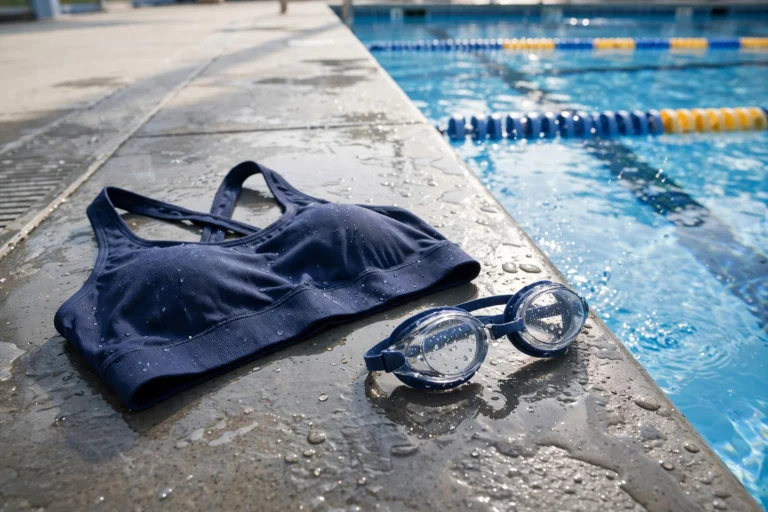
Impact labels squeeze a whole session into one word. Direction changes load a bra sideways, as court sports and dance fitness do. Jumping loads it in vertical bursts; steady running loads it rhythmically. Arm position matters: overhead work needs straps that clear your reach; floor work needs a back comfortable underneath you. Water changes the equation: buoyancy carries some body weight, so swimming asks less of a bra than the same movements on land, while reach and wet stretch test the fit. Check yours: count them in one workout. A medium impact class built on direction changes can out demand a steady run.
Factor 3: Tissue Firmness and Life Stage
MedlinePlus describes breasts losing fat, tissue and mammary glands with age, estrogen decline at menopause shrinking gland tissue, and connective tissue less elastic. So firmer tissue holds more of its own shape, while softer tissue leans on the bra’s structure, and the same size can need firmer construction later in life. Density shifts with age too and cannot be felt by hand (facts about breasts). Pregnancy and the months after birth change size and sensitivity fastest of all, and a bra that fit in March may not fit in May, so recheck often then and treat each purchase as short term. Check yours: recheck at your cycle’s fullest point, after size changes, and through menopause.
Factor 4: Pain History Outranks the Chart
If exercise hurts, your correct level is the level that removes the pain, even a full step above your chart level. Among 540 elite athletes, 44 percent reported exercise induced breast pain (Brisbine and colleagues, 2020), and among 239 women, 17 percent named their breasts as a barrier to exercise, with the wrong sports bra a leading reason (Burnett, White and Scurr, 2015). Sensitivity steers construction too: pressure sensitive skin argues for padded straps; a wire intolerant ribcage, for moving the wire, not tightening the band. Check yours: pain in the first ten minutes points at level or construction. New, one sided, or persistent pain is a medical question, not a bra question; why breasts are sore covers the causes and warning signs.
Factor 5: Asymmetry and Shape Decide the Construction
A size difference between sides is the norm, not the exception: research covered in our facts about breasts roundup found the left side wider in about 77 percent of women. Fit the larger side first; balance the smaller with strap length or padding rather than sizing down into pain. Shape decides whether that size delivers. Projected shapes carry volume forward and need cup depth; squash them into flat compression and they spill at the center. Shallow shapes spread volume wider and thinner; a deep cup leaves the top standing empty. Both are construction mismatches, not sizing failures. Check yours: center overflow means projected; loose fabric at the cup top means shallow.
Disclosure: Stellaleah is reader supported. When you buy through links in this article, we may earn a commission from Amazon at no extra cost to you. Our picks are research based: we verify manufacturer specs and published listings, and we never claim hands on testing we have not done. Read our affiliate disclosure.


Three Bras That Show the Factors at Work
Factor 2, Movement Pattern: Le Mystere Active Balance (Style 6210)
Studio training is the movement pattern problem: floor work, overhead reaches, constant direction changes. The Active Balance answers with adjustability, not brute force. Its contour underwire cups hold each side separately with light compression, in a frame whose elastic hides inside the bottom band, and the wings wrap into a ballerina back that stays anchored as arms move. Straps adjust fully and convert with a slide: standard for mat work, crossed when the session speeds up. Listing copy via Tiendamia shows band and cup sizing to G cups.
Pros
- Straps adjust and convert to a crossed fit for different movement patterns
- Contour cups hold each side separately, better for mixed studio work than flat compression
Cons
- Light compression will not control a run; a studio pick, not a mileage pick
- Narrower size range than the big support brands; closure not stated in listing copy
| Spec | Detail |
|---|---|
| Support | Light compression; low to medium studio impact |
| Size range | Band and cup sizes; bands 34 to 38, cups to G seen (confirm grid in catalog) |
| Closure | Not stated in listing copy (confirm in catalog) |
| Construction | Contour underwire cups in a frame; hidden band elastic; ballerina back |
| Adjustability | Fully adjustable straps; converts to a crossed fit |
Factor 4, Pain History: Anita Performance WireX (Style 5599)
For the reader whose chart level still hurts, it changes the mechanism instead of tightening everything. Anita builds the WireX with a three quarter underwire positioned on the outside of the cup, so the wire never presses the skin under the bust, a classic friction point. The brand rates it at maximum support, with a power mesh lined back and padded straps that adjust front and back and cross into an X back. It also serves factor 1, with an H cup ceiling per US trade coverage.
Pros
- External wire removes the underbust friction point entirely
- The brand’s maximum support rating, with an X back option
- Padded straps adjust front and back, no mirror needed
Cons
- Hand wash only, per the brand care notes
- More bra than low impact days need
- Fit depends on the wire sitting exactly on the ribcage
| Spec | Detail |
|---|---|
| Support | Maximum support (brand rating) |
| Size range | Cups to H; band range to confirm in catalog |
| Closure | Not stated on the brand page (confirm in catalog) |
| Construction | External three quarter underwire; pique lined perforated fabric; power mesh back; 55 percent nylon, 23 percent polyester, 22 percent elastane |
| Adjustability | Padded straps, front and back adjustment; X back option |
Factor 5, Asymmetry and Shape: adidas Aeroreact Training Light Support Bra
Asymmetry is usually solved with loose inserts and guesswork. This bra builds the solution in: removable pads with grip dots, per the retailer spec record at Tradeinn. Keep the pad in on your smaller side and out on the larger, and the fit balances with nothing extra to buy. Straps adjust independently, so each side gets its own length, and bonded edges sit flat on shallower shapes. The fabric is an AEROREADY interlock, 89 percent recycled polyester and 11 percent elastane. The ceiling is real: light support only, a balancing tool for lighter days, not an answer for high mass or bounce.
Pros
- Removable pads balance a size difference side by side
- Independently adjustable straps give each side its own fit
- Bonded edges and a smooth interlock face sit flat under fitted tops
Cons
- Light support only; more mass will outrun it on anything bouncy
- Alpha sizing rounds band and cup into one letter; fit is approximate
| Spec | Detail |
|---|---|
| Support | Light support (brand rating) |
| Size range | Alpha sizes XS to XL (confirm grid in catalog) |
| Closure | Pullover; elastic bottom band, no back closure |
| Construction | AEROREADY interlock; removable grip dot pads; bonded edges; mesh vents |
| Adjustability | Adjustable straps; removable pads |
Common Questions
The chart says medium support for my size. Why does running still hurt?
Because the chart cannot see factor 4: pain moves your target up a level, or sideways into a different construction. If the pain is new, one sided, or present at rest, treat it as a health question; why breasts are sore covers the main causes.
My cup size changed but my band stayed the same. Does my support need change?
Yes. Your mass changed (factor 1), and a life stage shift may have changed construction needs too (factor 3). Recheck both before reordering the same bra in the new size.
The Bottom Line
Charts give a starting level. The five factors give you your level. Your strongest factor decides: pain and mass outrank labels, every time.