You can find your perfect sports bra in one sitting, with a tape measure, a mirror, the bras already in your drawer, and about an hour, by running eight steps in order, each one closing with a checkpoint that tells you what done looks like before you move on. Skip a step and the next one wobbles: order before you measure and you are bracketing a guess; skip the drawer audit and you repeat the failure already in your drawer.
This is the walkthrough that chains the cluster together. The deep dives live elsewhere: the home sizing session owns measuring, the sports bra buying guide owns decisions. This page owns the path.
How to find your perfect sports bra in one sitting
Work at a table. You need a soft tape, a mirror, every sports bra you own, and a size card, paper or phone, that will hold your measurements, your bracket, and one date. Do not start by opening a shopping app: the first four steps cost nothing, and they decide what step 5 orders.
| Step | Done looks like |
|---|---|
| 1. Measure | Your starting size and both sister sizes are written on the card |
| 2. Audit the drawer | You can name, in one sentence, why your current bras failed |
| 3. Name the job | One main activity and one honest support target, written down |
| 4. Shortlist constructions | Three constructions, each with a reason, and no product names yet |
| 5. Order the bracket | Three sizes ordered, in no more than two constructions |
| 6. Run the protocol | Five checks, each marked pass or fail in writing |
| 7. Decide | Your keep, exchange or change verdict follows a symptom, not a feeling |
| 8. Set the rotation | Three bras in rotation and a recheck date on the card |
The path, step by step
Step 1: Measure, and write down three sizes
Measure your underbust snugly and your bust at its fullest, tape level all the way around. Round the underbust to the nearest even band. The difference in inches is the cup letter: 1 inch is A, 2 is B, 3 is C, 4 is D, 5 is DD. Worked example, the same one our sizing guides carry: underbust 33 gives a 34 band, bust 39, difference 5, so the starting size is 34DD. Then write the sisters beside it: 32DDD (band down, cup up) and 36D (band up, cup down). The full session is our guide to find your bra size at home.
Checkpoint: the card holds three sizes, not one. A single size is a hope; a bracket is a plan.
Step 2: Audit the drawer you already own
Put on the bra you train in most and count its failures against the ten signs: band riding up, tightest hook dependency, spillage, gaping, straps at either end of the slider, a floating or digging center, lingering marks, wrinkled cups, wire on tissue, retired elastic. Our signs your sports bra is the wrong size audit scores it: 1 to 2 signs mean adjust, 3 to 5 mean remeasure, 6 or more mean replace.
Checkpoint: you can finish this sentence: “My current bras fail because of the ______.”
Step 3: Name the job for the next 90 days
Pick one main activity, the hardest session in your week, and pair it with your measured cup size. Impact is the activity multiplied by the cup: a D cup at a fast walk can need what an A cup needs for a jog. Buy for the next 90 days of training, not for the marathon you mention at parties.
Checkpoint: one activity and one support target on the card, in plain words: “trail running, DD cup, high support.”
Step 4: Shortlist three constructions, not ten products
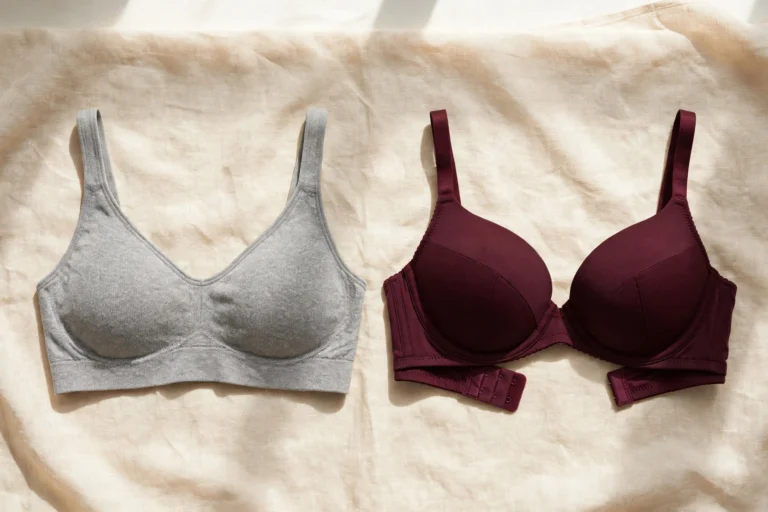
Constructions, not brands. Compression presses tissue toward the chest and suits lower impact and smaller cups. Encapsulation holds each breast in its own cup and is the default as impact and cup size climb. Hybrid designs combine both. Wirefree versus underwire is a second, separate choice. Each branch is reasoned through in the sports bra buying guide.
Checkpoint: three constructions named, zero product tabs open. If your shortlist has logos on it, you skipped this step.
Step 5: Order the bracket
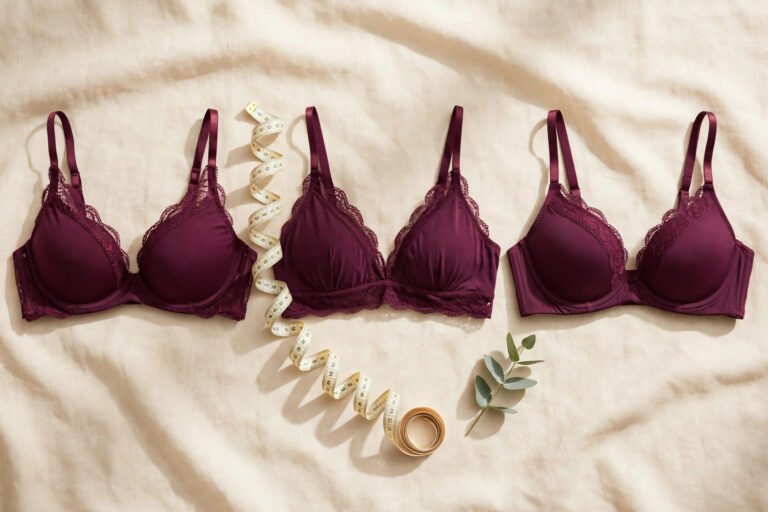
Order your starting size plus both sisters, in no more than two constructions, and keep each construction to one style, so the comparison tests sizes rather than styles. Note the returns window on the card before the box arrives; the bracket only works if returning two of the three is free and easy.
Checkpoint: one order, three sizes, two constructions at most, returns deadline written down.
Step 6: Run the fitting room protocol, in order
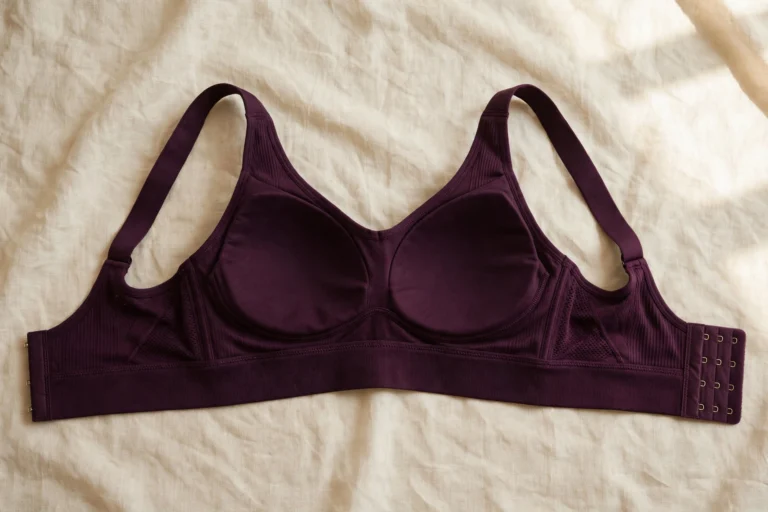
Same order every time. Fasten on the loosest hook. Scoop and swoop all tissue into the cups. Then the five checks, in fitter order: band level and snug, cups contained with no spillage or gaping, straps secure without digging, movement (jog in place for 20 to 30 seconds, reach overhead, twist, bend), and time (ten minutes of wear before you judge). The full routine is our guide to how a sports bra should fit.
Checkpoint: five verdicts on paper. A bra you “kind of like” has not been protocolled; it has been glanced at.
Step 7: Decide from the symptom table, not a feeling
| What the protocol showed | The verdict |
|---|---|
| Band rides up in the starting size, cups behave in the smaller band sister | Keep the sister; the size was the problem |
| Spillage in all three sizes of one construction | Change construction; the cup shape, not the letter, is wrong |
| Gaping in all three sizes | Change construction toward a shallower or compression cup |
| Movement still travels in both constructions | Step up a construction class; do not answer bounce with tighter straps |
| Pain, numbness or lingering grooves at ten minutes | Stop. Wrong size or wrong style, and no adjustment fixes it |
The ten common failures behind these rows, with their fixes in fitter order, live in sports bra fitting problems.
Checkpoint: your verdict names a row. If it names a mood, rerun step 6.
Step 8: Set the rotation and the recheck date
One bra worn daily is a bra being worn out. The keeper from step 7 becomes the pattern for a rotation of three: one on, one in the wash, one resting, because elastic needs rest between wears. Finish the size card: starting size, the size that won, the construction that won, and a recheck date six months out, or sooner on a weight change, a new training load, or the first returning sign from step 2. The rotation logic is step 7 of the sports bra buying guide.
Checkpoint: the card is complete, and the date is on it. A size without a recheck date expires silently.
Affiliate disclosure: When you buy through links in this article, we may earn a commission as an Amazon Associate at no extra cost to you. See our Affiliate Disclosure page. Prices and availability change; the cards below pull live details.


Three exemplars for the steps that need a product
Step 5, the forgiving first order: Panache Clara Full Cup Bra (7255)
A bracket order teaches you something only if one style sells all three of your sizes and forgives small errors. The Amazon listing family for the Clara, style 7255, runs deep into the UK grid, with a forgiving construction: BraForMe describes four piece unlined cups with a stretch lace top cup, an inner side sling, and powermesh wings, in 77% polyamide, 16% polyester and 7% elastane. It is an everyday bra, stated plainly: it teaches your bracket in UK letters, and the winning size then anchors the sports order in step 5’s second construction.
Pros
- Deep UK grid: your starting size and both sisters exist in the one style
- Stretch lace top cup forgives asymmetry and small volume errors
- Unlined seamed cups hide nothing, so the bracket verdict is honest
Cons
- UK sizing: translate your US bracket into UK letters before ordering
- An everyday bra, not a training bra; it proves the size, it does not run in it
- Lace texture can show under thin tops
| Key Specs | Detail |
|---|---|
| Support | Everyday underwire support; not impact rated |
| Size range | UK bands 30 to 40, cups D to J (core range; some listing variants run wider) |
| Closure | Hook and eye |
| Construction | Four part unlined underwire cups, stretch lace top cup, inner side sling, powermesh wings |
| Adjustability | Adjustable straps; hook and eye band |
Step 6, the protocol bra: SYROKAN Underwire Cross Back Sports Bra (A262)
The protocol needs hardware to check: hooks to start loose, a fixed cup shape to read, straps that stay put through the movement test. The Amazon listing for SYROKAN style A262 specifies molded underwire cups, a hook and eye closure, cross back straps, and a high support label, with a body of 92% polyester and 8% elastane over a polyester lining. Run the five checks on it in order: the band either stays level or it does not, and the molded cup either contains after the scoop or it spills.
Pros
- A true structured sports bra in band and cup sizes, built for the protocol
- Molded cups make spillage and gaping easy to read at check two
- Cross back straps stay off the shoulder edges during the movement check
Cons
- A fixed molded cup shape is less forgiving of asymmetry than an unlined cup
- Hand wash only
- Full size grid endpoints not stated in the listing data
| Key Specs | Detail |
|---|---|
| Support | High support (brand label) |
| Size range | Band and cup sizes; full grid endpoints to confirm in the catalog |
| Closure | Hook and eye |
| Construction | Molded underwire cups, cross back straps; body 92% polyester and 8% elastane, lining 100% polyester |
| Adjustability | Hook and eye band; strap sliders not confirmed in the listing data |
Step 8, the rotation workhorse: Fruit of the Loom Spaghetti Strap Cotton Pullover Sports Bra (9036)
A rotation is easier to keep when one value pack fills it instead of three separate orders. The Amazon listing for Fruit of the Loom style 9036 specifies a pull on, wire free cotton rich bra with spaghetti straps, a 2 ply front, a fabric covered elastic band, and a light support label, sold in multi packs across band sizes 32 to 48. Its job in the rotation is the honest one: easy days and rest days, while your structured keeper recovers between hard sessions. Light support is a real ceiling; this pack fills the rotation, it does not replace the bra that passed step 6.
Pros
- Multi packs build a three bra rotation in a single order
- Band number sizing runs 32 to 48, wider than most value packs
- No hardware anywhere: nothing to dig, poke or set wrong
Cons
- Light support only; not the answer for running or larger cup impact
- Cotton rich fabric dries slowly once a session turns sweaty
- Band numbers without cup letters average the fit; some bodies land between sizes
| Key Specs | Detail |
|---|---|
| Support | Light (listing label) |
| Size range | Band sizes 32 to 48; the listing chart maps each band to cups A to DDD |
| Closure | Pull on |
| Construction | Wirefree compression, 2 ply front, spaghetti straps, fabric covered elastic band; cotton rich (percentages conflict across listing families, so none are printed) |
| Adjustability | None |
Common questions
How long does the whole path take?
About an hour at home, plus delivery time for the bracket order. Steps 1 to 4 take twenty minutes; the protocol takes fifteen per bra once the box arrives.
What if my bracket straddles two constructions and both feel wrong?
Trust the symptom table in step 7 over persistence. Three sizes failing in two constructions is information: the job target from step 3 is usually the thing to revisit, because impact was understated.
Can I run the path again when my size changes?
That is what the recheck date is for. Start at step 1, keep the card, and let the new bracket replace the old one.
The bottom line
The path is the product. Measure and write three sizes, audit the drawer, name the job, shortlist constructions, order the bracket, run the protocol, decide from the table, and set the rotation with a recheck date. Eight checkpoints, one sitting, and a size you proved instead of a size you were sold.