Search for a shock absorber classic sports bra in the US and you will meet the same bra three times without being told. It is listed as the N109 by the brand itself, as the SN109 under Champion, and under Champion’s model number U10035, and almost no listing explains that all three codes describe one design: the Active D+ Classic, the wirefree big bust staple in Shock Absorber’s range for decades.
This is a research based review. We have not hands-on tested the D+ Classic. The design facts come from the brand’s own pages and Champion’s manufacturer data; the fit behaviour comes from a specialist fitting retailer and a long-running fit database, each cited at its own strength. Where sources disagree, and on this bra they do, the disagreement is printed rather than smoothed over.
Affiliate disclosure: Stellaleah is reader supported. As an Amazon Associate I earn from qualifying purchases, at no extra cost to you. This review carries no product card of its own by design: the D+ Classic is carded exactly once on this site, in our large bust construction guide, and that is where its Amazon link lives. Our full Affiliate Disclosure explains how the site earns.
What the Shock Absorber Classic Sports Bra is
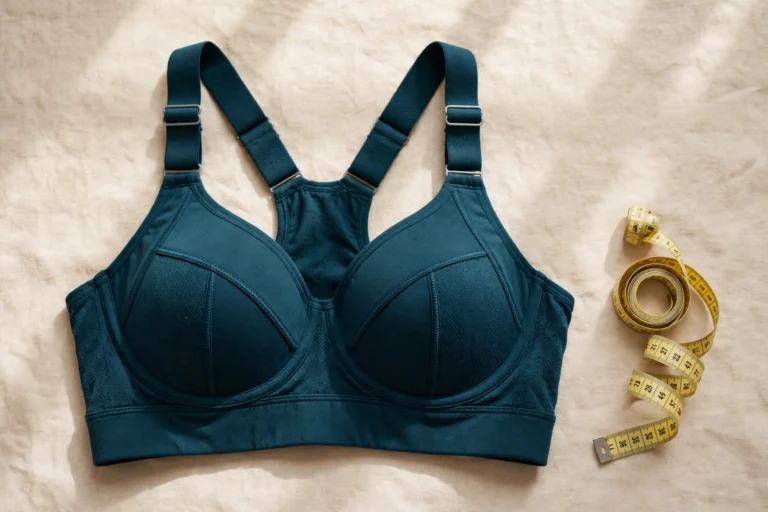
The D+ Classic is a wirefree, high coverage sports bra built for D cups and above, and its whole design argues that a big bust does not need a wire to be held firmly. There is no moulding, no padding and no racerback hardware. What you get instead is firm fabric, a tall front, divided cups and a proper hook and eye back, closer to a traditional bra than to a stretchy crop top.
It sits at the top of the brand’s support ladder. Champion’s manufacturer chart rates its bounce control Extreme, the same bra sold in Australia as a Berlei collaboration carries Support Factor 4, the top step of that scale, and specialist fitter She Science files it plainly as high impact support. Three labelling systems, one message: this is the brand’s serious end. Our Shock Absorber brand guide maps where it sits against the rest of the range.
The design, piece by piece
The cups are divided, and that is the whole trick. Most wirefree compression bras are a single panel that presses the bust flat as one mass. The D+ Classic is cut and sewn into two separate cups, so each breast sits in its own compartment. Champion’s manufacturer notes describe an encapsulation cut and sew construction with taped inner seams, a laminated high centre front and a semi-rigid inner sling. Specialist retailers classify the bra as compression led, and that is the honest label: the divided cups borrow encapsulation’s shape, but the hold itself is firmness and coverage.
The front is high, deliberately. Compression fails at the top edge first, as tissue escapes upward on impact; the Classic’s tall centre front and full coverage are the countermeasure. There is no neckline engineering here to admire; the coverage is the engineering.
The back closes like a normal bra. A wide hook and eye fastening (three hooks and three columns on the grid BraStop publishes) means no over-the-head wrestling and no double closure system. In a bra this firm, that is a genuine usability feature, not a detail.
The straps are wide, cushioned and adjustable. She Science lists wide, soft, non-slip straps with sliders that tune the length. BraStop describes them as semi adjustable, meaning the slider does not run the full strap length, so petite and tall frames alike have less travel to work with.
The fabric is a firm polyamide blend: 57% polyamide, 39% polyester, 4% elastane on Champion’s chart, with a moisture management finish. Four percent elastane is a low stretch recipe: the fabric holds its shape because it barely gives, and the sizing below follows from that.
Where the Classic comes from
The brand behind it was built on lab work before lab work was fashionable. Shock Absorber tells its own story plainly: research at Edinburgh University in 1994 prompted the original bra, and the brand launched in 1995 with a collection built to different impact levels and cups up to a G, endorsed by Olympic hurdler Sally Gunnell.
In 2005 the brand commissioned 3D breast movement research at the University of Portsmouth, led by Dr Joanna Scurr’s team, and states that every new style since has been tested at Portsmouth. It is inside that programme that Champion publishes the Classic’s headline figure: up to 80.1% bounce reduction, the highest number in Champion’s own comparison chart. Treat that as what it is, a brand figure from the brand’s own testing, not an independent measurement and not ours.
The Classic’s own launch date is not something the brand’s published history pins down, and we are not going to invent one. What the record does show is endurance. She Science says the style has consistently been one of its best selling bras, a fitter staple for wearers who used to double up two bras for the same firm hold, and the fit database at Bratabase holds years of wearer reports on the N109. Styles that disappoint do not accumulate a decade of fit data.
One piece of housekeeping explains the name confusion: Shock Absorber and Champion are both Hanesbrands brands, which is why Champion sells the bra in some markets and Australia gets it as a Berlei collaboration. Same owner, same design, different badges.
Sizing, and the three name trap
The trap first, because it costs US shoppers real money. N109, SN109 and U10035 are one bra. N109 is the brand’s own style code, SN109 is Champion’s style code for the same design, and U10035 is Champion’s model number for it. Shoppers routinely compare it against itself without knowing, or scroll straight past the US listing because it wears its Champion name.
The grid is the second trap, because there is no single grid. Champion’s current manufacturer chart lists the SN109 at UK bands 30 to 40, cups D to G. The Amazon US listing carded in our construction guide runs bands 30 to 38 with cups to an H, GG only in some bands. Neither chart is fake; they are different markets and production runs of the same design. Order from the grid attached to the exact listing in front of you, in UK sizing, because every version of this bra uses the UK system.
Fit behaviour is consistent even when the charts are not. Champion’s own manual guidance for the U10035 warns that the material has minimal stretch and suggests trying one or two cup sizes larger if the fit feels excessively tight. Bratabase wearer reports repeat the pattern at individual strength: the N109 runs small in both band and cup, with high sides that cut in on some shapes and a centre that does not sit flat, expected on a wirefree design rather than a fault. Between sizes, start from the larger cup and let the hook and eye columns fine tune the band. Our impact levels guide covers why firm reads differently at high impact.
US availability is the honest limitation. The Classic is a UK staple and a patchier US proposition: it surfaces mainly through the Champion listing on Amazon and import retailers, stock thins at the grid’s edges, and it may wear a Champion badge rather than the name you searched for. If your size is gone this month, that is distribution, not discontinuation; the style remains a current brand line.
Key specs
| Field | Shock Absorber Active D+ Classic (N109 / SN109 / U10035) |
|---|---|
| Support | High impact; bounce control rated Extreme in Champion’s manufacturer chart |
| Size range | UK sizing throughout. Champion chart: bands 30 to 40, cups D to G. Amazon US listing grid: bands 30 to 38, cups D to H, GG in some bands |
| Closure | Back hook and eye, three hooks and three columns (BraStop) |
| Construction | Wirefree, non-padded, compression led; two separate cut and sewn cups, semi-rigid inner sling, laminated high centre front |
| Adjustability | Adjustable cushioned straps (semi adjustable per BraStop) and a multi-column hook and eye back |
Pros
- Wirefree support that genuinely reaches high impact, a short list at D cups and above
- Divided cups keep a separated shape instead of a single flattened shelf
- A normal hook and eye back, so a very firm bra stays easy to get on and off
- Decades of fit data and fitter reports behind it
Cons
- Runs small and firm, with minimal stretch, so first orders often need a cup size experiment
- The grid changes by market and listing, and the three style codes make comparison shopping harder than it should be
- US stock is patchy, especially at the edges of the size range
- The high, plain front is coverage first; there is no lower neckline option
Who should skip it
Skip the Classic if you want racerback freedom of movement for overhead and racket work: the traditional straps and high sides are built for containment, not range. Skip it if you are below a D cup, where simpler compression crops already do the job. Skip it if a flattened, held-down feel is your hard no: fitters report wearers describing their bust as all but disappeared in it, and that compression character is the product, not a sizing error you can adjust away. And skip it, for now, if your size sits at the wide band, deep cup corner and no US listing stocks it; a bra you cannot buy in your size is a research project, not a purchase.
Verdict
The D+ Classic is the default for one specific job, and it has held that job for a very long time: the firmest wirefree hold a larger cup shopper can buy. Its support credentials come out of a university lab programme the brand still runs, and its flaws are the honest kind: a tight first fit, a shifting size grid, thin US distribution. If you run or train at a larger cup size and wires are off the table, this is still the bra newer designs get measured against. Its card lives in our guide to sports bra types for large busts, by construction.
Common questions
Is the Shock Absorber N109 the same bra as the Champion SN109? Yes. Same Active D+ Classic design under two style codes, with Champion model number U10035. Compare prices and size grids between listings if you like, but do not compare the bras, because there is only one.
Does the D+ Classic run small? By most accounts, yes. Champion’s own guidance notes the fabric’s minimal stretch and suggests a larger cup if it feels excessively tight, and years of wearer reports describe it as small in band and cup. Treat your first order as a fitting, not a final answer.
Is it really suitable for running? That is the job it was built for: top of the brand’s support ladder, fitter recommended for high impact at D cups and above, with divided cups that exist because a plain compression panel was not enough at these sizes. The runners who dislike it dislike the compression character, not the support level.
Why is there no buy card in this review? Because the site cards each product once. The D+ Classic is already carded in our large bust construction guide, linked above; this review does the job a card cannot.
The bottom line: one bra, three names, and a support record built in a lab and a fitting room over decades. Find it under whichever code your retailer uses, order in UK sizing, start a cup up if you are between sizes, and judge it on a run, not on the hanger.