The questions about exercising while breastfeeding tend to arrive all at once. Will a workout dry up my milk? Will my baby refuse the next feed? How soon is too soon? The reassuring part is that moderate exercise and breastfeeding is one of the better studied questions in this whole area, and the evidence is consistent: regular aerobic exercise improves a mother’s cardiovascular fitness without affecting milk production, composition, or infant growth, which is how the American College of Obstetricians and Gynecologists states it in Committee Opinion No. 804.
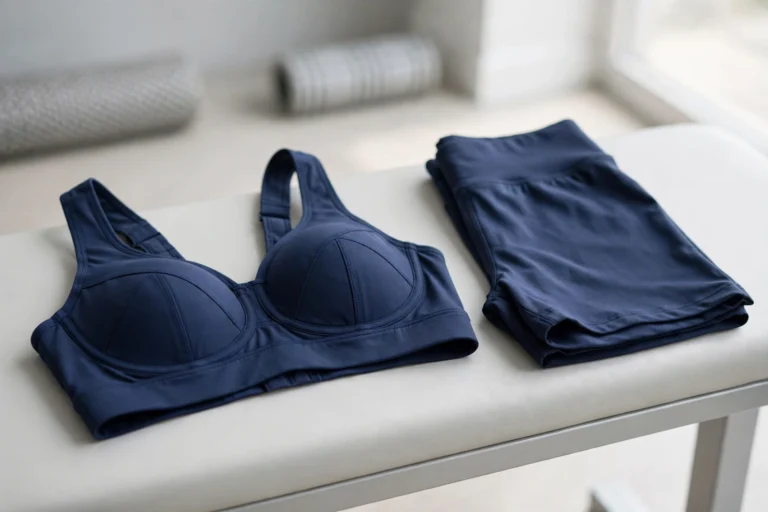
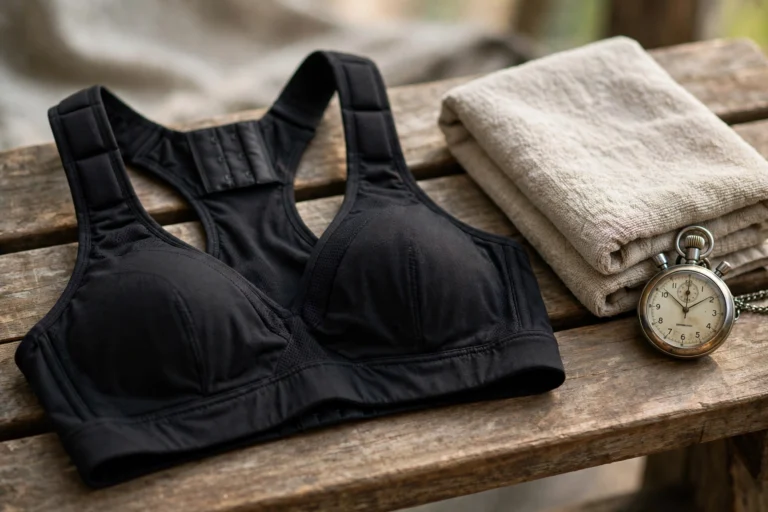
What the research does not hand you is a bra that fits. A nursing bust changes size across a single day, fuller before a feed and smaller after, and a sports bra built for a stable, pre pregnancy size was never designed for that. So this page answers the milk questions from the lactation and sports medicine sources themselves, then treats the bra problem as what it is: a fit problem, with fit solutions. Our guide to how to choose a maternity sports bra covers the earlier stage.
Will exercising while breastfeeding hurt my milk supply?
No. At moderate intensity, the studies find no effect on milk supply, milk composition, or how babies grow. The anchor evidence is a randomized trial by Dewey and colleagues, published in The New England Journal of Medicine in 1994: 33 previously sedentary, exclusively breastfeeding women exercised aerobically from 6 to 8 weeks postpartum, 45 minutes a day, 5 days a week, for 12 weeks. They got fitter, with no significant differences in milk volume, milk composition, infant weight gain, or prolactin between the groups.
The lactic acid story deserves a straight answer, because it is the claim most often repeated as fact. The research summarized by KellyMom found no noticeable rise in lactic acid in milk after exercise at 50% or 75% intensity, in women whose calorie needs were met. Lactic acid rose only after maximal, exhaustive effort, lasted up to about 90 minutes, and has no known harmful effects for the baby. The famous refusal story traces to a single 1992 study in Pediatrics by Wallace and colleagues, with a caveat the retellings drop: the babies were fed expressed milk by dropper, an unfamiliar method, and the mothers reported no previous nursing problems after exercise. Wright, Quinn and Carey (2002) later found infant acceptance of milk fed 1 hour after exercise was not impeded, even after high intensity exercise.
One more single study flag: Gregory and colleagues (1997) found IgA, one of milk’s immune factors, dipped for 10 to 30 minutes after exhaustive exercise, then normalized; Lovelady and colleagues (2003) found no such differences after moderate exercise. Brief, exhaustive only, and not a supply effect.
When can I start exercising again after birth?
That call belongs to your clinician, not to any article, including this one. What we can do is report the general published guidance accurately, framed as general. The American College of Obstetricians and Gynecologists patient guidance says that after a healthy pregnancy and a normal vaginal delivery, it is usually safe to begin a few days after birth, or as soon as you feel ready; after a cesarean birth or complications, ask your ob-gyn when to start. Its general shape is gradual: 20 to 30 minutes a day, simple postpartum exercises first, and stop if something hurts. La Leche League International offers its own practical framing: wait until your baby is at least 6 weeks old, expect a cesarean recovery to run 6 to 8 weeks, talk to your healthcare provider first, and start slowly. The two do not contradict each other: one describes when gentle activity can resume after an uncomplicated birth, the other a sensible runway back to real workouts. Your delivery, your recovery, and your clinician’s knowledge of both outrank any general timeline.
Should I feed or pump before I exercise?
Yes, if you can, and the reason is your comfort, not your milk. ACOG advises feeding before exercising to avoid the discomfort of engorged breasts, and La Leche League Canada gives the same tip: feed your baby before exercise if your breasts feel full. Feeding first is also the cheapest support upgrade available, and La Leche League International pairs it with the obvious partner point: a supportive sports bra for comfort. Pumping does the same job if your baby is not due a feed.
Feeding first does not protect your supply; the studies above found nothing to protect it from. It simply starts you at your smallest size of the day, which matters for the fit question next.
What support does a size that changes across the day actually need?
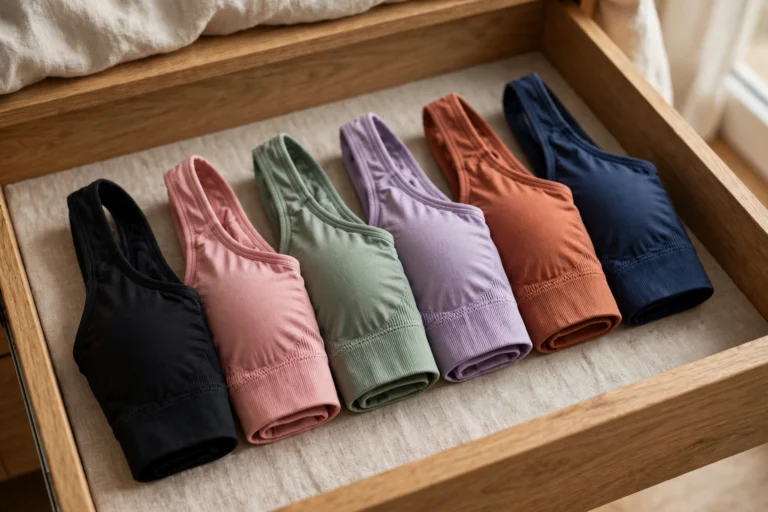
Fit the bra to your fullest point, then demand adjustability everywhere else. A nursing bust can shift by a cup size or more between feeds, so a bra fitted to your emptiest moment will compress at your fullest, and one fitted to your fullest will move around after a feed unless its straps and band can be taken in. The features that solve this are unglamorous and specific: fully adjustable straps, a hook and eye band with several rows of settings, and cups that hold their shape across the swing. Sweat and Milk, a nursing sports bra specialist, makes the same point in its fit guidance: most women fit between sizes as supply fluctuates during the day, and its high impact styles use an adjustable band so support stays consistent as the chest changes.
This is also why a pre pregnancy high impact bra so often fails now: fitted to a stable bust, a fixed band or short hook row, one assumed cup volume, and no nursing access at all. That is not a quality failure; it is a design brief from a different stage. Our Cadenshae sports bra guide looks at one nursing specialist in depth, and the three picks below were chosen for three specific jobs: adjustability, fast clips, and fuller bust coverage.
Do tight bras matter while breastfeeding?
Fit and comfort matter; beyond that, the honest answer is narrower than the internet version. KellyMom, the lactation resource run by an IBCLC, lists pressure on the breast, from fingers, a tight bra or clothing, or a bag strap, among the usual causes of a plugged duct, and its care guidance during a plugged duct or mastitis episode is a well fitting, non restrictive bra, since tight bras and underwires pressing on the area can worsen symptoms. That is a comfort and fit point from a named lactation source. It is not a diagnosis, and no bra prevents or treats a blocked duct.
So the working rule is simple: firm, never painful, and off after the workout rather than lived in. The rest belongs to clinicians and lactation consultants. One routing line, stated once: a fever, a hard and painful red area on the breast, or flu like symptoms mean contact your clinician promptly rather than wait, because that picture can mean mastitis, and Academy of Breastfeeding Medicine guidance quoted by KellyMom says that if symptoms are not improving within 12 to 24 hours, or you feel acutely ill, you need clinical care.
What about sweat, taste, and feeding straight after a workout?
Rinse or shower first if you can; the salt on your skin is the likelier culprit, not your milk. Both La Leche League Canada and KellyMom note that some babies fuss at the salty taste of sweat on the breast, and that a quick rinse of the chest before nursing solves it. As covered above, milk itself only picks up measurable lactic acid after exhaustive effort, and babies in the follow up research accepted milk an hour after even high intensity exercise.
If your baby does seem fussy after a genuinely hard session, KellyMom’s practical options are to express a little milk first, about 3 to 5 mL from each side, wait around 30 minutes, or ease the intensity down. Comfort tactics from a lactation source, not rules; most mothers in the studies simply fed as usual.
How much water and food do I need?
Drink to replace what you sweat, and eat enough to meet your needs; that is the level the reputable guidance actually states. La Leche League International advises replacing the fluids lost through sweating, and ACOG pairs its exercise guidance with adequate hydration. On food, the careful point comes from the research itself: the studies that found no lactic acid rise and no supply effect, including the work by Quinn and Carey, were run in women whose caloric needs were met. Exercising on top of under eating is a different, untested question. This page offers no diet advice and no numbers to chase; eat to appetite, drink to thirst and then some on workout days, and raise anything more specific with your clinician.
Affiliate disclosure: Stellaleah is a participant in the Amazon Services LLC Associates Program. Buying through links on this page may earn us a commission, at no extra cost to you. Full affiliate disclosure.


Sweat and Milk Chloé 3 Running Nursing Sports Bra: the fluctuating size pick
The Chloé 3 earns its place on one number: a 6 row adjustable closure, the widest band adjustment we found in a nursing sports bra. Its Amazon listing describes a bra built for B to H cups and medium to high impact activity, with one handed nursing access and laser cut ventilation. Sweat and Milk explains the logic on its high impact pages: support has to stay consistent even as your chest changes throughout the day, and an adjustable hook and eye band is how its running styles do it. Fit it at your fullest, on a middle row, and you have room to move both ways.
Pros
- 6 rows of band adjustment, the most of any pick here
- One handed nursing clips, so feeding first takes seconds
- B to H cups covers most nursing size swings
Cons
- Strap adjustability not stated, so the band does all the adjusting
- Alpha sizing is band led, so measure before ordering
| Item | Detail |
|---|---|
| Support | Medium to high impact |
| Size range | B to H cups |
| Closure | 6 row adjustable hook and eye (listing title) |
| Construction | Wirefree, medium to high coverage, laser cut ventilation |
| Adjustability | 6 row band; straps not stated |
| (All rows per the Amazon listing.) |
Sweat and Milk Maeve Run Times: the feed before you go pick
The Maeve’s Amazon listing title leads with exactly what the pre workout feed needs: sewn in cups, easy one handed nursing, and adjustable shoulder straps, in a nursing and pumping sports bra from the Sweat and Milk running line. Sewn in cups stay put through the clip down, the feed, and the clip back up, and the straps let you reset the fit to your post feed size before you head out. Its full spec grid was not published in the listing data we captured, so the table below stays at listing level.
Pros
- Sewn in cups mean no pads to reposition after a feed
- Adjustable straps for the post feed refit
Cons
- Support level not stated in the captured listing, so treat it as a low to medium impact pick until confirmed
- Sewn in cups cannot be removed if you prefer a pad free feel
| Item | Detail |
|---|---|
| Support | Not stated in the captured listing |
| Size range | Alpha sizes (a Large variant is evidenced) |
| Closure | Not stated in the captured listing |
| Construction | Sewn in cups; nursing and pumping access |
| Adjustability | Adjustable shoulder straps |
| (All rows per the Amazon listing title; the brand sells Maeve in its running line.) |
Motherhood Maternity Full Busted Seamless Clip Down Nursing Bra: the fuller bust pick
Fuller busts are usually handed a scaled up version of a smaller bra. This one is a separate cut: the Full Busted version of style 99162, which the Amazon listing describes as covering D cups and beyond, in sizes S to 3X, with medium support, adjustable straps, clip down cups, a hook and eye closure, and removable pads. Honesty about its job matters: the listing positions it for everyday wear, and medium support means walks, gentle return to exercise weeks, and low impact work, not running. For a fuller bust in the early weeks, a seamless wirefree bra that genuinely fits beats a high impact bra that does not. When you are cleared for more, the Chloé 3 is the step up.
Pros
- A dedicated Full Busted cut, not a stretched average pattern
- Clip down cups and adjustable straps for feed first workouts
Cons
- Medium support caps it at low impact activity
- Seamless knit gives comfort compression, not encapsulation
- Fabric blend differs between variants, so check your colorway
| Item | Detail |
|---|---|
| Support | Medium support; low impact and daily wear |
| Size range | S to 3X; Full Busted for D cups and beyond |
| Closure | Hook and eye back closure |
| Construction | Seamless knit, wirefree, full coverage, removable pads |
| Adjustability | Adjustable straps; clip down cups |
| (All rows per the Amazon listing.) |
The bottom line
The evidence says moderate exercise does not reduce your milk supply, change your milk in ways that matter, or slow your baby’s growth; the lactic acid warning survives only at exhaustive effort, briefly, and with no known harm. Timing is your clinician’s call, feeding first is a comfort move, sweat is a rinse problem, and food and water are a meet your needs instruction, not a diet. The part you control completely is the bra: fit it at your fullest, buy adjustability, and match the support to the workout you are actually cleared for. When you rebuild the rest of the kit around it, our maternity activewear guide covers leggings and nursing access layers by stage.