

A maternity sports bra is not a bigger version of the bra you already own. It is a bra bought for a body whose band size, cup volume and sensitivity are all moving at once. Buy for the trimester you are in, start the band on its tightest hooks, and let the adjustment built into the bra do the forward planning.
One boundary before the fit advice: what exercise is appropriate during your pregnancy is a question for your obstetrician or midwife, not for a bra guide. This article covers fit, comfort and buying timing only. If you notice pain that does not settle, a lump, redness or any skin change, raise it with your clinician rather than through bra fit.
The short answer
If you only take three rules from this guide, take these. Band first: your ribcage expands as pregnancy progresses, so the band runs out of room before the cups do, and band adjustment is where your money should go. Hooks start tight: a maternity purchase should fit snugly on the tightest column so you can let it out as you grow; a nursing bra bought late needs the opposite room, columns to tighten as your ribcage settles after birth. Support follows the activity: as your training changes across the trimesters, match the bra to the session. Our guide to sports bra impact levels explains how impact labels work.
What changes in each trimester, and what it means for a maternity sports bra
The pattern most fitting guides agree on, including the fitting guidance from Cake Maternity and Hotmilk Lingerie, is that cup change and band change do not arrive together. Cups usually move first; the band follows as the ribcage expands; after birth, the band needs to come back in while cup volume fluctuates through the day if you are nursing.
| Stage | What changes | The bra response |
|---|---|---|
| First trimester (weeks 1 to 12) | Sensitivity and tenderness are common, and cup volume often grows before anything else changes | Soft, wirefree cups with stretch and no rigid seams against the skin; buy only when your current bra starts to dig or spill |
| Second trimester (weeks 13 to 27) | The ribcage expands, so the band feels tight even when the cups still fit | Work the hook columns outward before you replace the bra; an extender bridges the gap; wide, adjustable straps earn their place here |
| Third trimester (week 28 to birth) | Band at its widest for most women, cup volume at or near its peak | Buy with columns left to tighten after birth, not just room to grow; if you plan to nurse, this purchase should carry nursing access |
| After birth (nursing months) | Ribcage gradually settles back; cup volume rises and falls across the day around feeds | Tighten the band back in column by column; a stretch cup absorbs the daily fluctuation better than a rigid moulded cup |
Individual timing varies a lot. The table is a sequence, not a schedule, so buy against what your current bra tells you, not the calendar.
The features that earn their place
Wide, adjustable straps. As cup volume grows, strap load grows with it. A wider strap spreads that load over more shoulder, and adjustment lets you rebalance as your body changes.
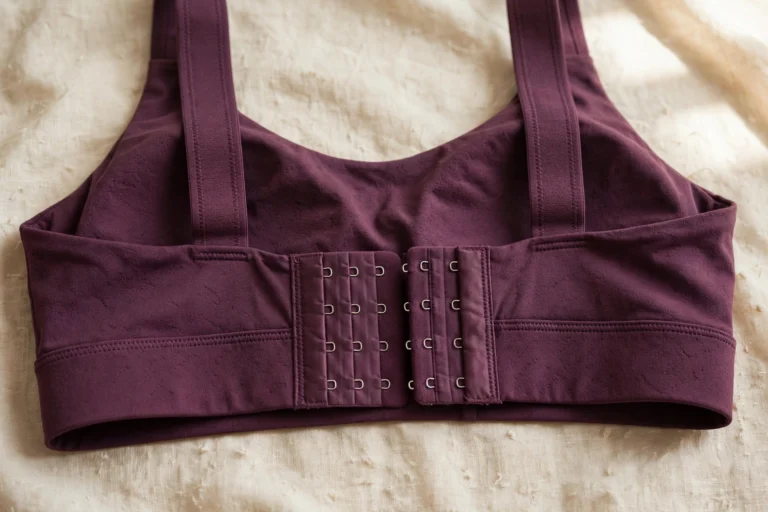
More hook columns than you think you need. A standard sports bra often fastens with three columns. Maternity designs commonly offer five or six; Cake Maternity rates the five options on its Zest sports bra as expanding or contracting the band by up to half a size.
Wirefree versus flexible wire is a comfort choice, not a rule. Some women want wirefree softness against sensitive tissue; others want the separation of a wire once cup volume is larger. Flexible wire, used by Cake Maternity and Hotmilk Lingerie in their sports styles, bends with the body instead of holding a rigid curve. What matters is that nothing digs or leaves a mark that lingers.
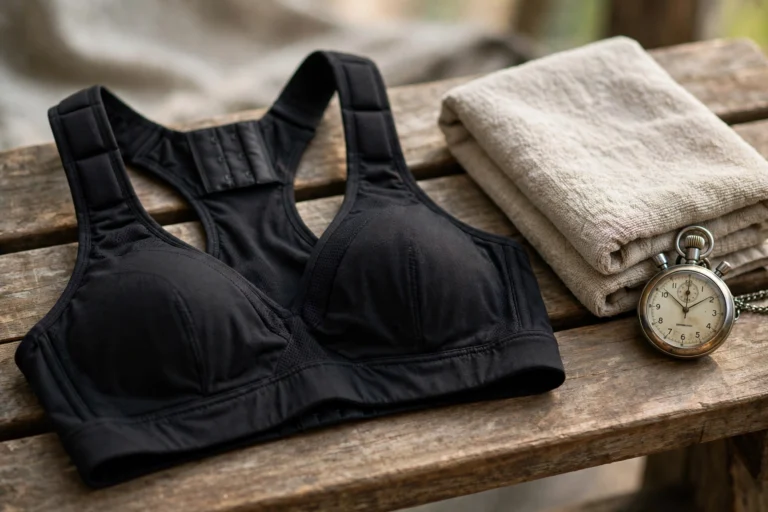
A racerback conversion option. A clip or J-hook converts straight straps to a racerback, changing shoulder pressure and adding security for higher movement sessions.
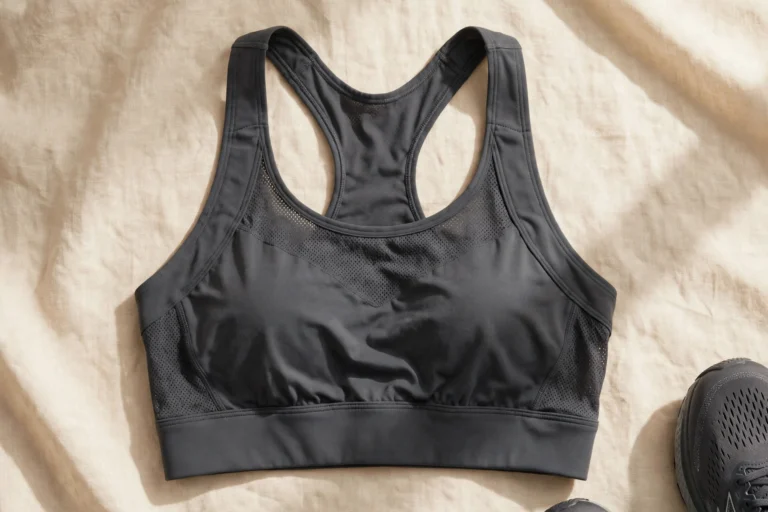
Breathable, moisture-moving fabric. Warmer skin and heavier sweating are ordinary in pregnancy; spacer fabric, mesh panels and moisture-wicking knits beat heavy padding.
Band first: the extender math
Here is the arithmetic competitors rarely spell out. A new everyday bra is fitted on its loosest hooks, because elastic relaxes with wear. Pregnancy reverses the direction of travel: fit a maternity bra on its tightest columns, and spend the remaining columns as your ribcage expands. Start a five column bra on the first column and four steps of band growth are already paid for.
When the columns run out, an extender is the bridge, not a failure. A separate extender typically adds up to about 2 inches of band length, often enough for the last weeks. Our bra band extender guide covers when an extender is the right tool and when it hides a size problem. After birth the hardware runs in reverse: you walk the hooks back in as your ribcage settles, so judge a late purchase on columns in both directions.
Fit checks for a changing body
Run these each time you try a maternity sports bra, and re-run them at the start of each trimester:
- Band: fastened on the tightest columns during pregnancy, it sits level and firm; two fingers slide under it, a fist does not.
- Cups: no spilling at the top or sides after you scoop tissue into the cup, and no empty fabric wrinkling either.
- Straps: they stay put when you raise your arms, without leaving grooves that linger.
- Centre front: on a structured style it sits close to the chest; on a soft style, check the band under the cups is doing the anchoring.
- Movement test: walk, reach, twist and take ten brisk steps in place. The bra should not need readjusting afterwards.
- Skin check: after ten minutes, look for marks. Faint elastic lines are normal; painful or persistent marks mean the size or style is wrong now.
Clips or pull aside: the nursing access decision
Buying in the third trimester and planning to breastfeed? One bra should open for nursing, so it works on both sides of the birth.
Drop-down clips are the structured option: a clasp at the top of each cup releases the cup while a sling or frame keeps the bra’s shape and support in place. Clips work one-handed, which matters when the other arm holds a baby.
Pull-aside access is the simpler option: stretch cups with a crossover or low neckline that you move aside by hand. No hardware to learn, but a pull-aside cup offers less structure, so it pairs with lower impact activity.
If nursing-specific sports design is your priority, our Cadenshae guide covers a nursing sports range sold direct only, useful context for what the specialist labels build in.
When to buy, and how many
Buy the first maternity sports bra when your current one fails the fit checks, not at a set week. For most women the first failure is cup spillage in the first trimester or band tightness in the second. Two to three bras in rotation is the working number: one on, one in the wash, one ready. Hotmilk Lingerie advises the same shape of plan for nursing bras: start with two to three before the baby arrives, then add more once your size has settled, which they put at around 6 to 8 weeks after birth.
This guide is based on published manufacturer specifications and brand fitting guidance, checked in October 2026. We did not test these bras. As an Amazon Associate, Stellaleah earns from qualifying purchases made through links on this page; see our affiliate disclosure for how that works.


The trimester workhorse: Kindred Bravely Sublime Nursing Sports Bra
Kindred Bravely built this seamless racerback for low impact movement across pregnancy and nursing, and its sizing system is why it leads this guide. Instead of band and cup sizes, it uses alpha sizes in three cup ranges: Regular for B to D cups, Busty for E to I cups, with Super Busty options in the range. One alpha size spans several band and cup combinations, which is forgiving when your measurements move every few weeks. The cups clip down one-handed for nursing, and the light padding is removable. The honest limit is support level: the brand positions it for low impact activity such as walking and prenatal yoga, so treat it as the everyday and gentle session bra, not the run bra.
Pros
- Three cup ranges inside each alpha size, so one size tolerates real measurement change
- One-hand clip-down cups make the same bra work before and after birth
- Seamless, wirefree knit suits first trimester sensitivity
Cons
- Low impact support only; not built for running or high movement training
- No band columns to grow into; the stretch does all the work
- Hand wash care, per the brand
| Key spec | Detail |
|---|---|
| Support | Low impact (brand rating) |
| Size range | Alpha sizes S to 2X in Regular (B to D cups) and Busty (E to I cups) ranges, US sizing |
| Closure | Pull-on; no back closure |
| Construction | Wirefree seamless compression knit, racerback, removable light padding |
| Adjustability | Adjustable straps; nursing clips at both cups |
The high adjustability pick: Cake Maternity Zest Nursing Sports Bra
The Cake Maternity Zest is the structured counterpoint to the soft bras around it: a band and cup sized sports bra with a flexible wire, spacer fabric cups, cotton lined A-frame slings, and drop-down clips for feeding. Its standout number is at the back: an extended band with five hook-and-eye options, which Cake Maternity describes as expanding or contracting the fit by up to half a size, so the same columns serve growth in pregnancy and tightening after birth. The trade-offs are real: a structured bra is the wrong answer on a day when tenderness is the whole story, and the listing labels sizes in UK terms with US equivalents, so check the conversion chart before you order.
Pros
- Five hook-and-eye columns give the widest band adjustment in this guide
- Flexi-wire encapsulation with spacer cups, the most structured support here
- Racerback conversion clip and drop-down nursing clips in one bra
Cons
- Brand rates it for high impact, but a rigid structure will not suit tender days
- UK sizing on the listing (34DD UK shown as 34E US); chart checking is essential
- The firmest, least forgiving fit of the three if your size is changing weekly
| Key spec | Detail |
|---|---|
| Support | High impact (brand rating) |
| Size range | Band and cup sizes; listing labels UK sizes with US equivalents (full current range not confirmed) |
| Closure | Hook and eye, five columns |
| Construction | Flexi-wire encapsulation, spacer fabric cups, cotton lined A-frame nursing slings |
| Adjustability | Hook-and-eye columns, racerback conversion clip, drop-down nursing clips |
The nursing access pick: Suekaphin Nursing Sports Bra
Suekaphin sells this seamless racerback as a true sports shape rather than a sleep bra with ambitions: full coverage cups, a hook-and-eye back closure, adjustable straps and one-hand nursing clasps, with removable padding. The knit is 92 percent nylon and 8 percent spandex, and the listing carries a high support label. Read that label with the construction in mind: a wirefree seamless bra earns its keep on low to moderate movement and all-day wear. Its real value here is a proper back closure, which gives you band adjustment the pull-on styles lack, paired with the fastest nursing access of the three.
Pros
- Hook-and-eye back closure adds band adjustment that pull-on styles cannot offer
- One-hand nursing clasps and a racerback shape built for activity, not sleep
- Removable padding and a smooth seamless finish under training tops
Cons
- Wirefree seamless construction will not match a structured bra for high movement sessions, whatever the listing label says
- Alpha sizing is less precise than band and cup sizing
- Thinner brand documentation than the two maternity specialists above
| Key spec | Detail |
|---|---|
| Support | High support (Amazon listing label); wirefree seamless design |
| Size range | Alpha sizes, S to plus sizes (US listing) |
| Closure | Hook and eye, back |
| Construction | Wirefree seamless compression knit, racerback, removable padding |
| Adjustability | Adjustable straps, hook-and-eye band, one-hand nursing clasps |
Common questions
Can I just size up in my regular sports bra?
For a few weeks, sometimes. The problem is direction: a sized-up regular bra gives you a bigger cup on a band with the usual three columns, while pregnancy needs band growth first. Once you are on the last column, a maternity design fits better than another size of the wrong tool.
Do I need a different bra for each trimester?
Not necessarily. A stretchy alpha sized bra bought early can span a long stretch, and a column-rich bra bought in the second trimester can reach the birth. Plan on two purchase moments: an early forgiving bra, and a late, structured or nursing-capable bra.
When should I buy nursing sports bras for after the birth?
Late in the third trimester, in a style with columns to tighten and cups with some stretch or margin. Then reassess once your size has steadied, which Hotmilk Lingerie puts at around 6 to 8 weeks after birth, before buying more.
The bottom line
Choosing a maternity sports bra is mostly a timing exercise. Buy soft and forgiving when sensitivity and cup growth arrive first, spend your second purchase on band adjustment as your ribcage expands, and make the late purchase the one with nursing access and columns that run in both directions. Two or three bras, fitted at each stage, will carry you through.

2 Comments