
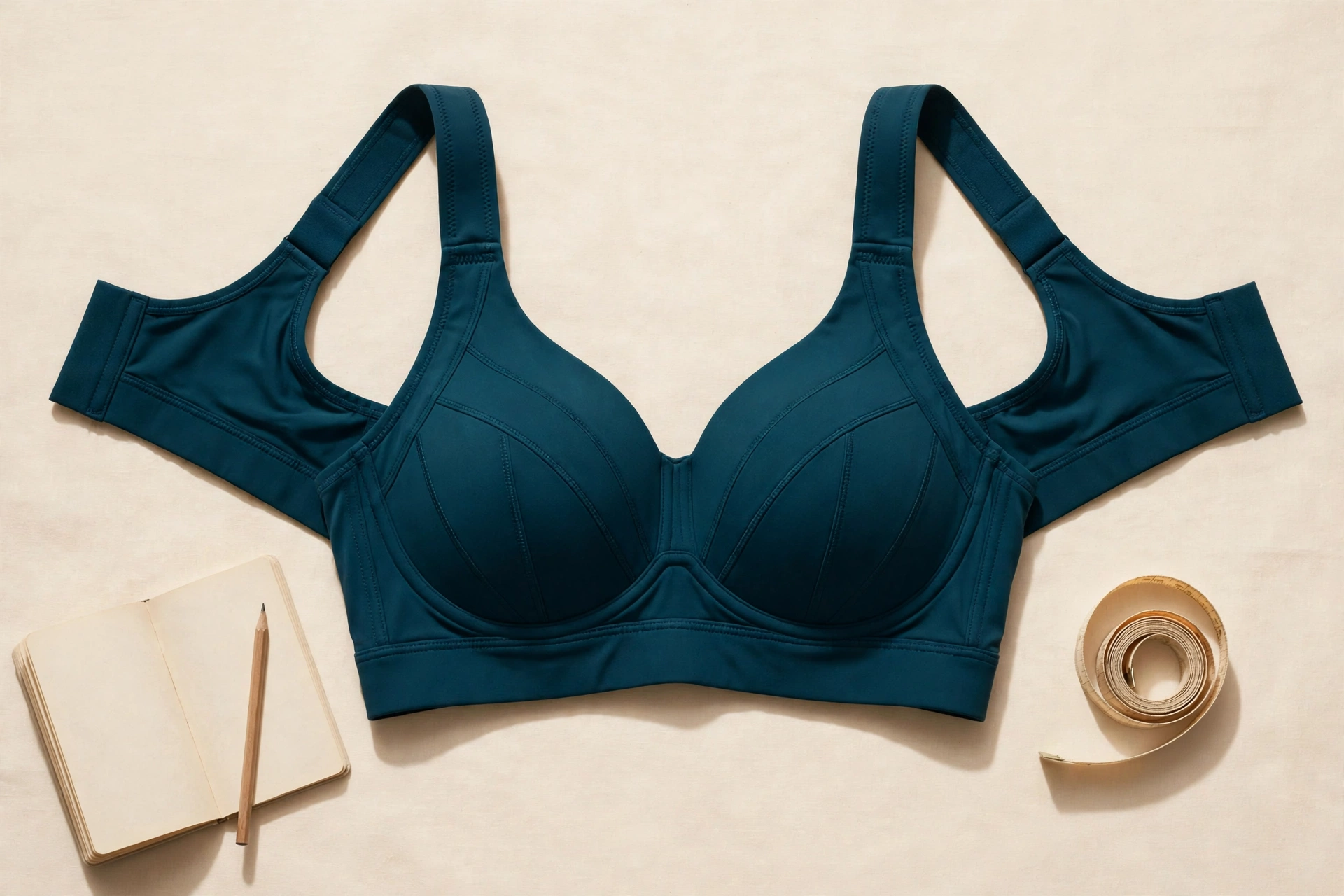
If you plan workouts around bounce or soreness, exercising with a larger bust can feel like a negotiation before it feels like exercise. The research says the problem is mechanical, not a fitness flaw: unsupported breasts move in three directions at once, movement closely linked to pain, and the right construction and fit can cut it dramatically. This guide translates the Portsmouth lab work into choices a DD+ reader can use. It is research-based: published studies and manufacturer specifications, not hands-on testing.
Breasts move in three directions, not one
The first thing the Portsmouth team established is that “bounce” is the wrong word. Tracking reflective markers in three dimensions, they found breasts trace a figure of eight as you run: roughly half the movement is vertical, a quarter side to side, and a quarter front to back, as Portsmouth researcher Michelle Norris explained to Health Daily News. A 2010 study by Joanna Scurr and colleagues, indexed on PubMed, confirmed considerable movement in all three planes and found that breast velocity, how fast the breast moves, had the strongest relationship with comfort.
The distances are not trivial: the group reports an unsupported breast can move up to 15 cm during running, per Hippocratic Post, and earlier treadmill testing recorded swings of up to 21 cm (Athletics Weekly). Breasts contain no muscle, so the load falls on skin and the Cooper’s ligaments. Slowing down is no workaround, either: breasts move about as much during a slow jog as at maximum sprint speed.
Why exercising with a larger bust can hurt
Pain scales with cup size. A survey of almost 1,300 London Marathon runners, published in the British Journal of Sports Medicine and summarised by ScienceDaily, found 32 percent reported breast pain: half of runners wearing an F cup or larger, against one in four A-cup runners, with 64 percent of those in pain feeling it during vigorous exercise. Half also linked pain to the menstrual cycle, so exercise is one trigger among several. Beyond runners, more than half of women experience exercise-related breast pain at some point, per the Portsmouth group via Hippocratic Post.
Pain does not just hurt. It changes what women do
- In the marathon survey, 17 percent said pain affected their ability to exercise, more than a quarter of those with pain had cut training intensity, and a fifth had missed a session (ScienceDaily).
- Among elite British athletes preparing for Tokyo, 17 percent said breast movement or bra fit had hurt performance, over 50 percent had experienced breast pain, and three-quarters had never been professionally fitted (Hippocratic Post).
- The barrier starts young: Portsmouth research found breasts were a barrier to exercise for 46 percent of schoolgirls, and in 2020 group research 65.6 percent of US participants had never used a professional fitting service, per WTIN.
The takeaway: for many women, the barrier is a support problem wearing a motivation costume.
Support changes your stride and your muscle effort, not only the bounce
In Portsmouth doctoral research on five-kilometre treadmill runs, archived in the University of Portsmouth research repository, a high-support bra reduced breast movement by up to 75 percent versus low support and significantly reduced breast pain. In low support, runners showed a shorter step length, more trunk flexion and more arm swing; high support kept a profile closer to economical form. Peak upper-body muscle activity fell too, by 37 percent in the pectoralis major and 26 to 30 percent in the deltoids, as if the body stopped bracing once the bra did the work. Reporting on this program puts the stride loss at up to 4 cm per step, roughly an extra mile across a marathon (Women’s Running).
Other labs agree: a Frontiers study covered by MedicalXpress found knee joint stiffness changed with support level, and its authors argue bras are sports equipment, not apparel. One caveat: movement increased across the five kilometres in both conditions, so fit and fabric condition matter, not just the label.
| What the lab found | What it means for your choice |
|---|---|
| Movement is three-directional, tracing a figure of eight | Choose cups that control side-to-side and forward motion, not only vertical bounce |
| Comfort tracks breast velocity most closely | Firm band and structured cups that stop movement quickly beat a soft, stretchy hold |
| Pain rises steeply with cup size | At DD and above, high support is the default for running and HIIT, even at an easy pace |
| Low support shortened stride and raised upper-body muscle effort | Support is performance equipment, not a comfort extra |
Turning the science into support choices
- Start from a measured size, not a remembered one. Our measurement guide covers the two measurements; the bra size calculator turns them into a starting size. Cups fit but band wrong? Try sister sizes before changing styles.
- Default to encapsulation or a combination design at DD+. Portsmouth researcher Brogan Horler told WTIN that the stretch fabric of a pure compression bra can struggle to control a larger bust’s extra momentum, while encapsulation holds each breast in a firmer cup. Our compression vs encapsulation explainer and construction guide show how to tell designs apart.
- Fit the band like equipment. Level and snug on the loosest hook when new, so you can tighten as elastic relaxes. If the straps are doing the restraining, the band is too loose.
- Match support to impact, not to pace. Movement barely drops between a jog and a sprint, so an easy run still earns the high-support bra.
- Reassess as the run, and the bra, age. Rotate two or three bras, and try the fixes in our sports bra hacks guide before replacing a nearly-right bra. Bands above 40? See our plus-size sports bras guide.
Two bras that put the findings to work
Both picks answer a specific finding above: one is true encapsulation, the other was engineered against the figure-of-eight pattern. Stellaleah has not wear-tested either; analysis rests on manufacturer and retailer specifications checked for this article.
Affiliate disclosure: the product cards and comparison table below link to Amazon.com. As an Amazon Associate, Stellaleah earns from qualifying purchases, at no extra cost to you. Our full Affiliate Disclosure explains how this site is funded.


Freya High-Octane Underwire Sports Bra (AC401003): the encapsulation route
Freya builds the High-Octane around separate moulded cups that support each breast individually, the direct answer to multi-directional movement. The foam-lined cups are perforated for breathability, the underwire sits in a silicone-padded casing, and Bare Necessities describes it as built for high-intensity activities such as running.
Pros
- True encapsulation: each breast held in its own structured cup, not pressed flat
- Wide DD+ range in UK sizing; cups reach K at some bands
- Perforated, breathable cups take on heat build-up over long sessions
- J-hook converts the straps to a racerback for a firmer, more centred hold
Cons
- UK sizing throughout; US readers should convert carefully before ordering
- The underwire will not suit readers who strongly prefer wire-free designs
- Bands stop at 40; higher-band readers should start with the plus-size guide
| Specification | Detail |
|---|---|
| Support | High impact (manufacturer) |
| Size range | UK bands 28 to 40, cups B to K depending on band |
| Closure | Back hook-and-eye, 3 columns and 3 rows, increasing with size |
| Construction | Encapsulation; underwire in silicone-padded casing; moulded foam-lined cups |
| Adjustability | Back-adjustable straps; J-hook racerback conversion |
Shock Absorber Ultimate Run Bra (S5044): built around the figure of eight
Shock Absorber designed this bra against the exact pattern the Portsmouth lab mapped. Its Infinity-8 support system stacks three layers: an inner panel that compresses, a middle Simplex layer that encapsulates each breast separately, and an outer cut-and-sew layer, per Shock Absorber. The brand claims the design reduces movement by up to 78.6 percent. That number comes from the brand’s own testing, not an independent lab, so treat it as a manufacturer claim, not a Portsmouth measurement.
Pros
- Combination construction targeting all three movement directions in one bra
- Wire-free, with a seamless inner lining that cuts friction points on long runs
- Double fastening and adjustable padded straps allow a tuned fit
- Moisture-wicking fabric system, per Shock Absorber
Cons
- Range tops out at a UK 38 band and G cup, narrower than the Freya
- Double fastening can be awkward to close alone; road.cc testers found the top clasp fiddly
- The brand says this style runs small and suggests a band size up
| Specification | Detail |
|---|---|
| Support | High support for running (manufacturer); claimed movement reduction of up to 78.6 percent |
| Size range | UK bands 30 to 38, cups A to G |
| Closure | Double back fastening: hook-and-eye band closure plus upper racerback clip |
| Construction | Combination: three layers pairing a compression panel with an encapsulating Simplex layer; wire-free |
| Adjustability | Adjustable wide padded straps; two-point back fastening |
Common questions
Does an easy jog really need a high-support bra?
Yes, for most DD+ readers. Movement barely drops between a slow jog and a sprint, and half of the women with breast pain in the marathon survey felt it during moderate exercise, per ScienceDaily. Judge by the activity’s movement, not by how relaxed the pace feels.
Compression or encapsulation: which does the science favour for a larger bust?
Start with encapsulation or a combination design. Horler’s explanation to WTIN is the clearest version: compression relies on stretch fabric, and with more mass and momentum that fabric may not control movement, while a firmer cup holds each breast in place. Compression still suits lower-impact training; it is a weaker default for running at DD+, not a wrong choice for everything.
Will the right bra get rid of breast pain completely?
Not always, and be wary of any product that promises it. Half of the marathon survey linked pain to the menstrual cycle, which no bra can change. Nicola Brown’s work suggests the right bra reduces discomfort for most women: treat fit as the first fix, not a guaranteed cure. Persistent pain, pain in one breast only, or a new lump means see a clinician, not buy another bra.
The bottom line
Exercising with a larger bust is a solvable equipment problem. Expect movement in three directions, respect velocity as the comfort driver, fit the band properly, and choose encapsulation or combination construction for high-impact work. Confirm your size in the bra size calculator, then shop construction before colour.
Sources
All sources checked 26 October 2026.
- PubMed: Scurr et al. (2010), breast support and kinematics during running.
- ScienceDaily: breast pain in female marathon runners.
- Athletics Weekly: performance benefits of the right sports bra.
- Hippocratic Post: ten years of the Portsmouth breast health group.
- University of Portsmouth research repository: Milligan, breast support and running biomechanics.
- MedicalXpress: breast support and knee joint stiffness in running.
- WTIN: optimising sports bra design, with Portsmouth commentary.
- Bare Necessities and Shock Absorber: specifications for the two bras above.



2 Comments