
Signs your bra does not fit show up in ordinary moments: the band creeps up your back by midday, a strap keeps sliding off one shoulder, or the cups wrinkle under a t-shirt. A bra that fits should feel like nothing by lunchtime, so if you are adjusting it all day, the fit is wrong, and in most cases the size is the problem, not the style.
This guide covers everyday bras, not sports bras. It is a troubleshooting list, not a diagnosis: it tells you which fit sign points to which size or style change, and when to remeasure instead of guessing. For remeasuring, use our guide to how to calculate your proper bra size or the bra size calculator.
Signs Your Bra Does Not Fit? Start With Size, Then Style
Most fit problems are size problems. Change the size before you change the style, and change the style before you change the category. A band that rides up, cups that gap, or straps that dig are usually fixed by moving one band or cup size, not by buying a different brand.
Style matters second. A plunge cup will gap on a fuller bust, a full coverage cup will gape on a shallow shape, and no size fixes a shape mismatch. Our breast shape and bra fit guide explains which shapes suit which cuts, and our guide to the best bras for everyday wear compares five everyday styles by construction.
1. The Band Rides Up Your Back
Stand sideways in a mirror. The band should sit level all the way around, at the same height front and back. If the band rides up at the back, it is too loose, and that is the single most common fit problem.
A loose band also forces the straps to carry the weight, which is why a riding band and digging straps often appear together. Try the next band size down, and go up one cup size at the same time so the cup volume stays the same. That paired move is called a sister size, and our sister sizes guide explains how it works.
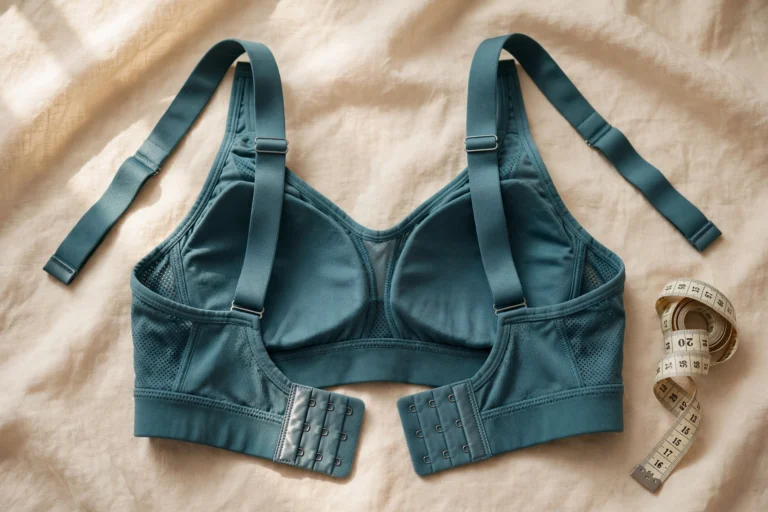
Fasten a new bra on the loosest hook. The tighter hooks are there for later, when the elastic relaxes with wear. If a bra only fits on the tightest hook on day one, the band is already too big.
2. The Band Leaves Marks That Stay
A band should leave a light impression that fades within minutes, the way a sock leaves a line on your ankle. Marks that stay red or sore for an hour after you take the bra off mean the band is too tight, or the band is the wrong width for your shape.
Check the fit before blaming the size. A band fastened on the tightest hook will mark even in the right size. Move to the loosest hook first, and if the marks stay, go up one band size and down one cup size to keep the volume.
3. The Cups Gape at the Top
Gapping is empty space between the top of the cup and your breast, visible when you lean forward or raise your arms. Gapping usually means the cup is too big, or the cup shape is wrong for your breast shape.
Try one cup size down first. If the smaller cup still gaps at the top while the bottom fits, the shape is the problem, not the size: a full coverage cup will gap on a shallow upper breast, and a plunge or balconette cut usually closes the gap. Do not size down twice to chase a gap, because the second step down will pinch somewhere else.
4. The Cups Spill Over the Top or Sides
Spillage is breast tissue pushed over the top edge of the cup, or bulging at the sides near the underarm. Spillage means the cup is too small, full stop.
Go up one cup size and recheck. If the spillage is mostly at the sides, a wider wire or a side support panel may help as well as the size change, so try the larger cup in a style with side support before deciding the brand does not work. A cup that spills at the top and gaps at the sides at the same time is a shape mismatch, and a different cut will fix it faster than another size.
5. The Cups Wrinkle or Collapse
Wrinkling is fabric folding or puckering inside the cup, usually at the bottom or the sides. A wrinkled cup means the cup is too big, or the cup is too deep for your shape.
Try one cup size down. If the smaller cup wrinkles too, the cup is too deep for a shallow shape, and a shallower cut, such as a balconette or a demi cup, will sit flatter. Wrinkling in a moulded cup is harder to see than in a seamed cup, so check a moulded bra in a mirror from the side, not just from the front.
6. The Straps Dig In
Straps should carry about a fifth of the support, with the band doing the rest. Straps that dig in are usually a symptom of a loose band, not a strap problem.
Fix the band first: go down one band size and up one cup size, then loosen the straps to the point where two fingers slide underneath. If the straps still dig after the band is right, look for wider straps or a style with padded straps, and check the strap placement: straps set too wide will slide, straps set too narrow will pull toward the neck.
7. The Straps Keep Slipping Off
A strap that slides off your shoulder every hour is a fit sign, not a habit to live with. Slipping straps usually mean the band is too loose, the straps are set too wide for your frame, or the straps have lost their elastic.
Shorten the straps first, then check the band. If the band rides up as well, the size is the cause. If the band is level and the straps still slip, the style is wrong for narrow or sloping shoulders: a racerback, a centre pull strap, or a convertible strap worn crossed will stay put where a wide set strap will not.
8. The Underwire Pokes, Lifts, or Sits on Breast Tissue
The underwire should sit flat against your ribcage, following the curve where breast meets chest, with the centre of the wire between the breasts. An underwire that pokes, lifts away from the body, or sits on breast tissue is a cup size or shape problem.
If the wire sits on breast tissue at the sides, the cup is too small or too narrow: go up one cup size. If the wire lifts away from the sternum in the middle, the cup is too small in the centre, or the gore is too wide for close set breasts. If the wire pokes at the underarm, the wire is too long for your frame, and a shorter wire or a wirefree style is the fix. Never bend a poking wire back into shape and keep wearing the bra; a bent wire will poke again.
9. The Centre Gore Floats Away From Your Chest
The gore is the small piece of fabric between the cups. In a well fitting underwire bra, it should sit flat against your sternum. A floating gore means the cups are too small, or the breasts are too close together for that gore width.
Go up one cup size first. If the gore still floats in the larger cup, try a plunge style with a lower, narrower gore, which suits close set breasts better than a full coverage gore. A floating gore on a wirefree bra is normal, because there is no wire to anchor it; judge wirefree fit by the band and cups, not the gore.
What to Change First: A Quick Decision Table
| What you see | Most likely cause | Change first |
|---|---|---|
| Band rides up at the back | Band too loose | One band size down, one cup size up |
| Band marks that stay | Band too tight | One band size up, one cup size down |
| Cups gape at the top | Cup too big, or wrong shape | One cup size down, then a shallower cut |
| Cups spill over the top | Cup too small | One cup size up |
| Cups wrinkle | Cup too big, or too deep | One cup size down, then a shallower cut |
| Straps dig in | Band too loose | Fix the band, then loosen the straps |
| Straps slip off | Band too loose, or straps too wide | Shorten straps, then fix the band |
| Underwire pokes or sits on tissue | Cup too small or too narrow | One cup size up, or a wider wire |
| Centre gore floats | Cups too small, or gore too wide | One cup size up, then a plunge cut |
One change at a time. Change the band or the cup, try the bra for a full day, and only then change the next thing. Changing both at once hides which fix worked.
When It Is a Style Problem, Not a Size Problem
Three signs point to style, not size. If the same size fits in one brand and gaps in another, the cut differs, not your body. If every cup in a size gaps at the top but fits at the bottom, your shape needs a shallower cup. If the band fits but the straps always slip, your shoulders need a different strap placement.
Do not keep buying the same style in new sizes when the style is the problem. A different cut in the same size is a cheaper experiment than a third size in the wrong cut.
Recheck the Fit After the First Few Washes
A bra that fits in the shop can change after a few washes. Elastic relaxes, fabric settles, and a band that was snug on the loosest hook may need the second hook sooner than you expect. That is normal wear, not a wrong size, as long as the band still sits level on the middle hook.
Recheck the nine signs after the first three or four washes. If the band rides up even on the tightest hook, the band has stretched past its life, and no size adjustment on that bra will fix it. A bra that only fits on the tightest hook from the start was already too big, so do not blame the wash.
When to Remeasure Instead of Guessing
Remeasure when more than one sign appears at once, when your weight has changed noticeably, or when a size that used to fit stops fitting in every bra you own. Guessing a new size from one bad bra wastes more money than remeasuring once.
Use our guide to how to calculate your proper bra size or the bra size calculator, and buy one bra in the new size before replacing the drawer. Our bra shopping checklist for parents covers the same one-at-a-time rule for a first fitting.
Frequently Asked Questions
How do I know if my bra fits properly?
The band sits level, the cups hold your breast without gaping or spilling, the straps stay put without digging, and the underwire lies flat against your ribcage. If you forget you are wearing it by lunchtime, it fits.
How often should I check my bra fit?
Check every time you buy a new bra, and recheck when your weight changes, after pregnancy, or when a size that used to fit starts showing one of the signs above. A bra that fit last year is not guaranteed to fit this year.
Should a new bra feel tight at first?
A new bra should feel snug on the loosest hook, not tight. Snug means it stays level and you can slide two fingers under the band; tight means it marks, pinches, or makes you want to take it off. A bra that is tight on day one will not break in to fit.
Why does my bra fit in the morning but not by evening?
Bands relax slightly with body heat and movement, so a band that is borderline loose in the morning will ride up by evening. Judge fit at the end of the day, not in the shop mirror. If it rides up by evening, the band is too loose.
Is it normal for one breast to fit differently from the other?
Yes, most people have one breast slightly larger than the other, and it is normal for one cup to fit a little differently. Fit the larger side, and use a small insert or a strap adjustment on the smaller side if the gap bothers you.
What if no bra seems to fit?
Try a different cut before a different size, and check your shape against our breast shape and bra fit guide. If every style in your measured size fails the same way, remeasure with our bra size calculator before buying more bras in the old size.
Your Next Step
Put on the bra you wear most, stand in front of a mirror, and run the nine checks above. Fix the first problem you find, change one size at a time, and try the new size for a full day before deciding.
A bra that fits is a bra you forget. If you are adjusting it all day, it does not fit, and now you know what to change.

One Comment