
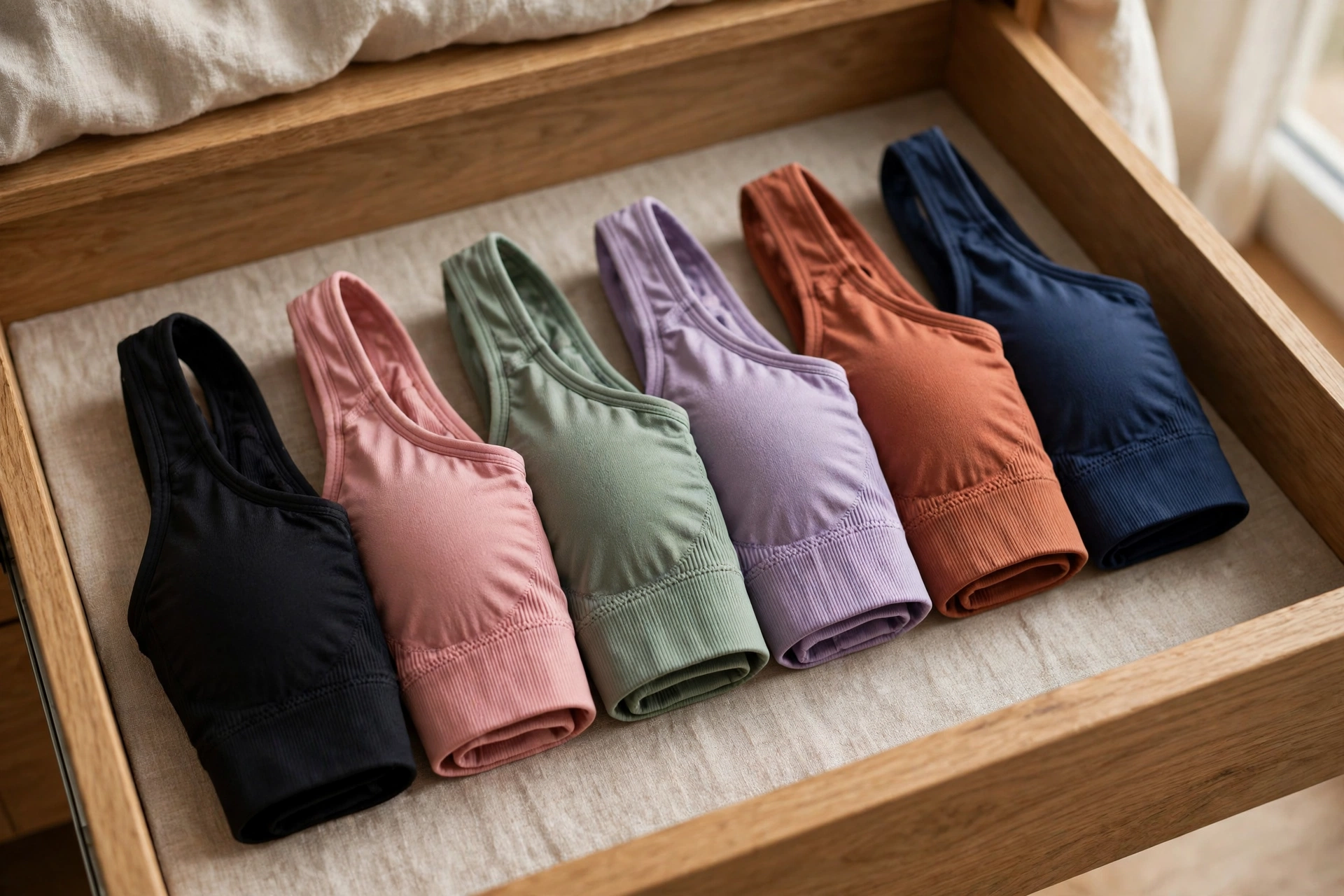
Most sports bra myths survive for the same reason: each one starts with a grain of truth. Two bras do feel tighter than one. Elastic really does die. The trouble starts when a half truth hardens into a rule, and the rule starts deciding for you.
The honest answer up front: not one of the eight claims below survives exactly as stated. Some are flat wrong. Some are half right in a way that still leads you astray. We checked each against the research and the fit logic, and printed the verdict beside it. Three myths also meet a bra that busts them in person.
The verdicts at a glance
| Myth | Verdict | The one line reason |
|---|---|---|
| Wearing two sports bras doubles the support | Busted | Two wrong fits do not add up to one right one |
| Tighter is always better | Half true | Firm in your size, yes; a size too small taxes your breathing |
| Wirefree means weak | Busted | Support comes from band, cups and fabric, not from a wire |
| A sports bra expires after 30 to 40 washes | Half true | Elastic dies, but the famous number is folklore, not a standard |
| Compression works for every body | Busted | At larger cup sizes, research favors structured cups |
| Expensive means better support | Busted | No cross brand support standard exists for price to certify |
| You only need one good sports bra | Busted | Elastic needs rest days, and so does your laundry schedule |
| Hand washing is mandatory or it dies | Half true | Labels vary; heat and softener are the real enemies |
Eight sports bra myths, checked one by one
Myth 1: “Wearing two sports bras doubles the support”
Why people believe it: if one bra is not holding you, adding a second feels like engineering.
What the evidence shows: support is not additive. Brooks Running lists doubling up as a myth, and Portsmouth researcher Joanna Scurr told The Open University the same thing: a properly supportive bra that fits correctly should be sufficient. Two bras stack two bands and two strap sets, trap heat and add rub points.
Verdict: Busted. Needing two bras is a fitting symptom, not a strategy.
Myth 2: “Tighter is always better”
Why people believe it: movement feels like looseness, so squeezing harder feels like the cure.
What the evidence shows: the cure is a firm band in your correct size, a different thing from a smaller size. University of British Columbia researchers measured a too tight underband during running: more work of breathing, faster and shallower breaths, worse running economy, as PhillyVoice reported; loosening the band improved economy by about 1.3 percent. A 2025 Journal of Sports Sciences study found the tight band also fatigued the breathing muscles faster.
Verdict: Half true. Firm, yes. Smaller than your size, no.
Myth 3: “Wirefree means weak”
Why people believe it: for decades, the serious sports bras had wires and the soft ones were for yoga.
What the evidence shows: a wire shapes and separates. It does not generate support. The band, the cup structure and the fabric do that work, and modern wirefree designs build all three in: seamed or molded cups, a firm hook and eye band, wide adjustable straps. The Glamorise module below does it in sizes reaching G cups. We compared the two constructions in Wirefree vs Underwire Sports Bras.
Verdict: Busted. Some runners still prefer a wired design at the highest impact. That is preference, not physics.
Myth 4: “A sports bra expires after 30 to 40 washes”
Why people believe it: care advice attributed to Hanes puts a typical sports bra at around 30 to 40 washes, as rounded up in a lifespan survey by FIELDTIME.
What the evidence shows: the direction is right and the number is folklore. Elastic does degrade with wear, sweat, heat and washing. But researchers in the Journal of Sports Sciences noted that evidence based replacement standards have yet to be established, and their anecdotal figure is different entirely: 100 workouts, or 8 to 10 months. Two invented numbers cannot both be law. Judge by snap instead: a band loose on its tightest hook, straps that will not hold an adjustment, bounce that is back.
Verdict: Half true. Elastic dies. The wash count is made up.
Myth 5: “Compression works for every body”
Why people believe it: compression is the default design on every rack, and it works for a great many women.
What the evidence shows: it works conditionally. A scoping review in Research in Sports Medicine summarizes the field: encapsulation, a structured cup for each breast, is the recommended route for larger breasted women, and McGhee and Steele found compression plus structured cups lowered discomfort and perceived movement at large sizes, while compression alone presses tissue flat without controlling it. At smaller cup sizes, plain compression is often all the physics requires.
Verdict: Busted as a universal rule. Right tool, right body.
Myth 6: “Expensive means better support”
Why people believe it: price usually signals quality, and premium brands do often buy better fabric and wider size ranges.
What the evidence shows: what price cannot do is certify support, because there is no cross brand support standard for it to certify. One brand’s high impact is another brand’s medium. Compare instead the spec sheet: construction, size range, closure, adjustability. A budget bra whose specs fit the job beats a premium bra in the wrong construction or size, every run. The Aoxjox module below is the demonstration.
Verdict: Busted. Judge the spec sheet, not the price tag.
Myth 7: “You only need one good sports bra”
Why people believe it: finding one bra that works feels like the finish line, and buying three sounds like a sales pitch.
What the evidence shows: elastic is a material with a memory, and it recovers that memory at rest. Fitters at Bravo Intimates put the rule as one to wear, one to wash, one in the drawer, and warn that a single bra in heavy rotation wears out in weeks rather than months. One bra also means training in yesterday’s sweat or skipping workouts for laundry.
Verdict: Busted. One bra is a countdown, not a collection.
Myth 8: “Hand washing is mandatory or it dies in the machine”
Why people believe it: plenty of labels do say hand wash only, and everyone has killed a bra in a dryer.
What the evidence shows: labels vary by brand and by model. Some listings specify hand wash only; others instruct machine wash cold. Under Armour guidance quoted by Fleet Feet splits the difference: hand wash cold if you can, or machine wash in a lingerie bag on a cool setting, skip the softener, keep away from heat. The mandatory part was never your hands. It is low heat and no softener, because heat and softener coatings break elastic down.
Verdict: Half true. Your care label outranks the myth.
Three more myths we have already checked
Three cousins get full articles of their own, so here are the verdict lines only. Sports bras prevent sagging: not supported by the research, walked through study by study in Breast Sag: What the Research Says. You cannot wear a sports bra all day: too broad; the answer depends on fit and construction, covered in Can You Wear a Sports Bra Every Day?. Small breasts need no support: busted, because discomfort is not a cup size exclusive, as Breast Size and Exercise explains. And the cancer claim is checked against the evidence in our Facts About Breasts piece.
Three bras that bust their own myth
This article is research based: we checked manufacturer specs, retail listings and published research, and we do not wear test. As an Amazon Associate I earn from qualifying purchases, and the product cards below are how the site is funded. Prices and availability change; the cards show the current listing.


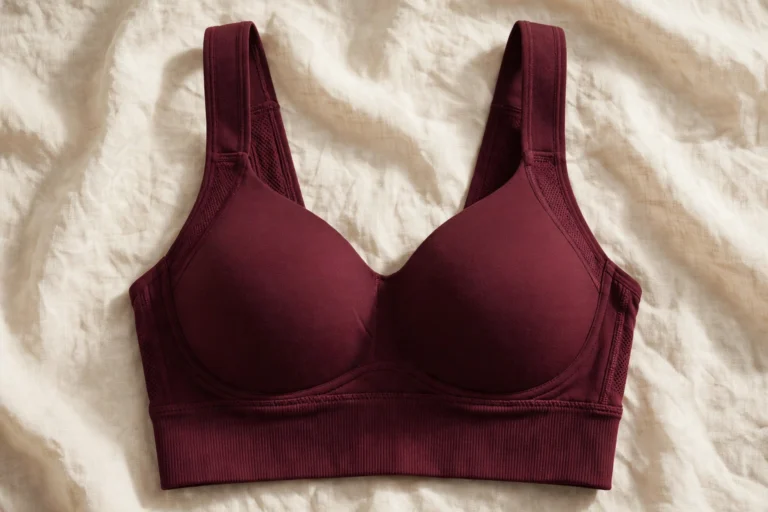
Myth 3, meet the Glamorise No-Sweat Mesh Sports Bra 1068
Here is wirefree support with the engineering left visible: seamed soft cups that hold each breast separately, a hook and eye band you can tighten over time, adjustable straps, and breathable mesh. Amazon’s listing rates it medium impact, and that printed honesty is the point: real support, in band and cup sizes reaching G cups rather than a hopeful S to XL. Its ceiling is real too: marathon miles at larger cup sizes may call for a higher rated design.
Pros
- Band and cup sizing to G cups, rare in a wirefree sports bra
- Hook and eye band and adjustable straps tune the fit over time
- Mesh panels move heat out, and the bra is machine washable
Cons
- Medium impact rating will not be enough for every runner at larger cup sizes
- Unpadded cups give a natural shape, not a molded one, and seams can show under thin tops
| Key Specs | Glamorise No-Sweat Mesh 1068 |
|---|---|
| Support | Medium impact (listing rating), multi sport |
| Size range | US band and cup sizes, to G cup (grid endpoints to confirm at build) |
| Closure | Hook and eye, back |
| Construction | Wirefree seamed soft cups, encapsulation leaning |
| Adjustability | Straps and band |
Myth 6, meet the Aoxjox Khloe Bra
Aoxjox is a budget Amazon label, and The Inventory flagged this longline compression tank as a budget pick wearers compare with bras at several times the price. Read its spec sheet the way myth 6 teaches: 75 percent nylon and 25 percent spandex, removable pads, an open racerback, and a size chart from XXS to XXL mapping to cup sizes up to 44C. Our analysis is more conservative than its label: the brand claims high support; we would call it a medium impact gym bra. The label oversells and the price undersells. The spec sheet tells the truth.
Pros
- Longline compression band at a budget price point
- High elastane content gives the compression real firmness
Cons
- No adjustability: fixed straps, pull on fit
- Alpha sizing blurs the band and cup distinction, so check the chart
- Open back offers less side containment than a closed racerback
| Key Specs | Aoxjox Khloe Bra |
|---|---|
| Support | Listed as high support; our analysis: medium impact training |
| Size range | Alpha XXS to XXL (brand chart maps to 28A to 44C) |
| Closure | Pull on, elastic |
| Construction | Compression, wirefree, removable pads |
| Adjustability | None |
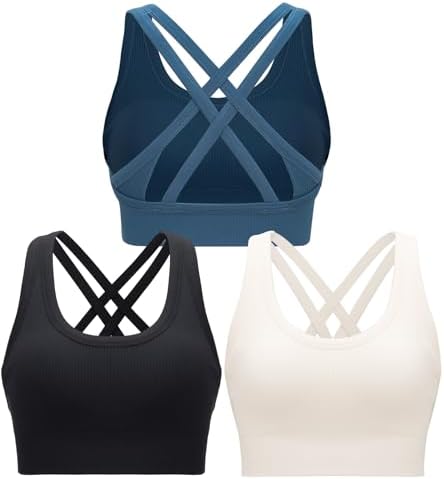
Myth 7, meet the RUNNING GIRL 3 Pack, WX3011
A 3 pack is the rotation rule from Bravo Intimates: one on, one in the wash, one rested and ready. Each bra is a pull on compression style with removable pads and a criss cross back. Keep expectations honest: these are everyday training bras for low to medium impact work, not marathon kit, and the brand’s support label is a listing claim, not a measured rating. Their job here is narrower: they make resting your elastic the default.
Pros
- Three bras in one purchase makes rotation automatic
- Machine washable, which suits a wash after every wear routine
Cons
- Alpha sizing only, with no band or strap adjustment
- Support suits training loads, not high impact running at larger cup sizes
- The listing’s fabric breakdown lacks elastane detail
| Key Specs | RUNNING GIRL 3 Pack WX3011 |
|---|---|
| Support | Listed as high support; our analysis: low to medium impact training |
| Size range | Alpha sizes, 3 pack (endpoints to confirm at build) |
| Closure | Pull on |
| Construction | Compression, wirefree, removable pads |
| Adjustability | None |
Common questions
If two bras feel better, is wearing both actually harmful? Not dangerous, just diagnostic. Doubling up usually means the single bra is the wrong size or construction for the job. Fix the fit and the second bra becomes unnecessary.
How do I know when a sports bra is actually finished? Ignore the calendar and the wash count. A finished bra shows you: the band stays loose on its tightest hook, the straps will not hold an adjustment, the fabric has lost its snap, or the bounce is back.
The bottom line
Sports bra myths are not lies; they are half truths that got promoted to rules. Keep the grain, drop the rule: firm instead of smaller, fitted instead of doubled, construction matched to your cup size, a rotation instead of a countdown, and your own care label instead of folklore.

One Comment