A bra size is two measurements written as one label, and how bra sizing works is the story of what each half does. The number is the band. The letter is the cup. Neither half means anything on its own, and that single fact explains most of the confusion around bra sizes.
This guide explains the system at principle level. It does not teach a new measuring method. Measuring methods differ between brands and between guides, and our own staged tutorial and live guide still disagree on one step, so this article points you to the measurement guide and the calculator for your starting size instead of adding a third recipe. What it does explain is what the numbers and letters mean once you have them, and where the labels from different countries part ways.
Quick Answer
A bra size has two parts: a band number and a cup letter. The band number comes from the measurement around the ribcage, just under the bust. The cup letter comes from the difference between the bust measurement and the band. Because the cup letter is a difference, not a fixed volume, the same letter holds a different amount on different bands: a 36C holds more than a 34C, and a 34C holds the same cup volume as a 32D or a 36B. US, UK and EU labels agree up to a D cup and diverge above it, so a UK G is a US I. Alpha sizes like S, M and L map to band-and-cup ranges and always need the brand’s own table.
How Bra Sizing Works: Two Numbers, One System
Think of a bra size as a pair of coordinates. The band number tells you the frame. The cup letter tells you how far the bust projects from that frame. A 34C and a 36C share a letter but sit on different frames, so they are different sizes. A 34C and a 32D share no letter or number at all, yet hold the same cup volume. Once you see the size as a pair, the rest of the system falls into place.
The two parts also do different jobs in the bra itself. The band is the anchor: it sits level around the ribcage and carries most of the support, which is why a band that rides up at the back is the first problem to fix. The cups hold and shape, and the straps mainly keep the cups in position. When a bra feels wrong, the cause is usually in one half of the pair, and knowing which half lets you change only that half.
Sizes run in steps. Bands usually step in even numbers in the US: 30, 32, 34, 36, 38, 40, and further in both directions. Cups step letter by letter. Each step is a small, regular change, which is why sister sizes work: move one step in one direction on the band and one step in the opposite direction on the cup, and the cup volume stays roughly the same.
What Does the Band Number Mean?
The band number is the underbust measurement, the distance around the ribcage directly under the bust, expressed in inches in the US and UK systems. A 34 band is built for a 34 inch underbust. In the EU system the same measurement is expressed in centimetres, so a US 34 is an EU 75. The number is a length, not a judgement, and it is the steadier half of the pair.
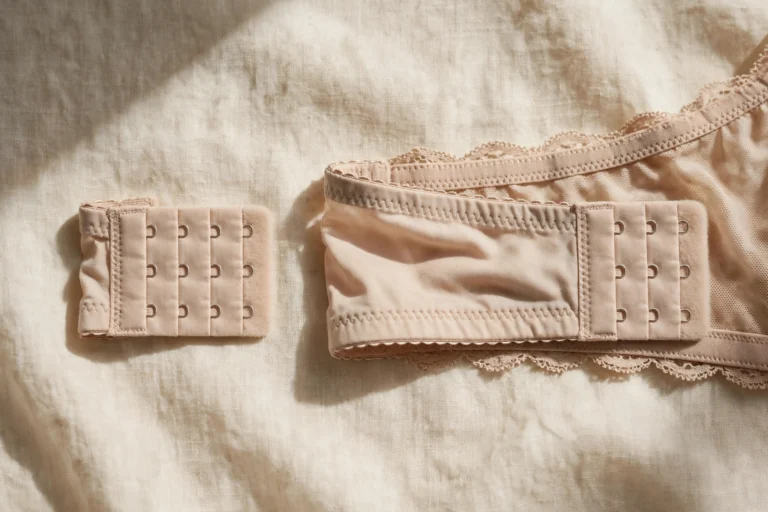
The band does the heavy lifting. A well-fitting band sits level all the way around, snug enough that you can fit two fingers underneath but not so loose that it rides up when you raise your arms. If the band rides up, it is too loose, and no strap adjustment fixes that, because the straps were never meant to carry the weight. If the band digs in and leaves deep marks, it is too tight, and the fix is a larger band, not looser straps.
Band sizes are not universal across brands, even when the number is the same. Brands cut to their own patterns, and a 34 band from one brand can measure a little longer or shorter than a 34 from another. That is why the number is a starting point and the fit check matters more than the label. Our US bra size chart lists the common combinations, and our guide to signs your bra does not fit shows how to read a band that is too loose or too tight.
What Does the Cup Letter Mean?
The cup letter is a difference, not a size on its own. In the US convention, each inch of difference between the bust measurement and the band gives one cup step: a 1 inch difference is an A cup, 2 inches a B, 3 inches a C, 4 inches a D, and so on. The letter describes how far the bust projects beyond the band, and it only has meaning when it is attached to a band number.
That is the idea most people miss, and it explains the most common sizing mistake. A C cup is not a fixed volume. It is a 3 inch difference on whatever band it sits on. A 3 inch difference on a 32 band is a smaller cup than a 3 inch difference on a 38 band, because the whole frame is larger. So a 32C and a 38C are different cups that happen to share a letter.
Read the letter with its number, every time. “I am a C cup” is not a size. “I am a 34C” is a size, and even then it is a size in one brand’s system on one day. The letter alone tells you almost nothing, and any advice built on the letter alone, including most “what cup are you” quizzes, is guessing.
The cup sequence this guide uses past D is the common US sequence: AA, A, B, C, D, DD, DDD/F, G, H, I, J, K. That sequence is not universal. Some US brands label DD as E and DDD as F, some continue with extra D letters, and UK brands use a different sequence entirely, which the next sections cover. Always check the brand’s own chart before you buy, and never treat one brand’s sequence as the rule for all brands.
Why the Same Cup Letter Holds a Different Volume on Different Bands
Cup volume grows with the band because the cup is built on a larger frame. Picture two cups with the same depth but different widths: the wider one holds more. That is what happens when the band goes up and the letter stays the same. A 36C is built wider than a 34C, so it holds more volume, even though both are called C. ThirdLove states the principle plainly: the cup letter alone does not tell you the true cup volume, because that depends on the band size too.
This is why going up a band without changing the cup so often fails. A 34C wearer whose band feels tight and who grabs a 36C has not just loosened the band. She has also gone up a cup volume, and the cups will usually gap. The correct move is the sister size: up one band, down one cup, to 36B. The band gets roomier and the cup volume stays the same. ThirdLove gives the same rule in the other direction: if the band is loose, go down one band and up one cup.
What Are Sister Sizes, and When Do They Help?
Sister sizes are sizes that share the same cup volume on different bands. The best-known example is the one our own calculator verifies: a 34C holds the same cup volume as a 32D and a 36B. One band step up and one cup letter down, or the reverse, keeps the volume while changing the band. ThirdLove states the rule the same way: sister sizes share the same cup volume with a different band size.
Sister sizes help in exactly one situation: the cups fit and the band does not. If the cups are right but the band is tight on the loosest hook, go up one band and down one cup. If the cups are right but the band is loose on the tightest hook, go down one band and up one cup. That is the whole job. If the cups do not fit, change the cup, not the sister size. A sister size will not fix gaping or spilling cups, because the volume is the same by definition.
Stay within one step of your usual size. ThirdLove warns that moving further shifts wire width, strap spacing and centre gore placement, so a size two steps away is a different bra in more than name. Our sister sizes guide carries the full chart and the one-step rule.
US, UK and EU Labels: Same Letters, Different Cups
US and UK sizes look identical up to a D cup, and that is where the trouble starts. The band numbers match, because both systems label bands in inches, and the cup letters match through A, B, C and D. Above D, the systems diverge, and the same letter means a different cup in each system.
The UK system uses double letters in much of its progression. A common UK cup sequence is D, DD, E, F, FF, G, GG, H, HH, J, JJ, K, and UK sizing does not use an I cup at all. The US system, by contrast, commonly runs D, DD, DDD/F, G, H, I, J, K. Because the UK sequence adds intermediate double-letter steps, the letters fall out of step above D: a UK G is a US I, not a US G, and a US DDD is a UK E. Breakout Bras warns that ordering by the cup letter alone can leave you several cup sizes smaller or larger than expected, and that warning is worth taking literally.
The EU system is different again. EU bands are the underbust in centimetres, rounded to the nearest 5, so a US 34 band is an EU 75, a US 32 is an EU 70, and a US 36 is an EU 80. EU cups use single letters, A, B, C, D, E, F, G, H, advancing in roughly 2 centimetre steps. A US 34DD converts to an EU 75E, and a US 34DDD converts to an EU 75F.
Convert the full size, never the letter alone. A 34DD in the US is a 34DD in the UK but a 75E in the EU. A UK 34E is a US 34DDD. The band number travels between the US and UK unchanged, but the cup letter does not travel between any two systems without a chart. Our UK vs US vs EU conversion guide carries the full tables, so this article gives the warning and one example rather than repeating them.
What Do Alpha Sizes (S, M, L) Mean?
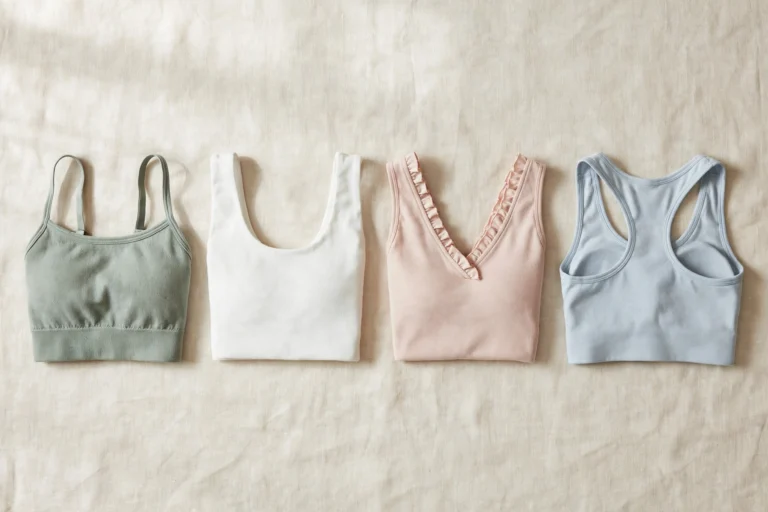
Alpha sizing replaces the band-and-cup pair with a single letter: XS, S, M, L, XL, and numbered extensions like 1X and 2X. Each alpha size maps to a range of band-and-cup combinations, not to one size. A medium from one brand might cover 34B to 36C, while a medium from another covers 32C to 34D. The letter tells you the rough range. It does not tell you your size.
Alpha sizing is most common in sports bras, bralettes and lounge bras, where the construction is more forgiving and the fit is less precise than an underwire everyday bra. That forgiveness is also the limit: a single alpha size has to cover several band-and-cup combinations, so it fits the middle of its range best and the edges worst. If you sit at the edge of an alpha range, or between two alpha sizes, check the brand’s own table before you buy. The table is the size. The letter is the shorthand.
For sports bras, alpha sizing carries a second warning. Support comes from the band and the cup working together, and a loose alpha fit that feels comfortable standing still can fail on a run. Our large-bust sports bra guide works through support by activity.
Why Does the Same Labelled Size Fit Differently Across Brands?
If the system is regular, why does a 34C from one brand fit and a 34C from another gap, dig or ride up? Because the system is a labelling convention, not a manufacturing standard. No authority certifies that every brand’s 34C is the same bra. Each brand cuts to its own pattern, grades its sizes by its own rules, and targets its own fit model. The label is a promise that the brand’s 34C is close to a 34C. It is not a guarantee.
The differences show up in the measurements brands actually use. In September 2026, Bra Atlas typed the same tape measurements into several brand calculators and got different answers from each: the same underbust and bust that measured as a 34D came back as a 36B from Wacoal, a 36A from ThirdLove and a 38A from SKIMS. Every brand answer had a bigger band than the measured one and a smaller cup letter. None of those answers is wrong for that brand’s bras. Each one is that brand’s size, for that brand’s cut.
The measuring method itself is part of the difference. The traditional add-4 method, which adds inches to the underbust before choosing a band, was tested by researchers White and Scurr in Ergonomics in 2012, and their study of 45 women found that it overestimated the band and underestimated the cup. Modern brand calculators mostly add 2 or 3 inches instead, but they do not all add the same amount. That is one reason our own site’s staged tutorial and live guide still disagree on a step, and one reason this article explains the system instead of publishing another recipe.
Construction adds a second layer of difference. Wire width, strap spacing, gore placement, cup depth and cup shape all change how a size feels, and they change between brands and between styles in the same brand. A 34C in a plunge bra and a 34C in a full-coverage bra from the same brand can fit differently, because the shapes are different. The size is the same. The bra is not.
When Should You Recheck Your Size?
A bra size is not permanent. It is a measurement of a body that changes, and the honest answer to “when should I recheck” is whenever the fit changes or the body changes. The common triggers are easy to list, and none of them needs a calendar reminder.
Weight change is the most common trigger. When weight changes, the band usually changes first, because the ribcage measurement moves, and the cup follows. Monthly cycle changes are shorter lived: many women notice the bust feels fuller at some points in the month, and a bra that fits on one week can feel tight on another. That is normal variation, not a sizing error.
Pregnancy and nursing change both measurements, sometimes several times, and the right response is to recheck fit at each stage rather than guessing a size in advance. Menopause and age change the bust over a longer period, often gradually enough that the change is only noticed when a favourite bra stops fitting. And sometimes the trigger is the bra itself: elastic wears out, bands stretch, and a bra that fitted for a year can become a bra that rides up.
Rechecking means returning to the measurement guide or the calculator for a starting size, then confirming it with the fit checks in the next section. If you have individual concerns about breast changes, ask a clinician, not a sizing guide.
Five Fit Signs That Tell You the System Is Working
A size is only a label until it is checked on the body. These five signs are the check, and they work for any size, in any brand.
1. The band sits level. It stays in the same place front and back, parallel to the floor, when you raise your arms. If it rides up at the back, it is too loose. If it digs in and leaves deep red marks, it is too tight.
2. The cups contain without spilling or gaping. The bust sits inside the cups with no tissue spilling over the top or sides, and no empty space at the top of the cup. Spilling usually means go up a cup. Gaping usually means go down a cup, or try a different cup shape.
3. The straps stay up without digging. Straps adjusted to two fingers of slack should stay on the shoulders through a normal day. Straps that slip are often a sign the band is too loose, because the band is not doing its share. Straps that dig in are often the same problem in reverse: the straps are carrying weight the band should carry.
4. The centre gore sits flat. On an underwire bra, the small piece between the cups should sit flat against the chest. If it floats, the cups are usually too small.
5. The underwire, if there is one, sits flat. It should follow the root of the bust without sitting on tissue and without poking at the sides. Wire that sits on tissue means the cup is too small or the wrong shape, and no amount of adjusting will fix it.
Our signs your bra does not fit guide works through each of these in detail, with the fix for each one. If more than one sign fails at once, change one thing at a time, starting with the band, and recheck.
The Size Is a Starting Point, Not a Verdict
Bra sizing looks like a code, and in a way it is: a band number plus a cup letter, with rules for how the two halves relate and how the labels translate between countries. But it is a code with no central authority, written by brands that each interpret it slightly differently. That is why the system rewards understanding over memorising. Know that the band is the anchor and the cup is a difference, know that the same letter means a different volume on a different band, know that a UK G is not a US G, and know that a sister size fixes a band problem and nothing else. With those four ideas, most sizing confusion resolves itself.
Start from the measurement guide or the calculator for your starting size, and check it against the five fit signs. When a brand or a style fits differently, trust the fit check over the label, and try the sister size before you try a different cup. For the wider picture, our US bra size chart lists the combinations, our conversion guide translates the labels, and our bra glossary explains any term used here without defining.
Common questions
Can I be two different bra sizes?
Yes, and most women are. Your size varies by brand, by style, and sometimes by the same brand’s different ranges. A 34C in one brand and a 36B in another can both be right, because they are sister sizes. Keep the size that fits in each bra, not one size for every bra.
Why is my size different in every brand?
Because each brand cuts to its own pattern and its own fit model, and brand calculators do not all use the same method. In September 2026 tests, the same measurements gave a 36B from one brand, a 36A from another and a 38A from a third. Start from each brand’s own chart and expect to try a sister size when you switch.
Is a DD cup the same as an E cup?
In US sizing, often yes: many US brands label DD as E and DDD as F. In UK sizing, no: a UK E is a US DDD, and a UK DD is a US DD. The letters only match within one system, so always convert the full size, band and cup together, and check the brand’s chart.
What size am I if I only know my alpha size?
You do not know yet. An alpha size like M covers a range of band-and-cup combinations, and the range differs by brand. Check the brand’s own alpha table, which lists the band-and-cup sizes each letter covers.
Do I need to measure again after my weight changes?
Yes, recheck your fit whenever your weight changes noticeably, and whenever a bra that used to fit stops fitting. Start from the measurement guide or the calculator for a new starting size, then confirm it with the five fit signs. Do not guess a new size from the amount of weight changed: no reliable rule turns pounds into cup sizes.