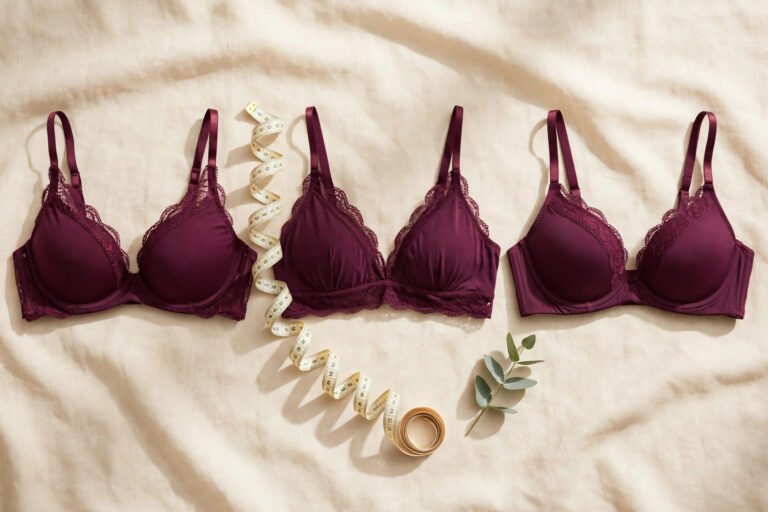
A cup letter looks like a size, but bra cup sizes explained properly start with a correction: the letter is not a size at all. It is a difference, measured in inches, between your bust and your band. Each step up the alphabet is one more inch of difference. That single rule explains the whole system, from AA to K, and it also explains why the same letter fits differently on different bands, why US and UK labels part ways above D, and why a size that fits in one brand can fail in another.
This guide works through the full cup run letter by letter, with the difference chart, the US, UK and EU translations, and the fit problems each end of the range tends to produce. It does not teach a new measuring method. Measuring methods differ between brands and between guides, so this article points you to the measurement guide and the calculator for your starting size instead of adding another recipe. What it does explain is what the letter means once you have it.
Quick Answer
A cup letter is the difference between your bust measurement and your band, in inches. A 1 inch difference is an A, 2 inches a B, 3 inches a C, 4 inches a D, 5 inches a DD, 6 inches a DDD, and the common US sequence continues G, H, I, J, K after that. The letter only has meaning with its band number attached: a 32C and a 38C share a letter but hold very different volumes. US and UK labels agree through DD and diverge above it, so a US DDD is a UK E, and a UK G is a US I. Some US brands label DD as E and DDD as F. Always check the brand’s own chart, and always read the full size, band and cup together.
Bra Cup Sizes Explained in One Paragraph
Think of the cup as a ruler, not a box. The band number sets the starting point, the length around the ribcage. The cup letter counts how many inches the bust projects beyond that starting point. One inch of projection is an A. Two inches is a B. Three is a C, four is a D, five is a DD, six is a DDD, and each inch after that is another letter. The letter counts inches of difference. It does not count volume, and it does not count anything absolute about the body. A 34C and a 36C both have a 3 inch difference, but the 36C sits on a wider frame, so its cup holds more. Our companion guide, Band Size vs Cup Size Explained, works through that relationship in detail: what the band does, what the cup does, and how the two halves trade against each other in sister sizes.
The Cup Difference Chart in Inches
This is the chart to bookmark. Find your bust minus band difference on the left and read across for the label in each system. The US column is the common US sequence. The UK column is the common UK sequence. The EU column is the common EU sequence. Where a brand’s own chart disagrees with this table, the brand’s chart wins for that brand’s bras.
| Bust minus band | US cup | UK cup | EU cup |
|---|---|---|---|
| Under 1 inch | AA | AA | AA |
| 1 inch | A | A | A |
| 2 inches | B | B | B |
| 3 inches | C | C | C |
| 4 inches | D | D | D |
| 5 inches | DD (or E) | DD | E |
| 6 inches | DDD (or F) | E | F |
| 7 inches | G | F | G |
| 8 inches | H | FF | H |
| 9 inches | I | G | I |
| 10 inches | J | GG | J |
| 11 inches | K | H | K |
Three things in this table deserve attention. First, every system agrees through D. A 4 inch difference is a D in the US, the UK and the EU, and that agreement is why the confusion starts above D rather than below it. Second, the US sequence skips DDDD: after DDD most US brands go straight to G. Third, the UK sequence adds intermediate double-letter steps, FF and GG, which is why the letters fall out of step above D: a UK F is a US G, and a UK G is a US I. HauteFlair sets out both sequences in its September 2026 guide, and Breakout Bras warns that ordering by the cup letter alone can leave you several cup sizes smaller or larger than expected.
The letters themselves are old. Lettered cup sizes are generally credited to S.H. Camp and Company in the early 1930s, per HauteFlair, and the system has been extended letter by letter ever since, differently in each country, which is why no single chart covers every brand.
AA, A and B Cups: The Small End
AA, A and B cups are the small end of the difference scale: under 1 inch, 1 inch and 2 inches of projection. The most common fit problem at this end is gaping, the cup standing away from the chest at the top. Gaping here usually means the cup is too big, but it can also mean the cup shape is wrong: a moulded cup that is too tall, or a full-coverage cut on a shallow shape, will gape even in the right size. If a smaller cup still gapes, try a different cup shape on the same size before you keep going down.
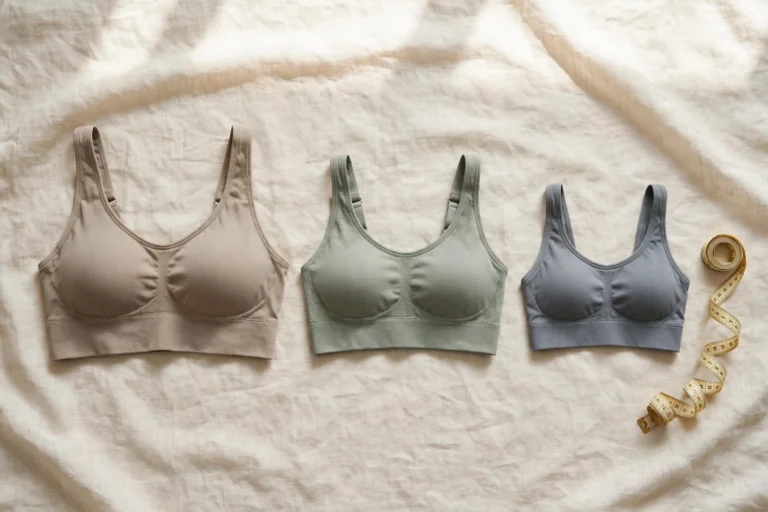
Constructions that tend to suit the small end are lightly lined cups, demi cups and balconettes, which follow the bust without adding bulk the wearer does not need, and bralette-style everyday bras, which skip the cup letter entirely and fit by band and alpha range instead. What matters is the fit check, not the construction name: the cup should lie flat against the chest with no empty space at the top, and the band should sit level.
Two things this guide will not do at the small end. It will not predict a size from a body type, and it will not promise enhancement. Push-up and padding claims belong to the product, not to the letter, and a cup letter has never been a judgement about the body wearing it. A, B and every other letter are measurements of a difference, and a smaller difference is not a smaller woman.
C and D Cups: The Middle of the Range
C and D cups are a 3 inch and a 4 inch difference, and they sit in the middle of the range, which is where most of the confusion about averages lives. There is no single settled average cup size. One often-quoted figure is 34DD, from a 2013 Intimacy survey, and another is 40C, from a Bedbible roundup, and the two figures disagree because they measure different populations by different methods. This guide asserts neither figure as the average. The honest statement is that C and D are common, not that either one is typical.
The middle of the range is also where the band-and-cup relationship first bites in practice. A 34C and a 36C share a letter but hold different volumes, and a 34D and a 32DD share a volume but not a letter: they are sister sizes, and our sister sizes guide carries the full chart. A C or D cup that spills usually needs a larger cup on the same band. A C or D cup that gapes usually needs a smaller cup, or a different cup shape. A C or D cup that fits in one brand and fails in another is usually a brand difference, not a body difference, and the brand section below explains why.
DD, DDD and Beyond: Where the Labels Split
DD is a 5 inch difference and DDD is a 6 inch difference, and this is where the labels start to split. Many US brands label a 5 inch cup as E instead of DD, and a 6 inch cup as F instead of DDD. ThirdLove does exactly that in its own chart, so a ThirdLove E is a DD and a ThirdLove F is a DDD. Other US brands keep DD and DDD. Neither choice is wrong. Both are the same cups under different names, and the only way to know which naming a brand uses is to read that brand’s chart.
Above DDD, the US sequence continues G, H, I, J, K, one letter per inch. The UK sequence continues E, F, FF, G, GG, H, with double letters at the intermediate steps. The two sequences describe the same cups, and the translation is fixed: a US DDD is a UK E, a US G is a UK F, a US H is a UK FF, a US I is a UK G, a US J is a UK GG, and a US K is a UK H. The EU sequence runs single letters, so a US DDD is an EU F and a US G is an EU G. If you are unsure which system a brand uses, look at what follows DD on the brand’s own chart: DDD means US labels, E means UK labels.
The sequence does not stop at K for every brand. Some US brands run further: Goddess lists its Kayla full-cup range as US DD to N on its own conversion chart, per Goddess, and Elomi’s Kendra runs UK DD to K on Elomi’s official page. The common US sequence ends at K because most US brands stop there, not because cups stop there. For the far end of the scale, our biggest bra size guide works through the largest sizes brands actually make.
Why the Same Cup Letter Fits Differently on Different Bands
Cup volume grows with the band because the cup is built on a larger frame. Picture two cups with the same depth but different widths: the wider one holds more. That is what happens when the band goes up and the letter stays the same. A 36C is built wider than a 34C, so it holds more volume, even though both are called C. ThirdLove states the principle plainly: the cup letter alone does not tell you the true cup volume, because that depends on the band size too.
Here is the same idea as a worked example. Take a 32C and a 38C. Both have a 3 inch difference between bust and band. But the 32C sits on a 32 inch frame and the 38C sits on a 38 inch frame, 6 inches wider, so the 38C cup is wider, deeper and holds substantially more. Anyone comparing cup sizes fairly must hold the band constant. A 30D and a 40D both have a 4 inch difference, but the 40D sits on a ribcage 10 inches wider, so its cup holds far more. The letter is a difference. The volume is the difference applied to a frame.
This is why going up a band without changing the cup so often fails. A 34C wearer whose band feels tight and who grabs a 36C has not just loosened the band. She has also gone up a cup volume, and the cups will usually gape. The correct move is the sister size: up one band, down one cup, to 36B. The band gets roomier and the cup volume stays the same. ThirdLove gives the same rule in the other direction: if the band is loose, go down one band and up one cup. Our companion guide, Band Size vs Cup Size Explained, works through the trade in full.
Why the Same Cup Letter Fits Differently Across Brands
If the system is regular, why does a 34C from one brand fit and a 34C from another gape, dig or ride up? Because the system is a labelling convention, not a manufacturing standard. No authority certifies that every brand’s 34C is the same bra. Each brand cuts to its own pattern, grades its sizes by its own rules, and targets its own fit model. The label is a promise that the brand’s 34C is close to a 34C. It is not a guarantee.
The differences show up in the measurements brands actually use. In September 2026, Bra Atlas typed the same tape measurements into several brand calculators and got different answers from each: the same underbust and bust that measured as a 34D came back as a 36B from Wacoal, a 36A from ThirdLove and a 38A from SKIMS. Every brand answer had a bigger band than the measured one and a smaller cup letter. None of those answers is wrong for that brand’s bras. Each one is that brand’s size, for that brand’s cut.
The measuring method itself is part of the difference. The traditional add-4 method, which adds inches to the underbust before choosing a band, was tested by researchers White and Scurr in Ergonomics in 2012, and their study of 45 women found that it overestimated the band and underestimated the cup. Modern brand calculators mostly add 2 or 3 inches instead, but they do not all add the same amount. That is one reason our own site’s staged tutorial and live guide still disagree on a step, and one reason this article explains the system instead of publishing another recipe.
Construction adds a second layer of difference. Wire width, strap spacing, gore placement, cup depth and cup shape all change how a size feels, and they change between brands and between styles in the same brand. A 34C in a plunge bra and a 34C in a full-coverage bra from the same brand can fit differently, because the shapes are different. The size is the same. The bra is not.
Cup Fit Problems and What Each One Means
The cup gives four clear symptoms, and each one names its fix. Use this table as a first read, then confirm it with the fit checks in the linked guides.
| Symptom | What it usually means | What to try first |
|---|---|---|
| Spilling over the top or sides | The cup is too small | Go up one cup on the same band |
| Gaping at the top of the cup | The cup is too big, or the wrong cup shape | Go down one cup, or try a different cup shape on the same size |
| Wrinkling or collapsing fabric | The cup is too big, or the wrong cup shape | Go down one cup, or try a different cup shape |
| Centre gore floats off the chest | The cup is too small | Go up one cup on the same band |
| Underwire sits on breast tissue | The cup is too small, or the wrong shape | Go up one cup, or try a different cup shape |
| One cup fits and the other does not | Breasts are different sizes, which is common | Fit the larger side and adjust the smaller side with the strap, never size to the smaller side |
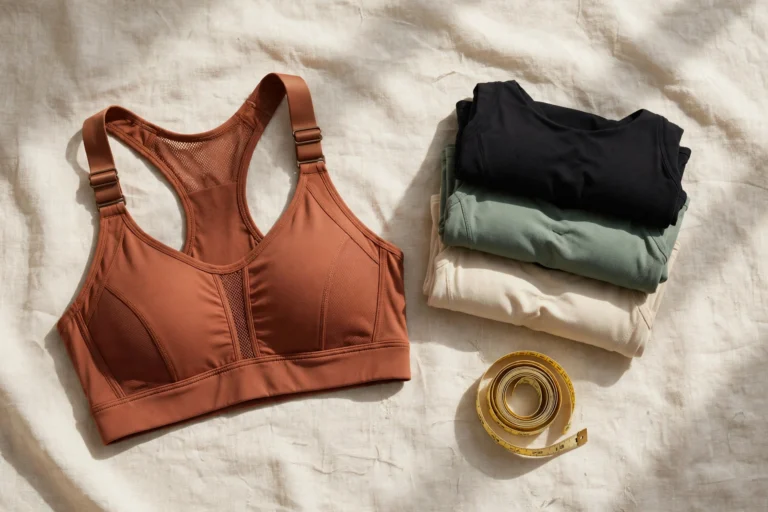
Two cautions belong with this table. First, shape can mimic size: a cup that is the right size in the wrong shape will gape or wrinkle, and no size change fixes a shape mismatch. Try a different cup shape, a demi instead of a full-coverage cut, or a seamed cup instead of a moulded one, before you keep changing letters. Second, do not diagnose from a fit complaint. A fit problem is a sizing or shape question, not a medical one, and readers with individual concerns about breast changes should ask a clinician, not a sizing guide. Our signs your bra does not fit guide works through each symptom in detail, and our Sports Bra Cup Fit guide covers the same symptoms in a sports context, where spillage, gaping and a floating gore have their own fixes.
Cup Size and Bra Style: What Changes With the Letter
The cup letter changes more than the size on the label. It changes what the bra has to do, and the construction changes with it. A small cup can be a single piece of moulded foam. A large cup usually needs seams, because a seamed cup can be shaped in panels where a single moulded piece cannot hold its form. Larger cups usually sit on wider bands and wider-set straps, because the band and the straps share the work of steadying a heavier cup. None of this is a rule about who should wear what. It is construction following the job, and it is why a style that works in a B cup can fail in a G cup even when both are the same brand and the same name.
Coverage follows the same logic. A demi cup covers less and suits lower necklines. A full-coverage cup covers more and suits higher necklines and fuller cups that need containing. A plunge cup trades coverage for a low centre, which suits deep necklines and suits no cup letter in particular. Our Types of Bras guide maps the styles by job and construction, so this article gives the cup-letter view and leaves the style map to that guide.
Moulded cups and unlined cups also behave differently as the letters grow. A moulded cup holds its own shape, which is why it smooths under clothes, but it can also gape when the bust shape does not match the mould. An unlined cup follows the bust, which is why it fits more shapes, but it shows more through thin fabric. Neither is better in general. Each suits a different combination of cup letter, bust shape and outfit, and the fit check decides between them.
How to Read a Cup Size When You Shop
Read the full size, band and cup together, every time. A letter without its band is not a size, and a size in one brand is not a promise about the next brand. Check the brand’s own chart before you buy, even for a brand you have bought before, because brands revise their charts and a style can use a different chart from the rest of the brand’s range. The chart is the size. The label on the bra you already own is a record of what fitted in that brand and that style.
If the cups fit and the band does not, use a sister size: up one band and down one cup, or down one band and up one cup, and stay within one step. If the band fits and the cups do not, change the cup and leave the band alone. If neither half fits, start again from the measurement guide or the calculator for a new starting size, then confirm it with the fit checks.
Alpha sizes need one extra step. A letter like M covers a range of band-and-cup combinations, and the range differs by brand, so an M from one brand can cover 34B to 36C while an M from another covers 32C to 34D. Our alpha sizes guide shows how many real sizes hide inside one letter, and why the brand’s alpha table is the only honest translation. For the wider picture, our US bra size chart lists the combinations, our conversion guide translates the labels, our How Bra Sizing Works guide explains the system at principle level, and our bra glossary explains any term used here without defining it.
Common questions
Is a DD cup the same as an E cup?
In US sizing, often yes: many US brands label DD as E and DDD as F. In UK sizing, no: a UK E is a US DDD, and a UK DD is a US DD. The letters only match within one system, so always convert the full size, band and cup together, and check the brand’s chart.
What is the biggest cup size?
There is no single biggest cup. The common US sequence runs to K, and the common UK sequence runs to H with double letters, but some brands go further: Goddess lists its Kayla range to a US N cup on its own conversion chart. For the far end of the scale, our biggest bra size guide works through the largest sizes brands actually make.
Can I be two different cup sizes?
Yes, and most women are. Your size varies by brand, by style, and sometimes by the same brand’s different ranges. A 34C in one brand and a 36B in another can both be right, because they are sister sizes. Keep the size that fits in each bra, not one size for every bra.
Why does my cup size change between brands?
Because each brand cuts to its own pattern and its own fit model, and brand calculators do not all use the same method. In September 2026 tests, the same measurements gave a 36B from one brand, a 36A from another and a 38A from a third. Start from each brand’s own chart and expect to try a sister size when you switch.
What size am I if I only know my alpha size?
You do not know yet. An alpha size like M covers a range of band-and-cup combinations, and the range differs by brand. Check the brand’s own alpha table, which lists the band-and-cup sizes each letter covers.