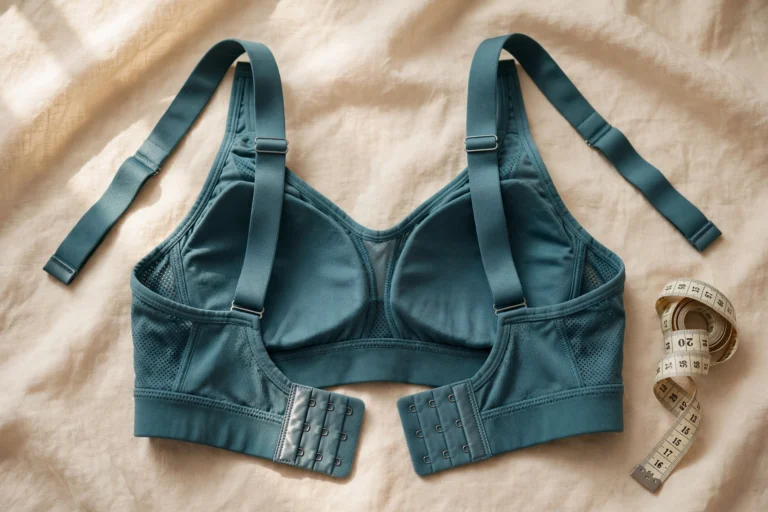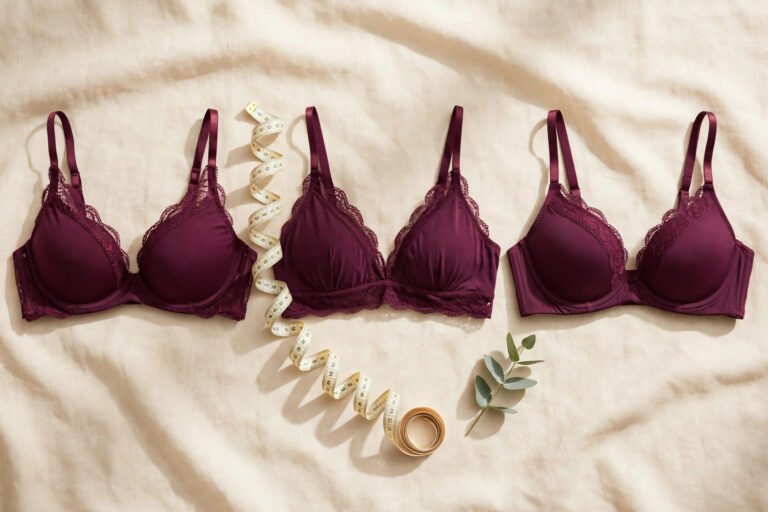
If you are shopping for sustainable bras, the honest answer is that no bra is fully sustainable, and the label on the tag will not tell you the whole story. A bra is a small, complicated garment: fabric, elastic, hooks, wire, padding and thread. What you can do is judge the parts that matter, and buy the bra you will wear for a long time.
Quick Answer
There is no single “eco-friendly” bra. A bra is more sustainable when its main fabric is a certified lower-impact fibre, when an independent certification backs the claim, and when it fits well enough to be worn often. The biggest sustainability lever is not the fibre at all. It is wearing the bra you already own for longer.
Sustainable Bras Start With the Fabric, Not the Label
The fabric is where most of a bra’s environmental story lives. A label that says “eco” or “green” without naming a fibre tells you nothing, so check the fibre content on the care label first, then the certification behind it.
Organic cotton
Organic cotton is cotton grown without synthetic pesticides, synthetic fertilisers or genetically modified seed. It is the same plant as conventional cotton, grown a different way, and the difference matters in the field: no synthetic agrochemicals means lower chemical exposure for farm workers and less chemical runoff.
The honest caveat is that organic cotton is still cotton, and cotton is a thirsty crop. Organic fields tend to rely more on rainfall than on irrigation, but the exact water gap varies by region and farming method, and yields are often lower, which can mean more land per kilo of fibre. It is not a guarantee that the finished bra is the most sustainable choice, because processing, dyeing, durability and washing all count too. Look for “organic cotton” backed by a certification, not the word “natural” on its own.
Recycled nylon and recycled polyester, including ECONYL
Most bras contain nylon or polyester, because those fibres give a bra its stretch, recovery and durability. Their recycled versions start from waste instead of new petroleum: recycled polyester usually from used plastic bottles or old textiles, and recycled nylon through a fibre called ECONYL.
ECONYL is a regenerated nylon 6 made by the Italian company Aquafil. Aquafil states that its ECONYL Regeneration System, introduced in 2011, collects nylon 6 waste such as fishing nets, old carpets and textile scraps, breaks it down chemically into caprolactam, and rebuilds it into new nylon polymer that performs the same way as new nylon 6.
Two limits are worth knowing. First, the process only accepts nylon 6 waste, so a mixed-fibre bra still has to be sorted before its nylon can be recycled. Second, “recycled” describes where the fibre came from, not what happens at the end. Recycled content is a genuine improvement on virgin nylon. It is not the same as a bra that can be recycled. Look for a stated recycled percentage and a certification behind it, such as the Global Recycled Standard below.
TENCEL lyocell and modal
TENCEL is a brand name owned by the Austrian company Lenzing, covering its lyocell and modal fibres, both regenerated cellulose fibres made by dissolving wood pulp and reforming it into fibre. “Lyocell” and “modal” are generic fibre types; “TENCEL” means the fibre was produced by Lenzing under its own standards.
TENCEL states that its lyocell fibres are made in a closed-loop process that recovers more than 99.8 percent of the solvent used, and that the wood for all its lyocell and modal fibres comes from controlled or certified sources meeting FSC or PEFC standards. The solvent is captured and reused instead of being discharged. In a bra, lyocell and modal usually appear in soft, smooth fabrics for bralettes and lounge bras. Generic lyocell or modal without the TENCEL name may come from a producer with different wood sourcing and solvent recovery.
Hemp
Hemp is a natural fibre made from the long bast fibres in the stalk of the plant. It is breathable, durable, naturally moisture absorbent, and it becomes softer with wear and washing. The plant can grow quickly and, under the right conditions, needs relatively few agricultural inputs, which is why hemp shows up so often in sustainable clothing ranges.
Sustainably Chic puts the caveat plainly: simply seeing “hemp” on a clothing label does not automatically make something sustainable. How the crop is grown, processed, dyed and blended all matter. Hemp in bras is usually blended, often with organic cotton, because pure hemp can feel stiff before it breaks in and a bra needs stretch that hemp alone does not provide. Look for a blend where the other fibres are also named and preferably certified.
What GOTS and OEKO-TEX Standard 100 Actually Certify
Certifications are the part of a sustainability claim you can check without trusting the brand’s word. Two appear on bras more than any others, and they certify different things.
GOTS: the organic and processing standard
GOTS stands for the Global Organic Textile Standard. It follows certified organic fibre from first processing through spinning, dyeing, printing and manufacturing, with environmental and social criteria at each step.
The label grades are specific. A product labelled “organic” must contain at least 95 percent certified organic fibres. A product labelled “made with organic materials” must contain at least 70 percent, with the exact percentage stated. Below 70 percent, no GOTS label is permitted. GOTS also restricts chemical inputs in processing, requires wastewater treatment, and prohibits substances including heavy metals, formaldehyde and chlorine bleaching. What GOTS does not certify: it is not a test of the finished garment for harmful substances, and it does not apply to synthetic textiles.
OEKO-TEX Standard 100: the chemical safety test
OEKO-TEX Standard 100 is a chemical safety certification for finished textiles. Every component is laboratory tested against a list of more than 1,000 harmful substances, including banned azo dyes, formaldehyde, heavy metals, phthalates and PFAS, covering thread, buttons, prints and elastic as well as the main fabric. Certificates last one year and must be renewed. Articles are sorted into four product classes by skin contact, with the strictest limits for baby items.
What OEKO-TEX Standard 100 does not certify: that a fabric is organic, recycled, biodegradable or low carbon, or factory working conditions and wages. A polyester bra can carry Standard 100, because the test is about what is in the finished product, not where the fibre came from. It is a safety label, not a sustainability label.
GRS: the recycled content standard
The Global Recycled Standard, run by Textile Exchange, verifies recycled content and chain of custody. A product needs at least 20 percent recycled content to qualify, and only products with at least 50 percent may carry the GRS logo on consumer-facing materials. Every stage of production must be certified. When a bra claims recycled content, GRS lets you check whether the percentage is real and traceable.
How to Spot Greenwashing on a Bra Label
Greenwashing is a misleading or unsubstantiated claim about the environmental benefit of a product. The US Federal Trade Commission polices these claims through its Green Guides, which the FTC describes as designed to help marketers avoid making environmental claims that mislead consumers.
1. A broad, unqualified claim. Words such as “eco-friendly” or “sustainable” with no explanation are the weakest claims a label can make. The guides treat unqualified general benefit claims as deceptive unless the marketer can back up every reasonable interpretation a consumer might draw. “Made with 68 percent GOTS-certified organic cotton” can be checked; “eco-friendly bra” cannot.
2. One green feature presented as a green product. A bra that is 5 percent organic cotton and 95 percent conventional synthetic is not an organic bra, and a recycled hook does not make the garment sustainable. Ask what share of the product the claim covers.
3. A certification that does not match the claim. An OEKO-TEX Standard 100 label used to imply a bra is organic, or a “recycled” claim backed only by a chemical safety test, is a mismatch. Match the label to the claim it certifies.
4. “Biodegradable” without a timeframe. Under the Green Guides, an unqualified biodegradable claim is deceptive unless the entire product completely decomposes within one year of customary disposal. A bra with elastic, metal hooks and mixed fibres is unlikely to meet that test.
5. “Recyclable” where no recycling exists. An unqualified recyclable label is allowed only when recycling facilities are available to a substantial majority of consumers where the product is sold. Most bras cannot be recycled through curbside programmes, so ask: recycled where, and by whom?
The check that catches most greenwashing: ask for the certification number or the percentage, then look it up. A brand that will not name its certifier or its percentage is telling you something.
The Most Sustainable Bra Is the One You Keep Wearing
Buying fewer bras and wearing each one longer beats switching fibres. A bra that fits well gets worn, washed, and worn again. A bra that does not fit sits in a drawer and gets replaced.
Buy for fit first. A bra in the right size and construction for your day is the one you will reach for: an everyday bra for everyday wear, a sports bra for sport. Our bra glossary explains the construction and fit terms on product pages.
Rotate, do not hoard. Two or three everyday bras in rotation last longer than one bra worn daily, because elastic recovers between wears and each bra goes through fewer wash cycles: one on, one in the wash, one resting.
Wash cold and gentle, and air dry. Heat and agitation wear elastic out, and elastic is what makes a bra fit. Wash in cool water on a gentle cycle, fasten the hooks, use a mesh laundry bag, skip fabric softener, and air dry. Our sports bra care guide sets out the full method, and the same rules apply to everyday bras.
Repair the small things, and know when it is finished. A slipped strap slider or a loose hook is usually fixable in a minute. A bra is done when the band rides up even on the tightest hook, when the elastic no longer springs back, or when the cups have lost their shape. Our guide to when to replace a sports bra covers the same signs in detail.
What to Do With a Worn-Out Bra
A bra at the end of its life still has options, and the bin is the last of them.
If it is still wearable, pass it on. A clean, gently used bra in good condition can be worn by someone else, and reuse is the best outcome because it extends the life of the item with no new manufacturing. The Bra Recyclers is a US social enterprise collecting bras since 2008. It accepts new or gently used bras, including sports bras, bralettes, nursing bras and mastectomy bras, in all sizes. Wearable bras go to nonprofit and community partners, and items that cannot be reused are directed to textile recyclers where possible. Note the hygiene rule: underwear must be new and unused. You can mail bras in or drop them at an Ambassador location.
If it is worn out, look for textile recycling. Some towns run textile recycling collections or drop-off bins for damaged clothing and fabrics. Check your local council or waste service first: a bra dropped in a donation bin that only accepts wearable items can end up sorted out and landfilled anyway.
If neither option exists near you, remove the metal first. Hooks, underwire and sliders are metal, and separating them takes a minute with scissors. It does not make the fabric recyclable, but it keeps metal out of the textile stream. Do not put a bra in a compost bin. A whole bra will not break down in home compost.
A Simple Checklist Before You Buy Sustainable Bras
Use this when a product page makes an eco claim.
-
Is the fibre named? The care label names the fibre and its share, not just the word “eco”.
-
Is there a certification? GOTS for organic fibre, GRS for recycled content, OEKO-TEX Standard 100 for chemical safety.
-
Can you verify it? A certificate number or a percentage you can look up beats a leaf icon.
-
Does it fit your actual day? The style and support suit how you will wear it, so it will be worn often.
-
Will you keep it? The construction and care requirements suit your laundry habits, so it will last.
-
Is the price honest? Certified fibres cost more. A suspiciously cheap “sustainable” bra is usually a vague claim, not a bargain.
Common questions
Are sustainable bras more expensive?
Usually, yes. Certified organic cotton, recycled nylon and TENCEL fibres cost more to produce than conventional equivalents, and independent certification itself costs money. That does not mean the most expensive bra is the most sustainable one. Check the fibre and the certification first.
Is organic cotton always the best choice for a bra?
No. Organic cotton is a real improvement in how the fibre is grown, but a bra also needs stretch, recovery and durability, which cotton alone does not provide. Most cotton bras blend cotton with elastane, and the blend decides how it performs and lasts. A well-made recycled nylon bra that fits and lasts two years can be the better buy than an organic cotton bra that loses its shape in six months. Fibre is one factor. Fit and durability are the others.
Can I recycle a bra with underwire?
Not through a normal recycling bin. Curbside recycling does not separate the metal parts from a mixed-fibre garment. The practical routes are reuse through a programme such as The Bra Recyclers, which accepts bras with wire, or textile recycling where your area offers it.
Should I replace all my bras with sustainable ones at once?
No. Replacing a drawerful of wearable bras to buy greener ones creates the waste you are trying to avoid. Wear what you own, and choose the more sustainable option when each bra wears out. The greenest bra purchase is the one you do not make yet.
Key Takeaways
No bra is fully sustainable. Judge the fibre, the certification and the construction, not the word “eco” on the tag.
Learn two labels properly. GOTS certifies organic fibre and its processing chain. OEKO-TEX Standard 100 tests the finished product for harmful substances.
Ask for the percentage and the certificate. A claim you can verify is worth more than a leaf icon and a vague promise.
Wear it longer. Fit, rotation, cold washing and air drying beat any fibre switch.
Plan the ending. A wearable bra can be passed on. A worn-out one belongs in textile recycling, not the bin.